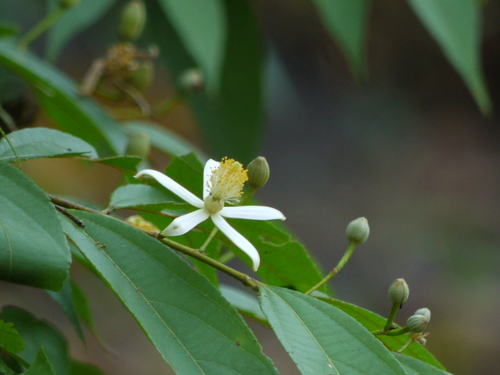
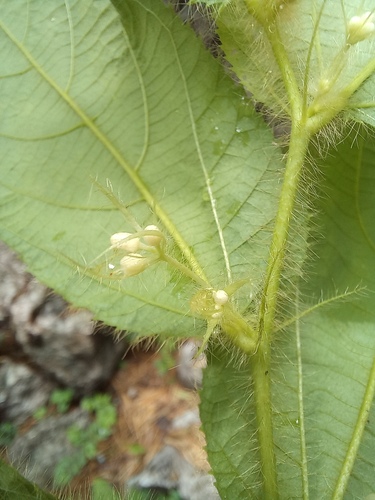
Malvaviscus arboreus
Cavanilles
Manzanito, Wax mallow
iNaturalist· cc-by-nc
(c) stephaniemartin, some rights reserved (CC BY-NC)
iNaturalist· cc-by-nc
(c) stephaniemartin, some rights reserved (CC BY-NC)
iNaturalist· cc-by-nc
(c) stephaniemartin, some rights reserved (CC BY-NC)
Summary
Source: WikipediaMalvaviscus arboreus is a species of flowering plant in the hibiscus family, Malvaceae, that is native to the American South, Mexico, Central America, and South America. The specific name, arboreus, refers to the tree-like appearance of a mature plant. It is now popular in cultivation and goes by many English names including wax mallow, Turk's cap (mallow), Turk's turban, sleeping hibiscus, manzanilla, manzanita (de pollo), ladies teardrop and Scotchman's purse; many of these common names refer to other, in some cases unrelated, plants. Its flowers do not open fully and help attract butterflies and hummingbirds.
Description
A small shrub. It grows about 2-4 m high. The leaves are long or heart shaped and velvety. They are 5-12 cm long. The leaves can have 3 lobes. The flowers are long and tapering. They face upwards. The fruit are small red berries.
Edible Uses
Fruit - raw. Juicy and somewhat mucilaginous, they are often eaten by children but adults find them mawkish in flavour and not very appetizing.
Medicinal Uses
A liniment made from the base of the plant is used for dressing burns. The flowers and leaves are emollient. A decoction of the flowers is used in the treatment of bronchitis, fevers, inflammation of the digestive tract, and in popular practice as an emmenagogue. A decoction of the flowers is used as a gargle to treat sore throats. A decoction of the leaves is used for the treatment of cystitis, diarrhoea, gastritis, and sore throat.
Distribution
A tropical plant. In Central America it grows from sea level to 2,000 m altitude. It suits hardiness zones 8-12. Geelong Botanical Gardens. Wittunga Botanical Gardens. In Yunnan.
Where It Grows
Antilles, Asia, Australia, Bolivia, Brazil, Caribbean, Central America*, China, Colombia, Costa Rica, Dominican Republic, El Salvador, Fiji, Himalayas, Indonesia, Mexico, Myanmar, Nepal, Nicaragua, North America*, Pacific, Pakistan, Panama, Peru, SE Asia, Slovenia, South America, USA, Vietnam, West Indies,
Cultivation
Plants can be grown from cuttings.
Propagation
Seed - Cuttings generally rot well. Layering
Other Uses
A decoction or infusion of the leaves is applied to the hair in order to make it soft and lustrous. The bark contains a tough fibre.
Notes
There are 3-6 Malvaviscus species. They occur in tropical America.
Synonyms
Also Known As
Amapola, Amapolita, Arito blanco, Arito, Bejuquillo, Bup gian-xay, Catapachat, Chinese pinyin, Flor de arito, Flor de santo, Gagapache, Gkrum guada, Khursani phul, Manzana, Manzano, Monacillo, Obelisco, Ok-htok-pan, Quesillo, Quesito, Tripa de buey, Tulipancillo
References (19)
- Altschul, S.V.R., 1973, Drugs and Foods from Little-known Plants. Notes in Harvard University Herbaria. Harvard Univ. Press. Massachusetts. no. 2754
- Chizmar Fernandez, C., et al, 2009, Plantas comestibles de Centroamerica. Instituto de Biodiversidad, Costa Rica. p 231
- Cundall, P., (ed.), 2004, Gardening Australia: flora: the gardener's bible. ABC Books. p 868
- Diss. 3:131, t. 48, fig. 1. 1787
- Etherington, K., & Imwold, D., (Eds), 2001, Botanica's Trees & Shrubs. The illustrated A-Z of over 8500 trees and shrubs. Random House, Australia. p 468
Show all 19 references Hide references
- Flora of Pakistan. www.eFloras.org
- FMNH Botany Collections Database - Mesoamerican Ethnobotany emuweb.field museum.org
- Hellmuth, N. M., 2011, Maya Ethnobotany. Complete Inventory of plants. Associacion FLAAR Mesoamerica. Tenth edition.
- Hibbert, M., 2002, The Aussie Plant Finder 2002, Florilegium. p 192
- http://www.botanic-gardens-ljubljana.com/en/plants
- Piedra-Malagón, E. M., et al, 2022, Edible native plants of the Gulf of Mexico Province. Biodiversity Data Journal 10: e80565 p 24
- Recher, P, 2001, Fruit Spirit Botanical Gardens Plant Index. www.nrg.com.au/~recher/ seedlist.html p 6
- Roa, J. A. G. & Boada, D. S. G., 2018, Fundación para el Fortalecimiento de la Fruticultura y Plantas Alimenticias no Convencionales en Colombia.
- Segura, S., et al, 2018, The edible fruit species in Mexico. Genet Resour Crop Evol (2018) 65:1767–1793
- Smith, A.C., 1981, Flora Vitiensis Nova, Lawaii, Kuai, Hawaii, Volume 2 p 433
- Smith, N., Mori, S.A., et al, 2004, Flowering Plants of the Neotropics. Princeton. Plate 28 (Photo)
- Sukarya, D. G., (Ed.) 2013, 3,500 Plant Species of the Botanic Gardens of Indonesia. LIPI p 670
- Tang ya, Malvaceae. Flora of China. p
- World Checklist of Useful Plant Species 2020. Royal Botanic Gardens, Kew