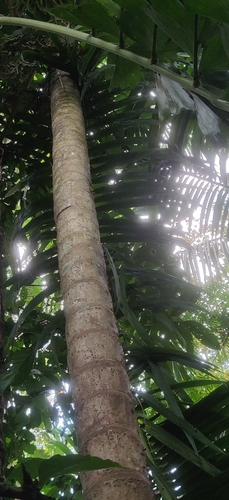
Astrocaryum vulgare
Mart.
Awarra palm, Tucum palm
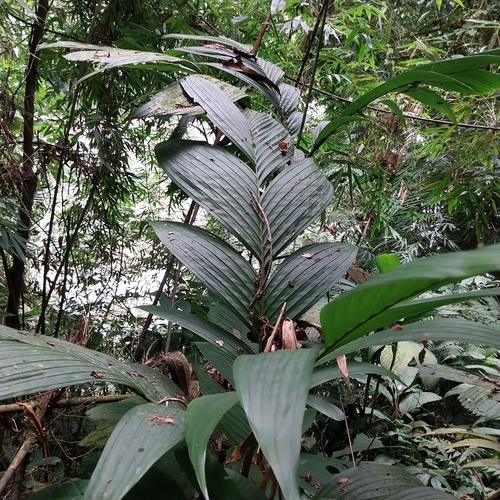
iNaturalist· cc-by-nc
(c) Fernando Praynha, some rights reserved (CC BY-NC), uploaded by Fernando Praynha
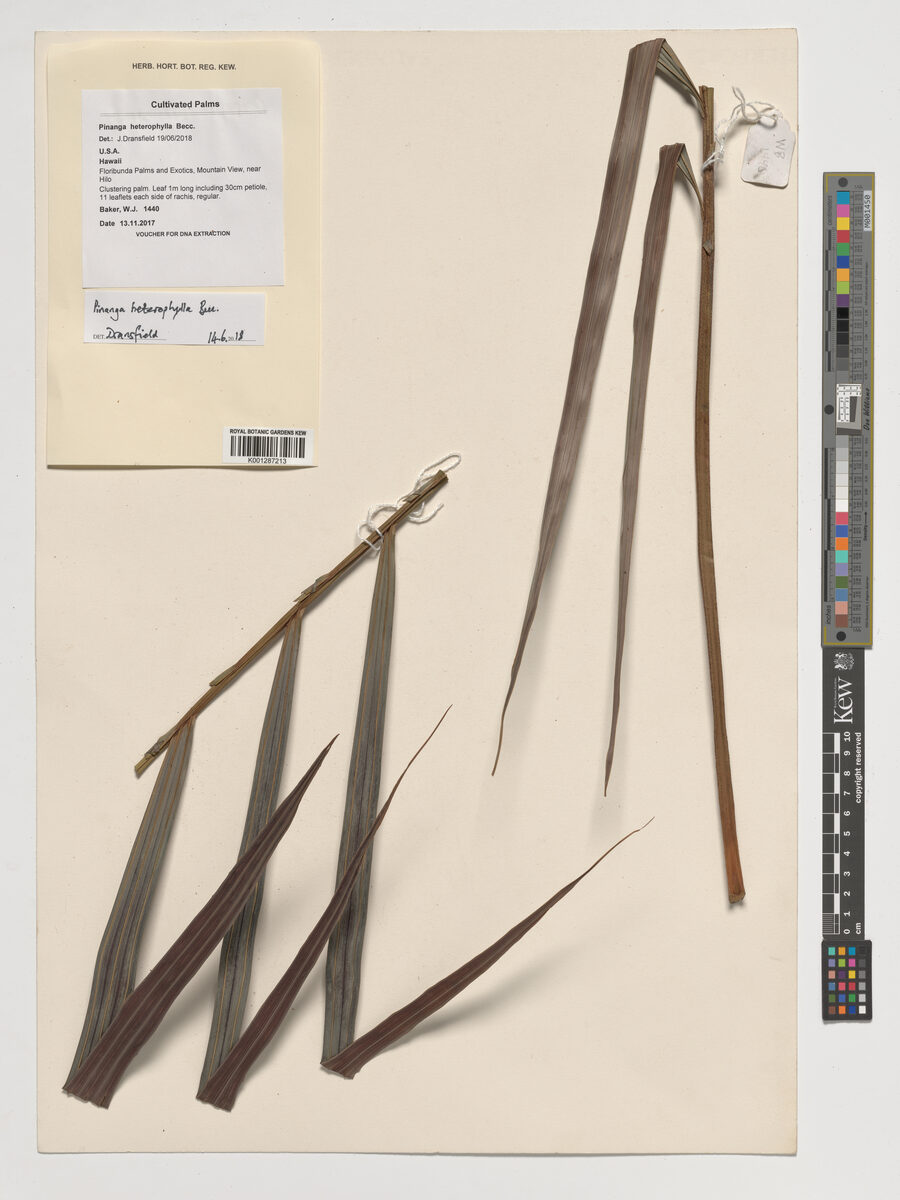
iNaturalist· cc-by-nc
(c) Jessica Launay, some rights reserved (CC BY-NC), uploaded by Jessica Launay
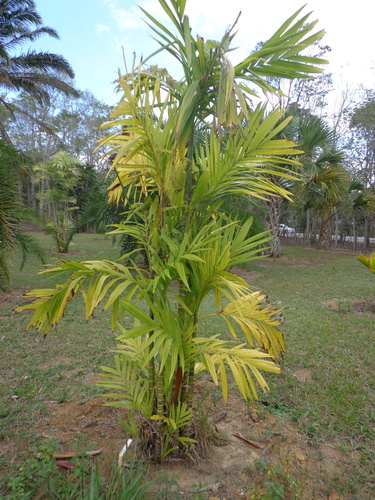
iNaturalist· cc-by-nc
(c) Gustavo Gonsioroski, some rights reserved (CC BY-NC), uploaded by Gustavo Gonsioroski
Summary
Source: WikipediaAstrocaryum vulgare is a very spiny palm native to the Guianas and the Amazon. It is a species which has greatly benefited from deforestation, as it cannot grow in undisturbed rainforest. It is common in the Pará state of Brazil, to the east of the Amazon. This plant has edible fruit. Astrocaryum vulgare was first described in the book Flora Brasiliensis by Carl Friedrich Philipp von Martius.
Description
A spiny palm. It forms clusters. It can be 4-10 m high and trunks 15-20 cm across. The trunk is densely armed with black flattened spines. The crown has a number of leaves 5-6 m long. The leaves are feather-like. The leaflets droop. They occur in groups and often at different angles. The leaflets are shiny green above and greyish underneath. The male and female flowers are separate but on the same plant. The flowering stalks are 2 m long. They have several branches. The flowers are cream. The fruit are oval and 3.5 cm across. They have a short pointed beak at the tip. The fruit are orange when ripe.
Edible Uses
Edible Parts: Apical bud Fruit Oil Sap Seed Edible Uses: Oil Fruit - raw. Slightly sweet. A flavour similar to apricots. Used for making juices. The mesocarp is rich in provitamin A; it provides a fatty, mashed pulp that is used to prepare the very popular French Guianan dish 'bouillon d'awara', which is traditionally eaten at Easter time. The orange-red, globose to ovoid fruit is 35 - 45mm long and 25 - 35mm wide with a fleshy mesocarp covering a single large seed. After harvesting, the fruits are stored for 3 days in sacks to ripen and allow the pulp soften slightly. They must then be eaten within 3 - 4 days before they dry and rot where bruised. The immature endosperm gives a juice called vino de tucuma, used for a drink or in culinary preparations. An excellent oil, used for cooking, can be obtained from the fruits. Similar to coconut oil. The seed contains a hard white substance from which a fine edible fat can be extracted. The seed contains 30 - 50% oil. The fruits and seeds of various species in this genus are reported to be used for oil production in the Amazon region. Existing analyses of fruit fat content show a relatively homogeneous composition among the different species, with around. 20% of fat content in the mesocarp, mostly composed of oleic and palmitic acids, and 20 - 35% of fat content in the endosperm, with a predominance of lauric acid. The palm heart (the inner core and growing bud of the plant) is harvested[418 Ecocrop Publication Author Website http://ecocrop.fao.org/ecocrop/srv/en/home Publisher Year 0 ISBN Description Basic information on a wide range of useful plants, plus details of environmental needs where available. ]. It provides a crispy food, rich in nutrients, that can be eaten raw or cooked. Harvesting the heart will lead to the death of the stem it was harvested from, though in multi-stemmed plants such as this the rest of the plant will continue to grow and often produce new stems. A wine is made from the fermented sap of the spathe.
Traditional Uses
The layer around the seed is eaten. An edible oil is extracted from the seed. The palm hearts can be eaten.
This uses section is brief — help expand it
Medicinal Uses
A decoction of the root is used to treat furunculosis and syphilis. The oil from the seed is laxative. It is used to treat rheumatism, pain and earache. It is used in a preparation for treating furuncles and is also swabbed onto aching feet and rubbed on feverish people to assist perspiration. The fruit can be utilized against the eye disease xerophthalmia (also called ophthalmoxerosis) of which the deficiency of vitamin A is the main reason. The whole fruit is used to calm colicky babies. The pulp of the fruit is used to treat coughs and as a breath freshener.
Distribution
It is a tropical palm. It will grow in the subtropics. It grows in Brazil in rainforest that does not get flooded.
Where It Grows
Amazon, Asia, Bolivia, Brazil*, Colombia, Ecuador, French Guiana, Guianas, Guyana, Indonesia, SE Asia, Singapore, South America, Suriname,
Cultivation
It grows best in areas where annual daytime temperatures are within the range 20 - 28c, but can tolerate 18 - 30c. It can be killed by temperatures of 2c or lower. It prefers a mean annual rainfall in the range 1,300 - 1,800mm, but tolerates 1,000 - 3,000 mm. Requires a sunny, sheltered position. Seedlings require some shade, whilst larger palms thrive in full sun. Plants do not like dry conditions at their roots. Prefers a pH in the range 5 - 7, tolerating 4 - 8. Plants regrow very vigorously from their roots after being cut down or after a fire. They are considered to be a serious weed species of pasture land. Young plants have a moderate rate of growth. Although usually spiny, occasional spineless forms exist in nature.
Propagation
The seed is enclosed in a hard endocarp which makes germination slow and erratic, and also has a short viability in storage. It may benefit from scarification before sowing to speed up germination. This can usually be done by pouring a small amount of nearly boiling water on the seeds (being careful not to cook them!) and then soaking them for 12 - 24 hours in warm water. By this time they should have imbibed moisture and swollen - if they have not, then carefully make a nick in the seedcoat (being careful not to damage the embryo) and soak for a further 12 hours before sowing. It is best to sow the seed as soon as it is ripe in a partially shaded position in a nursery seedbed or in individual containers. A high germination rate can usually be expected, with the seed sprouting within 90 - 150 days. When the seedbed-sown seedlings are 5 - 8cm tall, pot them up into individual containers and they should be ready to plant out 6 - 9 months later.
Other Uses
Oil An oil can be obtained from the fruits. It is used in soap making. A fine, soft, strong and durable fibre can be obtained from the unopened leaves. It is used for weaving and cordage. It is said to be the strongest fibre that can be produced in Amazonia and is widely used for making hammocks, ropes, bags, clothes etc. The fibre is resistant to rot and damage and was therefore in use on sail- ships in the earlier centuries. Fibre can be extracted from the petiole after soaking it in water. The leaflets are used in making baskets[1869 The genus Astrocaryum (Arecaceae) Publication Rev. peru. biol. 15(supl. 1): 031- 048 (Noviembre 2008) Author Kahn F. Publisher Year 2008 ISBN 1727-9933 Description ]. The shell of the kernel is used for making handicrafts such as rings, bracelets and collars. The oils extracted from the fruit and the seed are used as ingredients in commercial cosmetic preparations as emollients and skin conditioners. The wood is moderately heavy, very hard, strong and durable. It is used locally in making houses. The stems are used as poles for fences, corrals, and rural housing. Its resistance to diseases and high productivity make this species an alternative for the production of biodiesel, since the operating costs of an orderly plantation are much less than that of the oil palm. Special Uses Carbon Farming
Production
The kernel is 36% oil. The fruit are harvested once per year.
Notes
There are about 40-50 Astrocaryum species. The fruit are rich in Vitamin A.
Synonyms
Also Known As
Aourara, Awara, Chontilla, Cumare, Hericungo, Tucuma palm
References (26)
- Balick, M.J. and Beck, H.T., (Ed.), 1990, Useful palms of the World. A Synoptic Bibliography. Colombia p 63, 90, 162, 208, 309,
- Bircher, A. G. & Bircher, W. H., 2000, Encyclopedia of Fruit Trees and Edible Flowering Plants in Egypt and the Subtropics. AUC Press. p 46 (Also as Astrocaryum segregatum)
- Blomberry, A. & Rodd, T., 1982, Palms. An informative practical guide. Angus & Robertson. p 58
- Etkin, N.L. (Ed.), 1994, Eating on the Wild Side, Univ. of Arizona. p 123, 136
- Grandtner, M. M. & Chevrette, J., 2013, Dictionary of Trees, Volume 2: South America: Nomenclature, Taxonomy and Ecology. Academic Press p 50
Show all 26 references Hide references
- Haynes, J., & McLaughlin, J., 2000, Edible palms and Their Uses. University of Florida Fact sheet MCDE-00-50-1 p 2
- Henderson, A., Galeano, G and Bernal, R., 1995, Field Guide to the Palms of the Americas. Princeton. p 207
- Hist. nat. palm. 2:74, t. 62-63. 1824
- Janick, J. & Paul, R. E. (Eds.), 2008, The Encyclopedia of Fruit & Nuts. CABI p 89
- Johnson, D.V., 1998, Tropical palms. Non-wood Forest products 10. FAO Rome. p 90
- Johnson, M. and Colquhoun, A., 1996, Preliminary Ethnobotanical Survey of Kurupukari: An Amerindian Settlement of Central Guyana. Economic Botany, Vol. 50, No. 2, pp. 182-194
- Lorenzi, H., 2002, Brazilian Trees. A Guide to the Identification and Cultivation of Brazilian Native Trees. Vol. 01 Nova Odessa, SP, Instituto Plantarum p 289
- Marcia, M. J., et al, 2011, Palm Uses in Northwestern South America: A Quantitative Review. Bot. Rev. (2011) 77:462-570
- Omawale, 1973, Guyana's edible plants. Guyana University, Georgetown p 2 (As Astrocaryum tucumoides)
- Menninger, E.A., 1977, Edible Nuts of the World. Horticultural Books. Florida p 126 (As Astrocaryum tucumoides)
- Paz, F. S., et al, 2021, Edible Fruit Plant Species in the Amazon Forest Rely Mostly on Bees and Beetles as Pollinators. Journal of Economic Entomology, XX(XX), 2021, 1–13
- Roa, J. A. G. & Boada, D. S. G., 2018, Fundación para el Fortalecimiento de la Fruticultura y Plantas Alimenticias no Convencionales en Colombia.
- Rodriguez-Amaya, D. B., 1999, Carotenoides y Prepracion de Alimentos. University Estadual de Campinas, Brasil, Ph.D. thesis. p 25
- Sukarya, D. G., (Ed.) 2013, 3,500 Plant Species of the Botanic Gardens of Indonesia. LIPI p 757
- TodaFruta.com.br
- van Roosmalen, M.G.M., 1985, Fruits of the Guianan Flora. Utrecht Univ. & Wageningen Univ. p 332
- Villachica, H., (Ed.), 1996, Frutales Y hortalizas promisorios de la Amazonia. FAO, Lima. p 265
- Wickens, G.E., 1995, Edible Nuts. FAO Non-wood forest products. FAO, Rome. p 87, 163
- Wickens, G.E., 1995, Edible Nuts. FAO Non-wood forest products. FAO, Rome. p 163 (As Astrocaryum tucumoides)
- Wiersema, J. H. & Leon, B., 2013, World Economic Plants. A Standard Reference CRC Press. 2nd Ed. p 82
- World Checklist of Useful Plant Species 2020. Royal Botanic Gardens, Kew