Korthalsia ferox
Becc.
Ant rattan
gbif· cc0
President and Fellows of Harvard College
Description
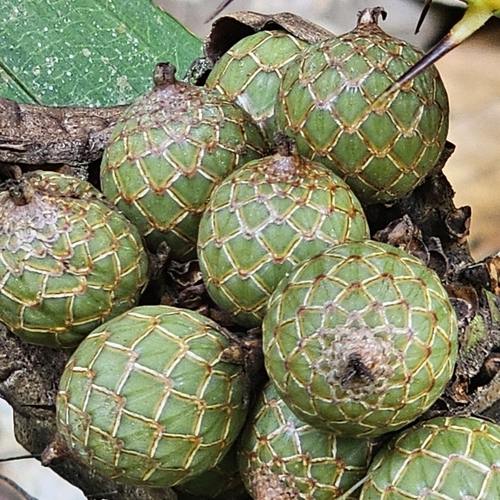
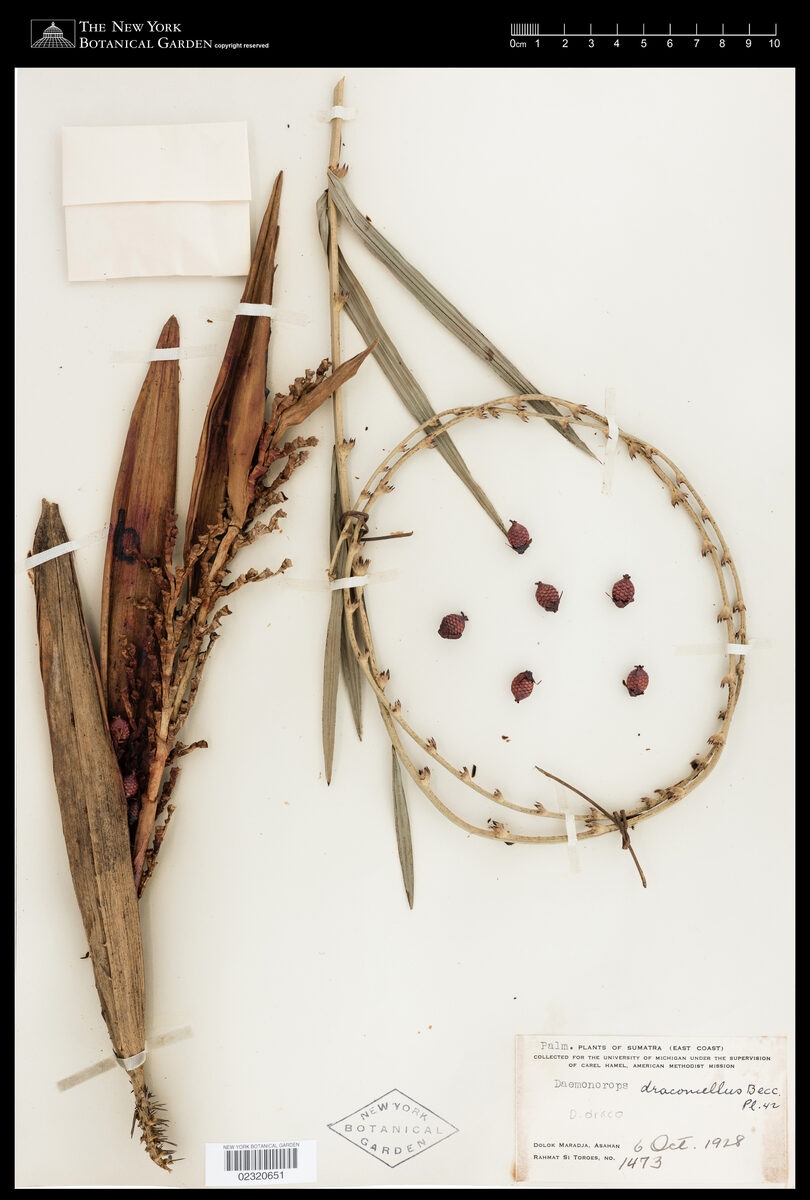
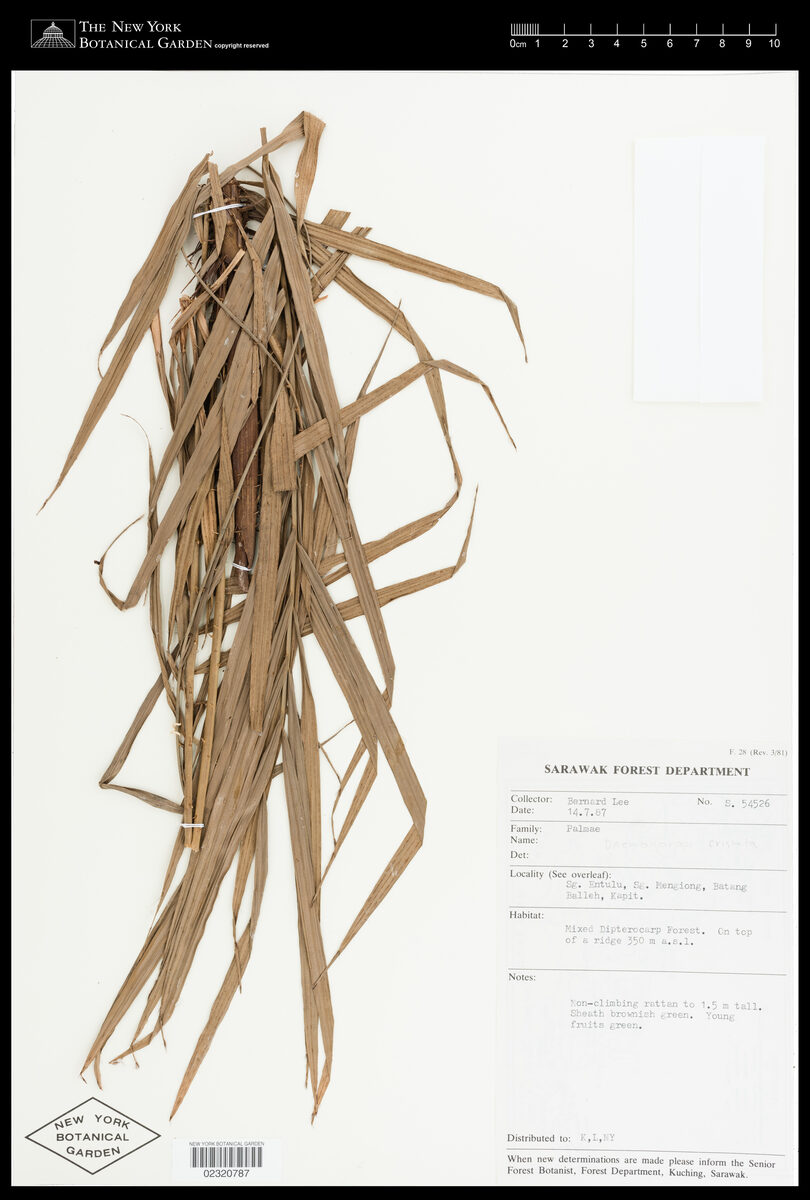
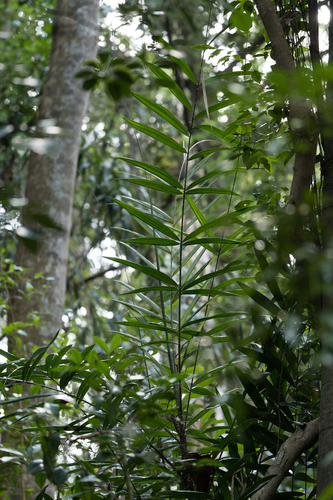
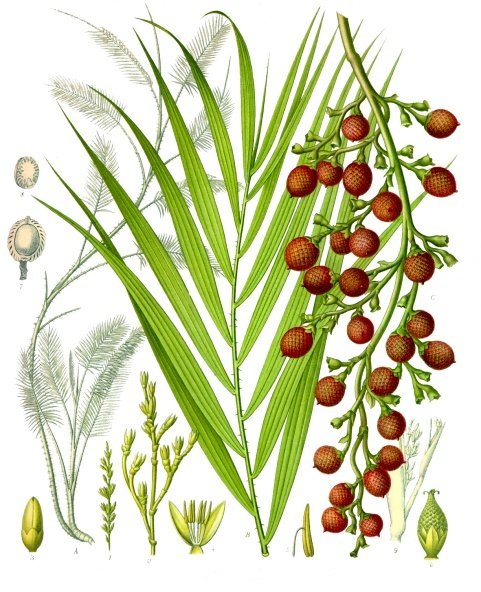
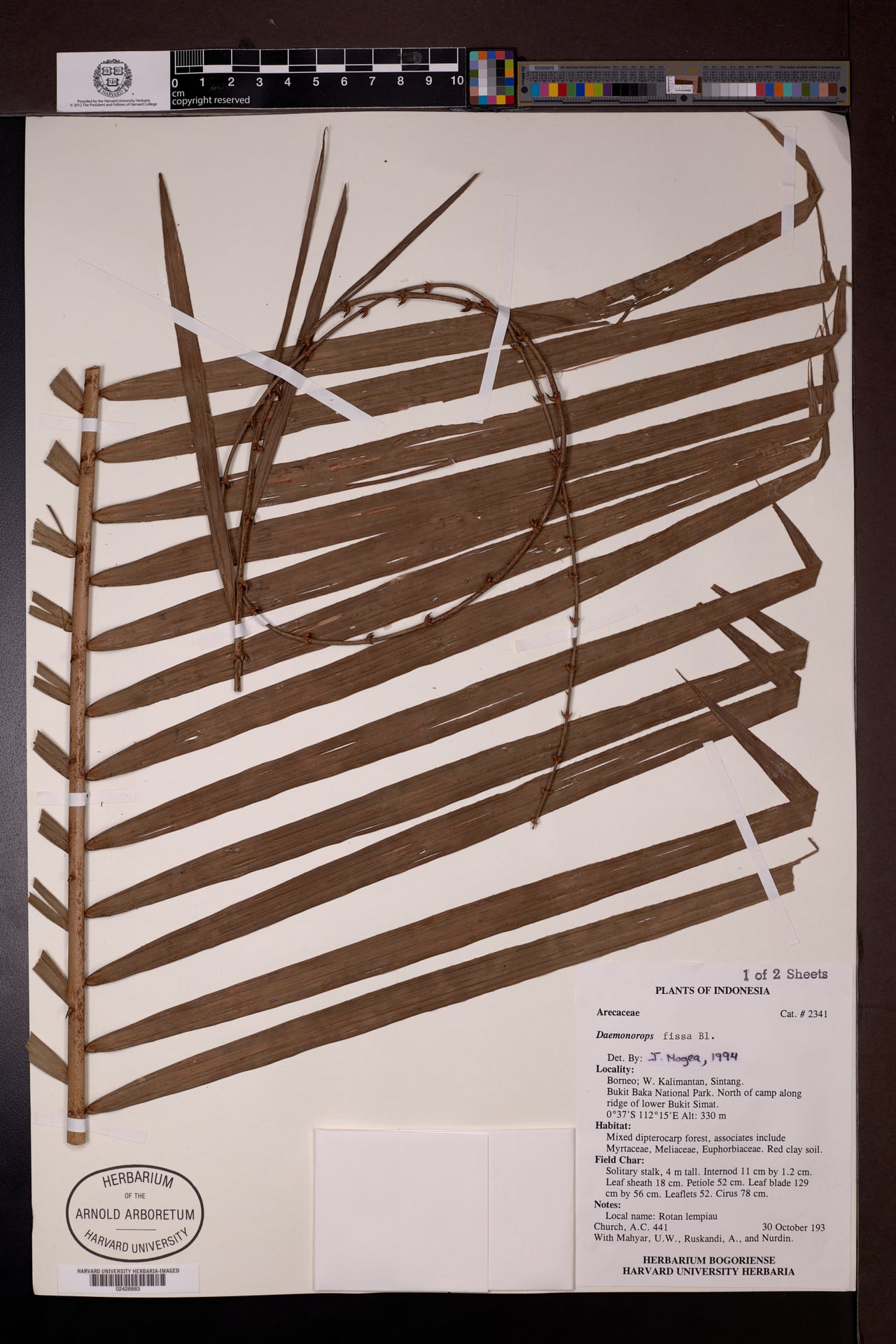
A climbing rattan. It grows in clusters and is branched. The stems climb into trees and are 2 cm across. The internodes are 30 cm apart. The leaves are 2.5 m long with a tendril at the end that is 1 m long. The sheaths have spines. The leaves have 6-8 leaflets on each side. The flowering shoot is 50 cm long. The fruit are curled and have 15 rows or reddish scales.
Edible Uses
The fruit of all members of this genus is more or less edible. It is sometimes eaten, but there is little flesh and it is therefore more likely to be used as a famine food when little else is available.
Known Hazards
Many species in this genus have ants living on them in structures evolved by the plant known as ocreas. In some species the ants can be very aggressive.
Distribution
It is a tropical plant. It grows in Sabah in Borneo. It grows in lowland and hill dipterocarp forests up to 800 m above sea level.
Where It Grows
Asia, Indochina, Malaysia, SE Asia, Vietnam,
Cultivation
Plants can be grown from seeds.
Other Uses
The large diameter cane is used as framework for cheap furniture and to make large fish-traps for use at sea. All members of the genus produce long and very durable canes and are used to make some of the most durable and attractive carrying baskets in southeast Asia. Unfortunately, the inner epidermis of the leaf sheaths adheres to the stem, making it difficult to clean and leaving the stem lacking the attractive, shiny appearance of many Calamus species. In addition, the nodes are frequently very irregular and marked with shallow pits or the remains of branches The canes are very widely used locally and often traded, but not usually more widely than local markets. Large diameter canes are used for purposes such as large fish traps and the framework of cheap furniture. Smaller diameter canes can be used whole or split for binding, weaving etc.
Also Known As
Rotan semut, Wei ser
References (3)
- Hoare, A., 2003, Food use of the Lundayeh SW Sabah. Borneo Research Council.
- Sang, D. T., & Mizoue, K. O. N., 2012, Use of Edible Forest Plants among Indigenous Ethnic Minorities in Cat Tien Biosphere Reserve, Vietnam. Asian Journal of Biodiversity Vol. 3 (1), p 23-49
- Sukarya, D. G., (Ed.) 2013, 3,500 Plant Species of the Botanic Gardens of Indonesia. LIPI p 785