Korthalsia laciniosa
(Griff.) Mart.
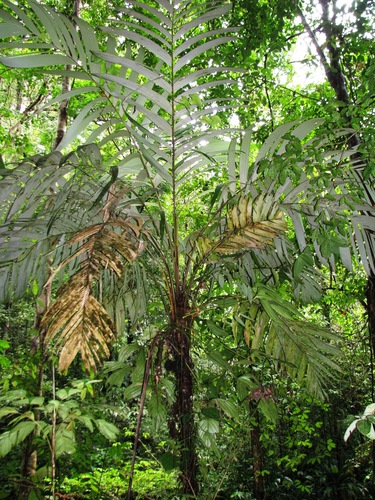
iNaturalist· cc-by
(c) T R Shankar Raman, some rights reserved (CC BY)
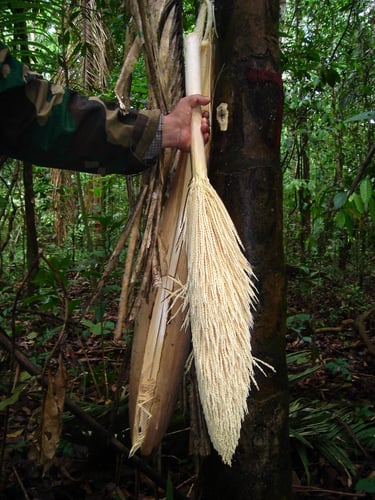
iNaturalist· cc-by
(c) T R Shankar Raman, some rights reserved (CC BY)
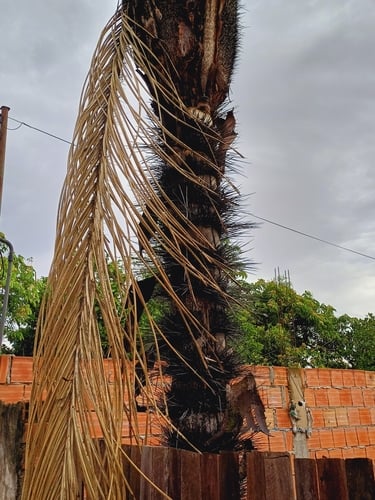
iNaturalist· cc-by
(c) T R Shankar Raman, some rights reserved (CC BY)
Summary
Source: WikipediaA large, very high liana, or "climbing tree" in the palm family, Korthalsia laciniosa occurs in the closed forests of Java, Sumatra, the Philippines, Malay Peninsula, Vietnam, Cambodia and elsewhere in Indochina, and the Nicobar and Andaman Islands.
Description
A rattan.
This description is brief — help expand it
Edible Uses
K. laciniosa is known as mây tầm võng in Vietnam (mây is common to many rattans, including more common and numerous Calamus species; other names such as mây ra may be used locally). Before 1990 it was harvested for markets, however in 2005 it was only used locally in Bạch Mã: harvested when the stems are 10-15mm diameter, and so allowing the clumped palm to grow the height given above. In Cambodia, there is demand for the plant to make ropes and baskets, it is known as phdau saôm or phdau soë:ng (in Khmer phdau="rattan"). In the Andaman & Nicobar Islands, rattan are integral materials to the livelihood of the inhabitants, this includes K. lacioniosa, known as rassi beth or rope beth. Small diameter canes are used to make fences and rafts, the same and the leaves are used for decorative purposes (such as tables and benches), especially during rituals and ceremonies of the Nicobarese. There is also a substantial export trade of rattan, with K. laciniosa highly valued yet only exported in small quantities. An earlier report on Korthalsia in the Andamans describes K. laciniosa as giving a robust and durable cane, occasionally used to make cane-chair frameworks, but becoming locally scarce in places on South Andaman due to over-extraction.
Known Hazards
Many species in this genus have ants living on them in structures evolved by the plant known as ocreas. In some species the ants can be very aggressive.
Distribution
It is a tropical plant.
Where It Grows
Asia, Indochina, Indonesia, Myanmar, SE Asia, Vietnam,
Cultivation
Plants succeed in moist tropical climates where temperatures never fall below 10°c, the average annual rainfall is 1,500mm or more and the driest month has 25mm or more rain. A monocarpic species, it can grow for many years without flowering, then flowers prolifically before setting seed and dying. The flowers are produced in panicles at the ends of the stems. Many species n this genus have a close association with ants that make their nests within swollen structures in the leaf sheaths known as ocreas. The ant-rattan relationship also seems to involve the presence of scale insects that are husbanded by the ants for honey dew on young rattan tissue. Ants occupying the ocreas of some species can be extremely aggressive.
Propagation
Seed - pre-soak 24 hours in warm water and sow in containers. The seed needs to be fresh for satisfactory germination
Other Uses
The long, strong, flexible stems are very durable. The canes are durable, but not very flexible. They are widely used by native peoples for making baskets, weaving into furniture etc, and as a strong and durable tying material. Used as the frames of furniture. The stems are up to 35mm in diameter. The inner epidermis of the leaf-sheaths is not easily separable from the cane surface and the nodes are frequently scarred on one side by the remains of axillary buds or branches. These factors detract from the overall marketability of the canes, which are otherwise very durable and not unattractive.
Synonyms
Also Known As
May ra, Rotan sendahan, Sakan-kyein, U-hlaing, Wapo-kyein
References (3)
- Aryal, K., Moe, A.T., Hein, P.P., Bay, Y.H.S., Htay, T., Aung, H.W., Shakya, B., Xuefei, Y., Shaoliang, Y. , 2020, Wild and non- cultivated edible plants and their contribution to local livelihoods in Putao, Myanmar. ICIMOD.
- Hariyadi, B., 2008, The Entwined Tree: Traditional Natural Resource Management of Serampas, Jambi, Indonesia. Ph. D thesis. Univ. or Hawaii. p 402
- Sang, D. T., & Mizoue, K. O. N., 2012, Use of Edible Forest Plants among Indigenous Ethnic Minorities in Cat Tien Biosphere Reserve, Vietnam. Asian Journal of Biodiversity Vol. 3 (1), p 23-49