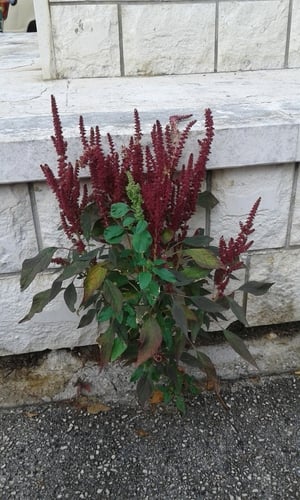
Achyranthes japonica
(Miq.) Nakai
iNaturalist· cc-by-nc
(c) Jessee J. Smith, some rights reserved (CC BY-NC), uploaded by Jessee J. Smith
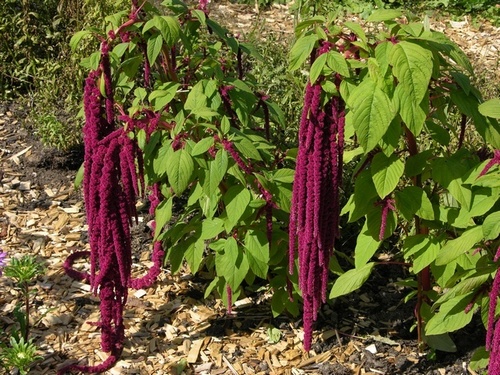
iNaturalist· cc-by-nc
(c) Tara Rose Littlefield, some rights reserved (CC BY-NC), uploaded by Tara Rose Littlefield
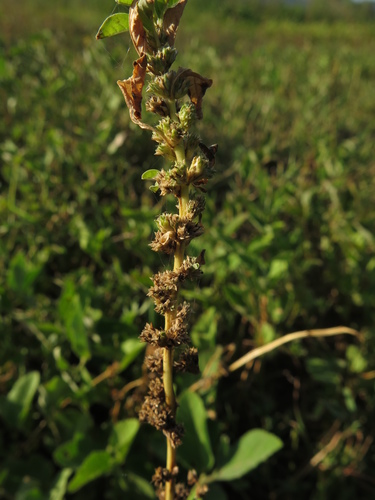
iNaturalist· cc-by-nc
(c) J. Richard Abbott, some rights reserved (CC BY-NC), uploaded by J. Richard Abbott
Summary
Source: WikipediaAchyranthes japonica, commonly known as Oriental chaff flower or Japanese chaff flower, is a perennial member of the genus Achyranthes in the family Amaranthaceae. It can be discovered on the roadside and its main distribution is in Korea and Japan.
Description
A shrub or small tree. It grows 5 m tall. There are prickles along the stem. The leaves are twice divided and there are 8-18 pairs of pinnae. There are up to 50 pairs of pinnules on each pinnae. The flowers are yellow. They are in large clusters at the ends of branches. The pods are flattened.
Edible Uses
No edible uses are known for this plant.
Traditional Uses
The root is used for brewing.
This uses section is brief — help expand it
Medicinal Uses
The root is used in Korea to treat oedema, rheumatism, and delayed menses, and is also used as a contraceptive and abortifacient. It contains triterpenoid saponins and has demonstrated analgesic, antiallergic, antiinflammatory, antispasmodic, diuretic, hypotensive, and uterine stimulant properties. The root also contains protocatechuic acid, which offers antioxidant effects and inhibits platelet aggregation.
Distribution
It is a temperate plant.
Where It Grows
Asia, Japan, Korea,
Propagation
Sow seed in a greenhouse in late spring. Germination should be fairly rapid. Prick out seedlings into individual pots of fairly rich soil once large enough to handle. It is advisable to overwinter the plant in the greenhouse during its first year, then transplant to its permanent position in late spring after the last expected frosts.
Other Uses
The seeds contain two insect-moulting hormones, which may have potential practical application as an insecticide.
Notes
There are 6 Achyranthes species. The grow in tropical and warm temperate regions.
Also Known As
Soemureup
References (6)
- Altschul, S.V.R., 1973, Drugs and Foods from Little-known Plants. Notes in Harvard University Herbaria. Harvard Univ. Press. Massachusetts. no. 901
- Bot. Mag. (Tokyo) 34:39. 1920 "iaponica"
- Hwang, H., et al, 2013, A Study on the Flora of 15 Islands in the Western Sea of Jeollanamdo Province, Korea. Journal of Asia-Pacific Biodiversity Vol. 6, No. 2 281-310
- Hwang, HS, et al, 2014, Distribution characteristics of plant in the Ungseokbong Mountain, Gyeongsangnam-do, Korea. Journal of Asia-Pacific Biodiversity. 7(2014) e164-e178
- Kim, H. & Song, M., 2013, Ethnobotanical analysis for traditional knowledge of wild edible plants in North Jeolla Province (Korea). Genetic. Resour. Crop Evol. (2013) 60:1571-1585
Show all 6 references Hide references
- Song, M., et al, 2013, Traditional knowledge of wild edible plants in Jeju Island, Korea. Indian Journal of Traditional Knowledge. 12(2) pp 177-194