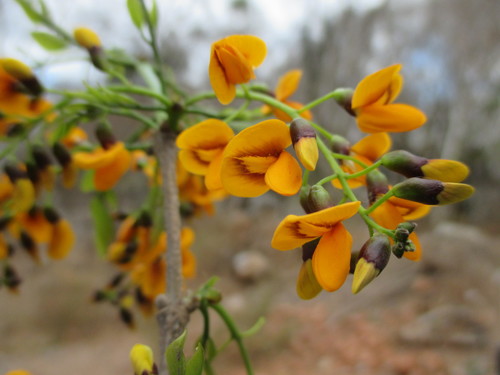
Ougeinia oojeinensis
(Roxb.) Hochr.
iNaturalist· cc-by-nc
(c) Shiwalee Samant, some rights reserved (CC BY-NC), uploaded by Shiwalee Samant
iNaturalist· cc0
no rights reserved, uploaded by S.MORE
iNaturalist· cc-by-nc
(c) Shiwalee Samant, some rights reserved (CC BY-NC), uploaded by Shiwalee Samant
Description
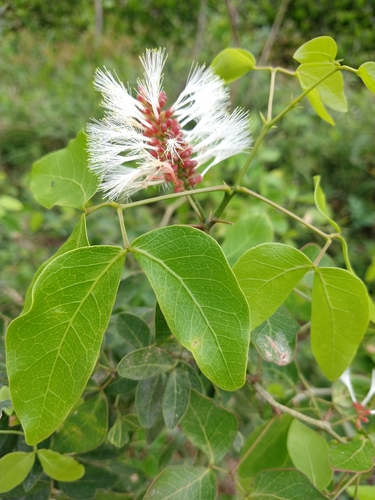
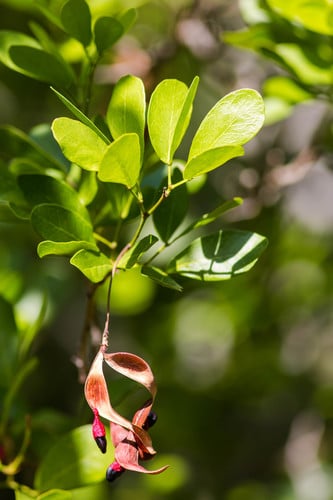
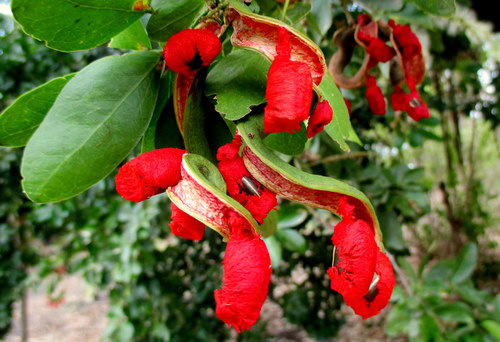
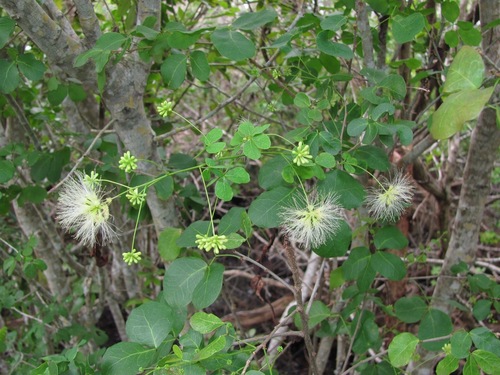
A medium sized tree. It loses its leaves during the year. It often has a crooked trunk. The bark is scaly like crocodile skin. It has a red gum when cut. It grows about 10 m high. The leaves are 8-20 cm long and 5-10 cm wide. They are bright green above and have pale dots underneath. The leaves have 3 leaflets. The flowers are pale pink or white. They are in dense round clusters. They are produced on the old wood. The flowers are in groups of 3 and the petals are thick and fleshy. The fruit is a narrow pod. It is 5-10 cm long and 0.1 cm wide. There are 2-5 seeds. These are 1 cm wide and smooth and brown. Seed germinate on the parent plant. The fruit is sweet and edible.
Edible Uses
The flowers are eaten boiled and mixed with rice. The sweet fruit pods are also edible.
Traditional Uses
The flowers are eaten boiled. They are mixed with rice.
This uses section is brief — help expand it
Medicinal Uses
The juice of the root, mixed with the powder of two fruits of black pepper, is taken in cases of eye trouble. The stembark is acrid, antiinflammatory, antispasmodic, astringent, cooling, depurative, febriguge, hypoglycemic, hypolipidemic, rejuvenating, styptic and sudorific. It is used to treat a range of conditions including diarrhoea, dysentery and fevers, and is said to be also useful in the treatment of anaemia, leucoderma, ulcers and biliousness. It is useful in the management of diabetes. A paste of bark is applied topically to cuts and wounds. A sap exudate (gum?) is used to make a medicine against dysentery. The gum is astringent. A methanolic extract of the stembark contains alkaloids, terpenoids, flavonoids, glycosides, tannins, saponins, proteins and carbohydrates
Known Hazards
The bark is used as a fish poison.
Distribution
A tropical plant. It grows along the waters edge and forms thick impenetrable belts. It grows between 700-1,200 m above sea level in the Himalayas.
Where It Grows
Andamans, Asia, Himalayas, India, Myanmar, Pakistan, SE Asia, Sri Lanka,
Cultivation
Plants are grown from seed. These germinate on the tree and grown in the mud.
Propagation
Seed - to maximize germination, pods should be broken into fragments, each containing one seed, and soaked in water for 24 hours before sowing. Seed should be sown 1 cm deep. Germination occurs in 3 - 8 days. Direct sowing is very successful and highly recommended. Nursery-propagation accelerates seedling growth, however the large taproot of sandan makes transplanting difficult. The seeds do not retain their viability for long and should be used within 12 months of maturity. Once collected seed should be properly dried and stored in sealed containers. Seeds weigh 28000-33000/kg. Division of suckers. Propagation by root cuttings is successful, but stem cuttings yield poor results.
Other Uses
Bark fibres are suitable for making rope. A red, transparent, astringent gum is obtained from incisions in the trunk. The light brown to red-brown wood is hard, tough, close-grained, elastic and durable. It is difficult to work, but turns well and takes polish readily. It is highly valued in India for making agricultural implements, makes excellent furniture, is useful for carriage building and is also used in construction. It is also a specialty timber for marine plywood. Sandan wood is a good fuel with a calorific value of 4 900-5 200 Kcal/kg. Sandan coppices well and produces abundant root-suckers. This characteristic is particularly useful for controlling erosion along steep banks and eroded hillsides. The tree comes up readily in blanks in the forest, on hilly slopes, landslips and bare places. In addition, the tree fixes atmospheric nitrogen. This could make it a valuable pioneer species, though its free-suckering might be a disadvantage here. Intercropping with lesser millet (Eleusine coracana) when about 60 cm wide strips are kept clear of the crop have been reported.
Notes
There are 2 Ougeinia species.
Synonyms
Also Known As
Bandhona, Banjan, Kala palas, Kalaphulas, Kari-honne, Kurimutal, Malavenna, Narivengai, Panan, Pandan tinsa, Panjan, Ruta, Sandan pipli, Sandan, Sar, Tanach, Tella motuku, Tinas, Tinis, Tinisha, Tinsa, Tiwas
References (8)
- Ambasta, S.P. (Ed.), 2000, The Useful Plants of India. CSIR India. p 417
- Annuaire Conserv. Jard. Bot. Geneve 13-14:51. 1909
- Dobriyal, M. J. R. & Dobriyal, R., 2014, Non Wood Forest Produce an Option for Ethnic Food and Nutritional Security in India. Int. J. of Usuf. Mngt. 15(1):17-37
- Flora of Pakistan. www.eFloras.org (As oogeinsis)
- Gunjatkar, N., & Vartak, V.D., 1982, Enumeration of wild edible legumes from Pune District, Maharashtra State. J.Econ. Tax. Bot. Vol 3 pp 1-9
Show all 8 references Hide references
- Masoodi, H. U. R. & Sundriyal, R. C., 2020, Richness of non-timber forest products in Himalayan communities—diversity, distribution, use pattern and conservation status. Journal of Ethnobiology and Ethnomedicine 16:56
- Sahni, K.C., 2000, The Book of Indian Trees. Bombay Natural History Society. Oxford. p 98
- Tewari, D.N., 1994, Important Plants of India. International Book Distributors, India. p 33