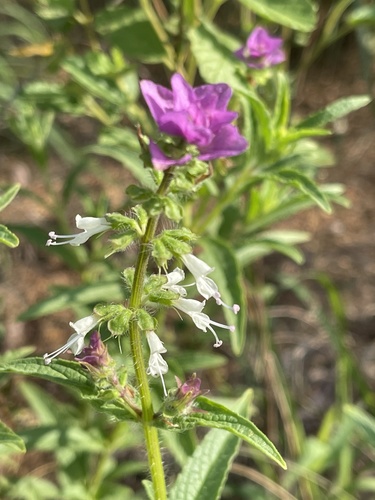
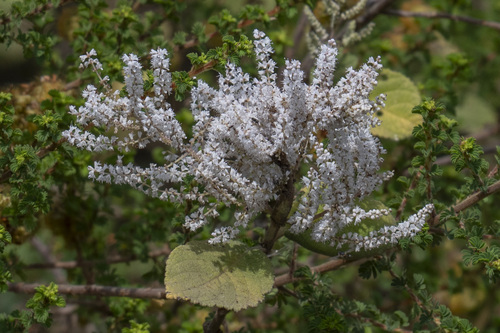
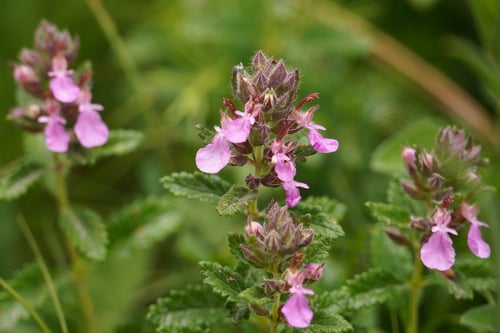
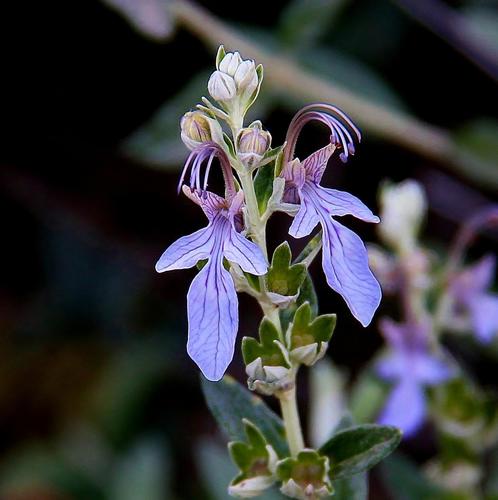
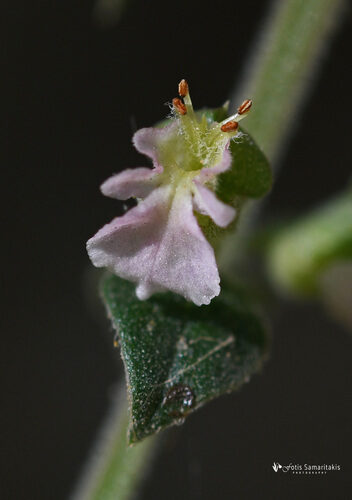
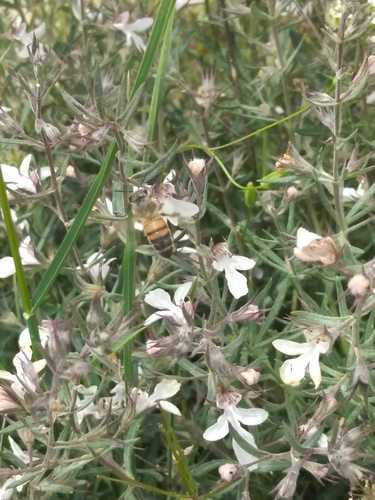
Elsholtzia blanda
(Benth.) Benth.
iNaturalist· cc-by
(c) Matt Berger, some rights reserved (CC BY), uploaded by Matt Berger
iNaturalist· cc0
no rights reserved
iNaturalist· cc0
no rights reserved
Description
A slender herb. It grows 30-150 cm high. The stems are square and branched. They are hairy. The leaves are opposite and oval. They have teeth along the edge. They are smooth on the upper surface and hairy underneath. The leaves are 3-8 cm long and 1.5-2 cm wide. The flower panicle can be at the ends of branches or in the axils of leaves. They are 6-12 cm long. The flowers are very small and white. The fruit are small nuts 0.7 mm long.
Edible Uses
The young shoots and leaves are served cooked as a vegetable and used as a tea substitute. The seeds are pickled and the flowers are used in chutney.
Traditional Uses
The young shoots and leaves are served cooked as a vegetable. They are also used as a tea substitute. The seeds are pickled. The flowers are used in chutney.
Medicinal Uses
The plant is used medicinally. It is analgesic, antiinflammatory, cardiac Traditionally, the aerial parts of the plant are used in India for the treatment of conditions such as fever, cholera, skin diseases, and inflammation. In traditional Chinese medicine the plant is used in the treatment of diarrhoea and dysentery, respiratory diseases, nephritis, hepatitis, pharyngritis, and acute enteritis. The aroma of the crushed leaves is inhaled in order to clear the nostrils when suffering from a cold or cough. A paste made from the tender leaves, with common salt added, is applied to old wounds of cattle to clear pus and maggots. The juice of the plant is used in the treatment of headaches. Applied topically, the juice is used to treat cuts and wounds. The essential oil contains linalool and geranyl acetate as the main compounds. Luteolin, luteolin-7-O-glucoside, luteolin-3´-O-glucoside, and luteolin-7-O-glactoside have also been identified
Distribution
A tropical and subtropical plant. In Nepal it grows from 300-2500 m altitude. It grows in moist, open places. In Yunnan.
Where It Grows
Asia, Bhutan, China, Himalayas, India, Indochina, Indonesia, Laos, Myanmar, Nepal, Northeastern India, SE Asia, Sikkim, Thailand, Vietnam,
Cultivation
Plants are grown from seed.
Other Uses
An essential oil is obtained from the aerial parts of the plant. The leaves contain up to 2% essential oil. There are some citral-rich chemotypes of the plant with a high citral content between 75.2 - 83.5%. These citral-rich forms can be utilized as an alternative source of citral oil, neral, and geranial. - this oil has the potential to compete with commercial citral oils obtained from lemon grass, Cymbopogon flexuous.
Production
In Nagaland leaves are harvested June to November.
Other Information
Plants are grown in gardens and leaves sold in local markets.
Notes
There are about 40 Elsholtzia species. It is used in medicine.
Synonyms
Also Known As
Ban silam, Ban tulsi, Bantuluki, Elsholtzia, Lajing, Lomba, Lu gu me, Phak luean, Pheiri, Si fang hao, Yaung-bway, Ya you man nuai, Yon-pa-bo
References (11)
- Ambasta, S.P. (Ed.), 2000, The Useful Plants of India. CSIR India. p 194
- Cao, Y., et al, 2020, Ethnobotanical study on wild edible plants used by three trans-boundary ethnic groups in Jiangcheng County, Pu’er, Southwest China. Journal of Ethnobiology and Ethnomedicine (2020) 16:66
- Hani Medicine of Xishuangbanna, 1999, p 804
- Jacquat, C., 1990, Plants from the Markets of Thailand. D.K. Book House p 99
- Li Hai-wen, Hedge, I.C., Lamiaceae. Flora of China. p 332
Show all 11 references Hide references
- Liu, Yi-tao, & Long, Chun-Lin, 2002, Studies on Edible Flowers Consumed by Ethnic Groups in Yunnan. Acta Botanica Yunnanica. 24(1):41-56
- Manandhar, N.P., 2002, Plants and People of Nepal. Timber Press. Portland, Oregon. p 216
- Pradheep, K., et al, 2016, Wild edible plants used by Konyak tribe in Mon district of Nagaland: Survey and inventorisation. Indian Journal of Natural Products and Resources. Vol 7(1) pp 74-81
- Rijal, A., 2011, Surviving on Knowledge: Ethnobotany of Chepang community from mid-hills of Nepal. Ethnobotany Research & Applications 9:181-215
- Singh, V. B., et al, (Ed.) Horticulture for Sustainable Income and Environmental Protection. Vol. 1 p 216
- Thokchom, R., et al, 2016, Documentation and assessment of wild medicinal and edible flowers of valley districts of Manipur. International Journal of Research in Applied, Natural and Social Sciences. 4(11):13-20