Syncolostemon bracteosus
(Benth.) D. F. Otieno
Purple top, White-tipped hemizygia
iNaturalist· cc-by-nc
(c) Troos van der Merwe, some rights reserved (CC BY-NC), uploaded by Troos van der Merwe
iNaturalist· cc-by-nc
(c) Troos van der Merwe, some rights reserved (CC BY-NC), uploaded by Troos van der Merwe
iNaturalist· cc-by
(c) Wynand Uys, some rights reserved (CC BY), uploaded by Wynand Uys
Description
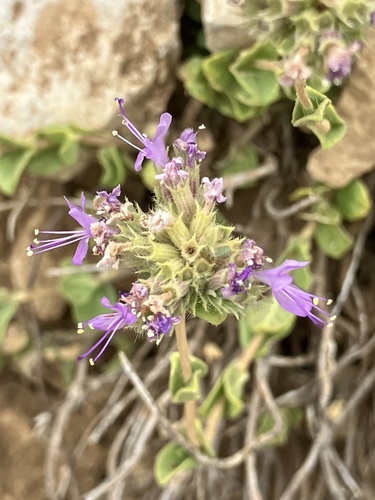
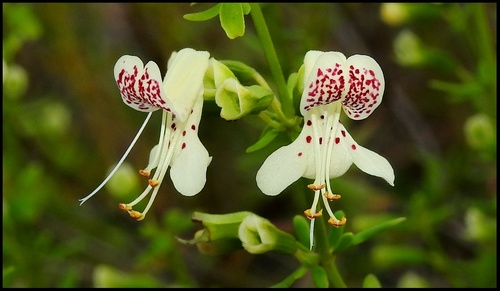
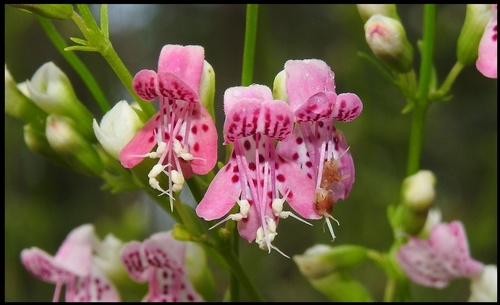
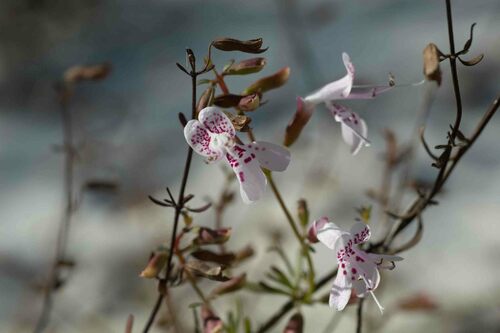
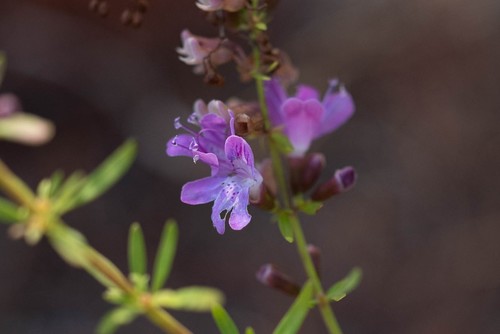
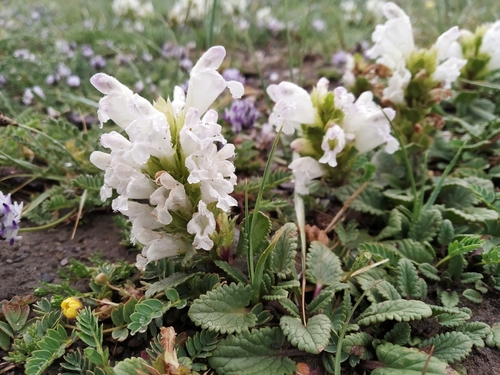
An annual herb. It grows 70 cm high. The plant has an aroma. The stems are 4 angled. They have spreading greyish hairs. The leaves are opposite. The leaves are narrow and sword shaped. They are 4-9 cm long by 1-2 cm wide. The flowers are simple. They are on a flowering shoot 12-30 cm long with 4-6 flowers. They are white tinged with red.
Edible Uses
The leaves are boiled in water to make a refreshing tea.
Traditional Uses
The leaves are boiled in water and the tea is drunk as a refreshing drink.
This uses section is brief — help expand it
Medicinal Uses
The leaf tea is drunk as a refreshing beverage.
Distribution
It is a subtropical plant. It grows in hot arid regions with a marked dry season. It grows in well-drained sandy soils. It grows between 380-1,150 m above sea level. It is often along creek banks. It can grow in arid places.
Where It Grows
Africa, Angola, Benin, Botswana, Cameroon, Central Africa, East Africa, Malawi, Mozambique, Namibia, Nigeria, Senegal, South Africa, Southern Africa, Tanzania, West Africa, Zambia, Zimbabwe,
Other Uses
The whole plant is very aromatic and is valued as an effective mosquito repellent. A bunch of the plants is tied together and put under the mattress or kept nearby and will keep the mosquitoes away the whole night.
Synonyms
Also Known As
Dingamwe, Engamwe, Jetamakurwe, Munandwa, Ohauveve, Oshive, Zivabva
References (5)
- Royal Botanic Gardens, Kew (1999). Survey of Economic Plants for Arid and Semi-Arid Lands (SEPASAL) database. Published on the Internet; http://www.rbgkew.org.uk/ceb/sepasal/internet [Accessed 19th April 2011] (As Hemizygia bracteosa)
- Ruiters-Welcome, A. K., 2019, Food plants of southern Africa. Ph.D. thesis. Univ. of Johannesburg p 71
- Welcome, A. K. & Van Wyk, B.-E., 2019, An inventory and analysis of the food plants of southern Africa. South African Journal of Botany 122 (2019) 136–179
- World Checklist of Useful Plant Species 2020. Royal Botanic Gardens, Kew
- www.zimbabweflora.co.zw 2011