Bidens schimperi
Walp.
Munondo bur-marigold
iNaturalist· cc-by
(c) Wilderness Safaris Botswana - Conservation Team, some rights reserved (CC BY), uploaded by Wilderness Safaris Botswana - Conservation Team
iNaturalist· cc-by
(c) Robert Taylor, some rights reserved (CC BY), uploaded by Robert Taylor
Description
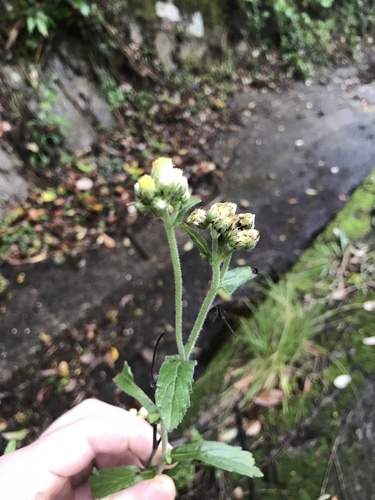
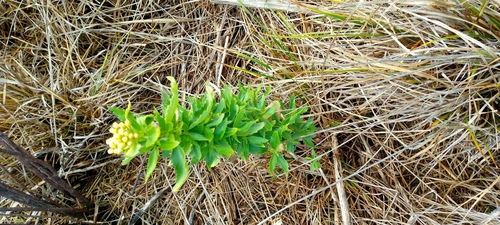
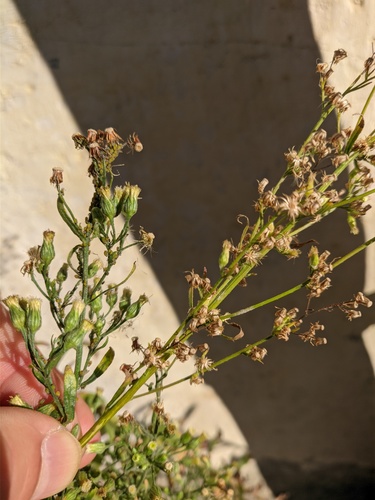
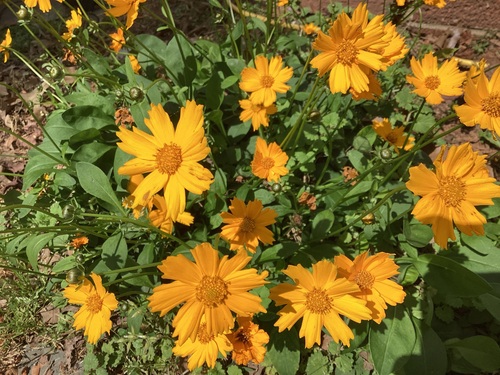
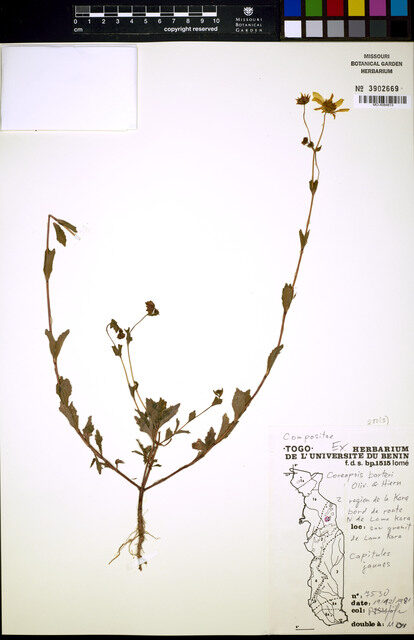
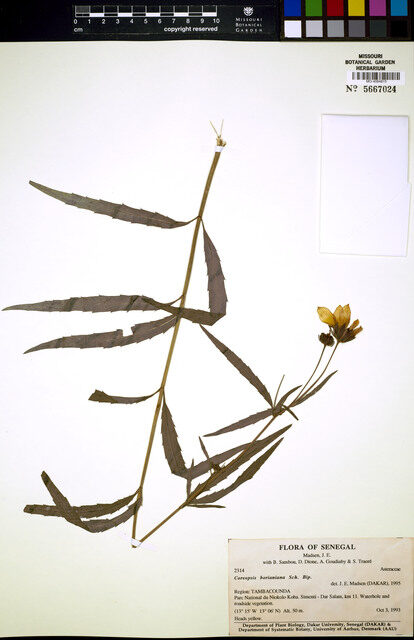
A herb. It grows 1.8 , tall. The leaves are roughly hairy. They are usually deeply divided into 3. The edges of the leaves are marked by a line of black dots. The flowers are yellow and larger than Bidens pilosa. The fruit have 2 hooked bristles.
Edible Uses
The leaves are bitter but are occasionally cooked and eaten as a leafy vegetable, typically chopped and mixed with other greens. It is used as a famine food.
Traditional Uses
The leaves are bitter but are occasionally cooked and eaten. They are chopped and cooked and mixed with other leafy vegetables.
This uses section is brief — help expand it
Medicinal Uses
The roots are used to treat coughs and colds.
Known Hazards
The leaves are notably bitter and not widely liked.
Distribution
A tropical plant. It grows on arable land. It is also in woodland and on flood plains. It grows between 300-950 m above sea level. It can grow in arid places. In Tanzania it grows from sea level to 2,400 m above sea level.
Where It Grows
Africa, Angola, Botswana, Burundi, Central Africa, East Africa, Ethiopia, Kenya, Malawi, Mozambique, Namibia, Somalia, South Africa, Southern Africa, Tanzania, Uganda, Zambia, Zimbabwe,
Production
Leaves are collected at the beginning of the rainy season.
Other Information
It is a famine food. Because it is bitter it is not liked.
Notes
There are about 200 Bidens species. Most are in North America.
Synonyms
Also Known As
Kishonanguo, Lihna, Lizumba, Masanjala, Mbilidzongwe, Mosimama, Nacadadoli, Nyatwanga, Nyaweza
References (14)
- Allen, D. J., 2007, Wildflowers and Common Trees of East Africa. Camerapix Publishers p 106
- FAO, 1988, Traditional Food Plants, FAO Food and Nutrition Paper 42. FAO Rome p 106
- Fowler, D. G., 2007, Zambian Plants: Their Vernacular Names and Uses. Kew. p 12
- Grubben, G. J. H. and Denton, O. A. (eds), 2004, Plant Resources of Tropical Africa 2. Vegetables. PROTA, Wageningen, Netherlands. p 118
- Lyimo, M., et al, 2003, Identification and nutrient composition of indigenous vegetables of Tanzania. Plant Foods for Human Nutrition. 58: 85-92
Show all 14 references Hide references
- Msola, D. K., 2007, The role of Wild Foods in Household Income and Food Security in Mufundi District, Tanzania. Morogoro, Tanzania. p 46
- Msuya, T. S., et al, 2010, Availability, Preference and Consumption of Indigenous Foods in the Eastern Arc Mountains, Tanzania, Ecology of Food and Nutrition, 49:3, 208-227
- Peters, C. R., O'Brien, E. M., and Drummond, R.B., 1992, Edible Wild plants of Sub-saharan Africa. Kew. p 88
- Roodt, V., 1998, Common Wild Flowers of the Okavango Delta. Medicinal Uses and Nutritional value. The Shell Field Guide Series: Part 2. Shell Botswana. p 43
- Royal Botanic Gardens, Kew (1999). Survey of Economic Plants for Arid and Semi-Arid Lands (SEPASAL) database. Published on the Internet; http://www.rbgkew.org.uk/ceb/sepasal/internet [Accessed 11th April 2011]
- Ruffo, C. K., Birnie, A. & Tengnas, B., 2002, Edible Wild Plants of Tanzania. RELMA p 164
- Vernon, R., 1983, Field Guide to Important Arable Weeds of Zambia. Dept of Agriculture, Chilanga, Zambia. p 82
- Williamson, J., 2005, Useful Plants of Malawi. 3rd. Edition. Mdadzi Book Trust. p 37
- World Checklist of Useful Plant Species 2020. Royal Botanic Gardens, Kew