Sterculia murex
Hemsl.
Lowveld chestnut
iNaturalist· cc-by-nc
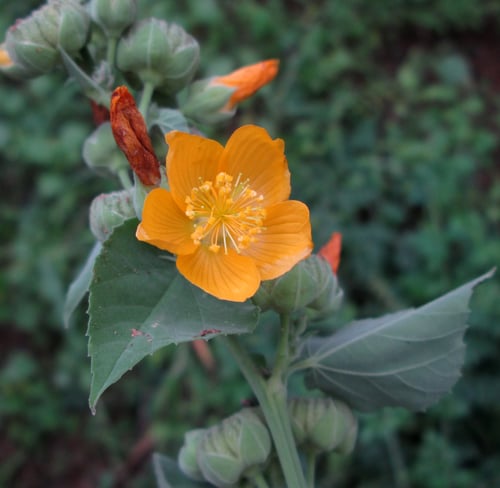
(c) carlbodenstaff, some rights reserved (CC BY-NC), uploaded by carlbodenstaff
iNaturalist· cc-by-nc
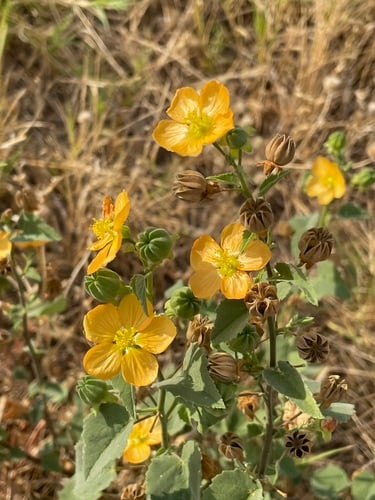
(c) Jacob Dirsuwei, some rights reserved (CC BY-NC), uploaded by Jacob Dirsuwei
iNaturalist· cc-by-sa
(c) JMK, some rights reserved (CC BY-SA)
Summary
Source: WikipediaSterculia murex Hemsl. or lowveld chestnut is a southern African tree in the family Malvaceae, and the subfamily Sterculioideae. It has a very limited distribution in the lowveld of eastern Mpumalanga. After S. alexandri it is the most southern representative of the genus in Africa. Kew currently recognises some 92 species of Sterculia, confined to the tropics and slightly beyond at low elevations.
Description
A handsome leafy tree. It is 6-12 m tall. It has wide spreading branches. There are 1-2 stems which are up to 30 cm across. The bark is thick, ribbed and grey-brown. The leaves are on long hairy stalks. They are alternate and have 5-10 stalkless leaflets. These radiate like fingers on a hand. They are oblong but narrow to both ends. They are usually 10 cm long by 5 cm wide. They are velvety on both sides. The flowers are in sprays at the ends of branches. These can be 10 cm long. Flowers are waxy and yellow. The sepals look like petals. The flowers are saucer-shaped and 2-2.5 cm across. The fruit are made up of carpels each 9-20 cm long by 7-13 cm wide. They can be singly or in groups of 2-5. They split along the upper surface to form boat shaped structures. These have spines over them. The openings are fringed with irritating hairs. The seeds are large and can be 2.5 cm long. They are black and rich in oil. They are edible.
Edible Uses
The seeds are eaten raw and can be pressed for oil.
Traditional Uses
The seeds are eaten.
This uses section is brief — help expand it
Known Hazards
The shell contains large oval seeds, resting in a bed of stinging hairs that can be irritating on contact with the skin or eyes.
Distribution
It is a subtropical plant. Plants are sensitive to frost. They grow in rocky locations. It suits hardiness zones 9-11.
Where It Grows
Africa, Australia, Eswatini, Slovenia, South Africa*, Southern Africa, Swaziland,
Cultivation
Plants are grown from seeds. Seeds grow easily but slowly.
Propagation
Seed - germinates readily if sown fresh. For better germination, the seed should be placed on top of the soil. The roots are formed first and the leaves only appear above the soil or the growing medium after a few months. A physical dormancy caused by the hard seed coat of the mature seeds of many species in this genus can be overcome by scarifying the seed. This is carried out by cutting away or abrading some of the seed coat to allow the ingress of water, though great care must be taken not to damage the embryo. The aril surrounding the seed should also be removed - this is easiest when it has been softened through soaking in water. The seeds germinate optimally at temperatures between 20 - 30°c. They can be sown in a nursery seedbed or in containers. A germination rate of about 95%, occurring within about 2 weeks can be expected if the seed has been properly treated.
Other Uses
The open fruit shell makes an unusual ash-tray, it is not easily charred by lighted cigarettes. The wood is soft and of little use.
Production
Young trees are fast growing.
Other Information
They are popular.
Notes
Also put in the family Sterculiaceae.
Nutrition
| Part | Moisture | kJ | kcal | Protein | Vit A | Vit C | Iron | Zinc |
|---|---|---|---|---|---|---|---|---|
| Nuts | 15.1 | 1733 | 415 | 16.2 | — | — | 2.6 | 4 |
Also Known As
Gebeleweni, Umbhaba
References (13)
- Cundall, P., (ed.), 2004, Gardening Australia: flora: the gardener's bible. ABC Books. p 1372
- http://www.botanic-gardens-ljubljana.com/en/plants
- Joffe, P., 2007, Creative Gardening with Indigenous Plants. A South African Guide. Briza. p 113
- Long, C., 2005, Swaziland's Flora - siSwati names and Uses http://www.sntc.org.sz/flora/
- Morley, B. & Everard, B., 1970, Wild Flowers of the World. Ebury press. Plate 57
Show all 13 references Hide references
- Palgrave, K.C., 1996, Trees of Southern Africa. Struik Publishers. p 596
- Peters, C. R., O'Brien, E. M., and Drummond, R.B., 1992, Edible Wild plants of Sub-saharan Africa. Kew. p 188
- Ruiters-Welcome, A. K., 2019, Food plants of southern Africa. Ph.D. thesis. Univ. of Johannesburg p 77
- Schmidt, E., Lotter, M., & McCleland, W., 2007, Trees and shrubs of Mpumalanga and Kruger National Park. Jacana Media p 414
- Van Wyk, Br. and van Wyk P., 2009, Field Guide to Trees of Southern Africa. Struik Nature. p 474
- Wehmeyer, A. S, 1986, Edible Wild Plants of Southern Africa. Data on the Nutrient Contents of over 300 species
- Welcome, A. K. & Van Wyk, B.-E., 2019, An inventory and analysis of the food plants of southern Africa. South African Journal of Botany 122 (2019) 136–179
- World Checklist of Useful Plant Species 2020. Royal Botanic Gardens, Kew