Asphodelus albus
Boiss.
White asphodel
iNaturalist· cc-by-nc
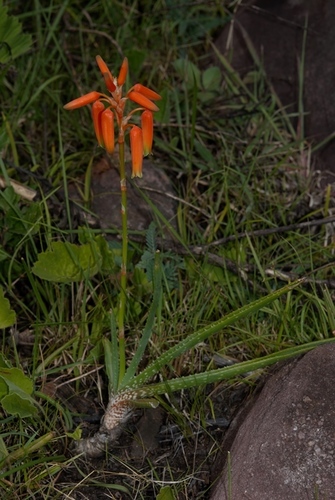
(c) Elio Giacone, some rights reserved (CC BY-NC), uploaded by Elio Giacone
iNaturalist· cc-by-nc
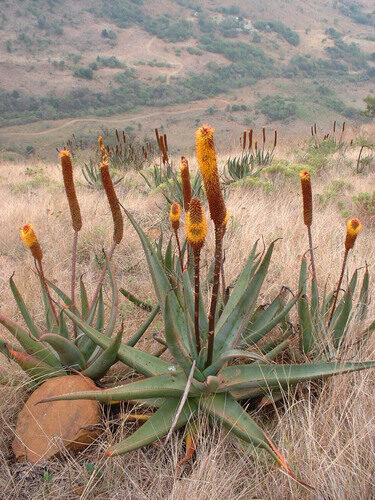
(c) Valentin Hamon, some rights reserved (CC BY-NC), uploaded by Valentin Hamon
iNaturalist· cc-by-nc
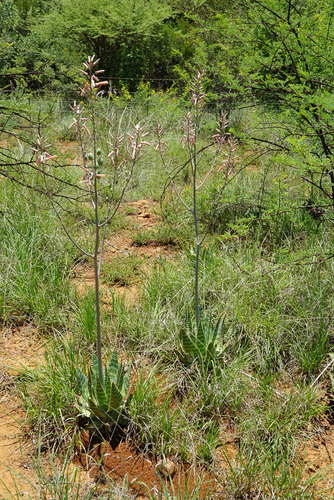
(c) Sarah Wang, some rights reserved (CC BY-NC), uploaded by Sarah Wang
Summary
Source: WikipediaAsphodelus albus, common name white asphodel, is a herbaceous perennial plant belonging to the genus Asphodelus.
Description
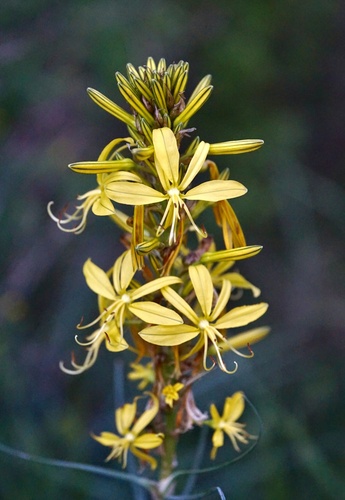
A clump forming herb. It keeps growing from year to year. It grows 1 m tall. It has a swollen root. The leaves are very narrow and 60 cm long. The flowering stems are 30-90 cm tall. The flowers are white or pink. They have a pinkish-brown stripe on each petal. The flowers are 30-40 mm long and in dense spike like groups.
Edible Uses
Edible Parts: Root Edible Uses: The root was at one time eaten as a food but, since it contains the alkaloid asphodeline, this is not really very advisable.
Traditional Uses
Caution The root is cooked and reduced to a pulp then blended with barley and buckwheat flours.
This uses section is brief — help expand it
Medicinal Uses
Antidermatosic Detergent Emollient Vulnerary The tubers are antidermatosic, detergent, emollient and vulnerary. They are mainly used externally in the treatment of skin conditions and for lightening freckles. They have also been employed internally as a cough remedy. The tubers are harvested in the spring and dried for later use. Use internally with caution, especially if you are suffering from nephritis or gastritis.
Known Hazards
The root is poisonous.
Distribution
It is a temperate plant. It grows on rocky ground and woodland. It suits hardiness zones 6-10.
Where It Grows
Africa, Australia, Balkans, Bosnia, Europe, France, Greece, Italy, Mediterranean, North Africa, Slovenia, Spain,
Cultivation
Succeeds in ordinary garden soil, tolerating partial shade. Requires a well-drained soil and a sheltered position. Prefers a deep rich sandy loamy soil. Prefers a soil that is not too rich and a sunny position. Grows well on hot dry banks and in thin grass. Established plants are drought tolerant. Plants are hardy to about -15°c. Plants seem to be immune to the predations of rabbits.
Propagation
Seed - sow March/April in a greenhouse and only just cover the seed. Germination usually takes place in 1 - 3 months at 15°c. When they are large enough to handle, prick the seedlings out into individual pots and grow them on in the greenhouse for at least their first winter. When the plants are large enough to handle, plant them out into their permanent positions in late spring or early summer. Division in early spring or autumn.
Other Uses
Alcohol An alcohol can be obtained from the fermented roots. Special Uses
Other Information
It is a famine food.
Notes
There are 12 Asphodelus species. Also put in the family Asphodelaceae.
Synonyms
Also Known As
Capljan, Gamon, Navadni zlati koren
References (11)
- Bircher, A. G. & Bircher, W. H., 2000, Encyclopedia of Fruit Trees and Edible Flowering Plants in Egypt and the Subtropics. AUC Press. p 45
- Blamey, M and Grey-Wilson, C., 2005, Wild flowers of the Mediterranean. A & C Black London. p 469
- Blanco-Salas, J., et al, 2019, Wild Plants Potentially Used in Human Food in the Protected Area “Sierra Grande de Hornachos” of Extremadura (Spain). Sustainability 2019, 11, 456
- Brickell, C. (Ed.), 1999, The Royal Horticultural Society A-Z Encyclopedia of Garden Plants. Convent Garden Books. p 146
- Cundall, P., (ed.), 2004, Gardening Australia: flora: the gardener's bible. ABC Books. p 197
Show all 11 references Hide references
- Gard. dict. ed. 8: Asphodelus no. 3. 1768
- Hibbert, M., 2002, The Aussie Plant Finder 2002, Florilegium. p 34
- Lim, T. K., 2015, Edible Medicinal and Non Medicinal Plants. Volume 9, Modified Stems, Roots, Bulbs. Springer p 13
- PARMENTIER
- Plants for a Future database, The Field, Penpol, Lostwithiel, Cornwall, PL22 0NG, UK. http://www.scs.leeds.ac.uk/pfaf/
- Redzic, S. J., 2006, Wild Edible Plants and their Traditional Use in the Human Nutrition in Bosnia-Herzegovina. Ecology of Food and Nutrition, 45:189-232