Asphodeline lutea
(L.) Rchb.
King's spear, Yellow asphodel
iNaturalist· cc-by-nc
(c) lichu, some rights reserved (CC BY-NC)
iNaturalist· cc-by-nc
(c) Nicolas HELITAS, some rights reserved (CC BY-NC), uploaded by Nicolas HELITAS
iNaturalist· cc-by-nc
(c) Stefan Neuwirth, some rights reserved (CC BY-NC), uploaded by Stefan Neuwirth
Summary
Source: WikipediaAsphodeline lutea (king's spear, yellow asphodel) is a perennial plant native to southeastern Europe, northern Africa, the Caucasus and the Levant. It is grown as a landscaping plant. It has been associated with the Asphodel of the Ancient Greek underworld, but so has the closely related Asphodelus ramosus.
Description
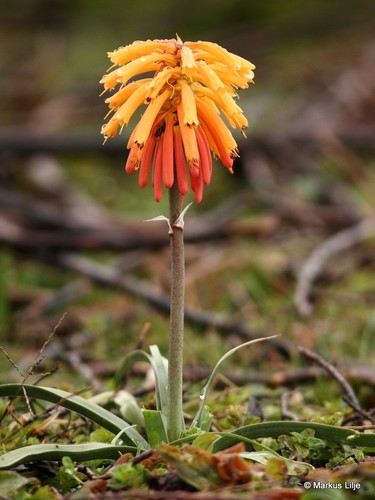
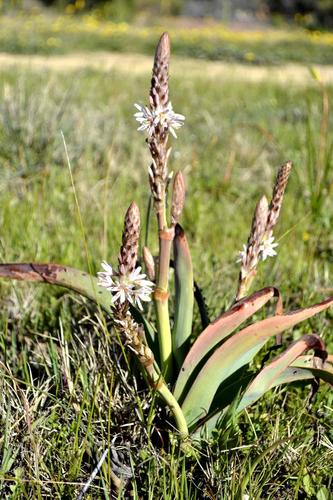
A perennial herb. It grows 90-120 cm high and 25-30 cm wide. The roots are fleshy. The leaves are grassy and green and occur on tall stems on whorls or rings. The flowers are yellow and starry. They occur in a spike. The fruit are seed pods that are round and green. These turn brown as they dry. They are 10-12 mm across.
Edible Uses
Edible Parts: Flowers Leaves Root Shoots Edible Uses: Root - roasted. This food was highly valued by the ancient Greeks, who roasted the roots like potatoes and ate them with salt and oil or mashed them with figs. The roots are not very thick but are abundantly produced and have a nice nutty flavour. They can be harvested at any time of the year, but are best used when the plant is dormant in late summer and early autumn. They do not store well and should be used within a few weeks of harvest. Young shoots - cooked. They smell less than pleasant whilst cooking but have a fairly bland flavour. Some people find that they have a very pleasant flavour. The plant comes into growth in late summer and the autumn, the young shoots can be harvested in moderation all through the winter. Flowers - raw. A delightful sweetness, they are a very decorative and tasty addition to the salad bowl but should be used as soon as possible after harvesting because they soon start to decompose. The flowers are very short-lived and are best picked in the late afternoon - thus you can enjoy them visually during the day and gastronomically in the evening. There is also said to be a double-flowered form, which will have twice the quantity of petals, though we do not know its name.
Traditional Uses
Caution: It should be cooked. The roots are roasted and eaten. They are eaten with salt and oil or mashed with figs. The flowering shoots are eaten. The young stems are eaten raw as a snack. The shoots are peeled and roasted.
Medicinal Uses
None known
Distribution
It is frost hardy. In the Mediterranean it grows on rocky slopes and in hills and mountains. It is best in rich soils. It is resistant to drought. It suits hardiness zones 6-9.
Where It Grows
Africa, Albania, Australia, Balkans, Bosnia, Croatia, Europe, Greece, Italy, Mediterranean*, Middle East, North Africa, Palestine, Sicily, Slovenia, Turkey, Türkiye,
Cultivation
Plants can be grown by division. They can also be grown by seeds.
Propagation
Seed - sow March/April in a greenhouse and only just cover the seed. Germination usually takes place in 1 - 3 months at 15°c. Once the seedlings are large enough to handle, prick them out into individual pots and grow them on in the greenhouse for their first winter. Plant them out into their permanent positions in late spring. Division in spring or autumn, with care since the roots are easily damaged. Ensure each division has at least one growing bud. Large divisions can be planted out straight into their permanent positions, smaller ones are best potted up until they are growing away strongly and can then be panted out. We have found that this plant can be successfully divided throughout the growing season so long as it is watered in dry weather.
Other Uses
Scented plant. Attractive edible flowers. Special Uses Food Forest Scented Plants
Notes
There are 19 Asphodeline species. Also put in the family Asphodelaceae.
Synonyms
Also Known As
Baton de Jacob, Calcacavallo, Flower of the dead, Garufi, Jacob's rod, Otaat, Puddicinu, Rumeni čepljec, Zlatoglavica
References (22)
- Ali-Shtayeh, M. S., et al, 2008, Traditional knowledge of wild edible plants used in Palestine (Northern West Bank): A comparative study. J Ethnobiol Ethnomed. 4: 13
- Bircher, A. G. & Bircher, W. H., 2000, Encyclopedia of Fruit Trees and Edible Flowering Plants in Egypt and the Subtropics. AUC Press. p 45
- Biscotti, N. & Pieroni, A., 2015, The hidden Mediterranean diet: wild vegetables traditionally gathered and consumed in the Gargano area, Apulia, SE Italy. Acta Societatis Botanicorum Poloniae 84 (3): 327-338
- Biscotti, N. et al, 2018, The traditional food use of wild vegetables in Apulia (Italy) in the light of Italian ethnobotanical literature. Italian Botanist 5:1-24
- Blamey, M and Grey-Wilson, C., 2005, Wild flowers of the Mediterranean. A & C Black London. p 469
Show all 22 references Hide references
- Bodkin, F., 1991, Encyclopedia Botanica. Cornstalk publishing, p 109
- Cundall, P., (ed.), 2004, Gardening Australia: flora: the gardener's bible. ABC Books. p 196
- Dolina, K. & Luczaj, L., 2014, Wild food plants used on the Dubrovnik coast (south-eastern Croatia) Acta Soc Bot Pol 83(3):175–181
- Facciola, S., 1998, Cornucopia 2: a Source Book of Edible Plants. Kampong Publications, p 143
- Fl. germ. excurs. 116. 1830
- Geraci, A., et al, 2018, The wild taxa utilized as vegetables in Sicily (Italy): a traditional component of the Mediterranean diet. Journal of Ethnobiology and Ethnomedicine (2018) 14:14
- Hedrick, U.P., 1919, (Ed.), Sturtevant's edible plants of the world. p 82
- Hibbert, M., 2002, The Aussie Plant Finder 2002, Florilegium. p 34
- Jackes, D. A., Edible Forest Gardens
- Joyce, D., 1998, The Garden Plant Selector. Ryland, Peters and Small. p 208
- Licata, M., et al, 2016, A survey of wild plant species for food use in Sicily (Italy) – results of a 3-year study in four Regional Parks. Journal of Ethnobiology and Ethnomedicine 12:12
- Lim, T. K., 2015, Edible Medicinal and Non Medicinal Plants. Volume 9, Modified Stems, Roots, Bulbs. Springer p 13
- Morley, B. & Everard, B., 1970, Wild Flowers of the World. Ebury press. Plate 41
- Pasta, S., et al, 2020, An Updated Checklist of the Sicilian Native Edible Plants: Preserving the Traditional Ecological Knowledge of Century-Old Agro-Pastoral Landscapes. Frontiers in Plant Science. Volume 11|Article 388
- Plants for a Future database, The Field, Penpol, Lostwithiel, Cornwall, PL22 0NG, UK. http://www.scs.leeds.ac.uk/pfaf/
- Redzic, S. J., 2006, Wild Edible Plants and their Traditional Use in the Human Nutrition in Bosnia-Herzegovina. Ecology of Food and Nutrition, 45:189-232
- Rivera, D. et al, 2006, Gathered Mediterranean Food Plants - Ethnobotanical Investigations and Historical Development, in Heinrich M, Müller WE, Galli C (eds): Local Mediterranean Food Plants and Nutraceuticals. Forum Nutr. Basel, Karger, 2006, vol 59, pp 18–74