Ampelocissus latifolia
(Roxb.) Planch.
Jungle grapevine
iNaturalist· cc-by-nc
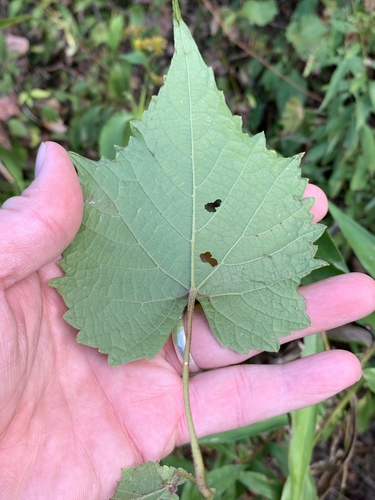
(c) Avinash Bhagat, some rights reserved (CC BY-NC), uploaded by Avinash Bhagat
iNaturalist· cc-by
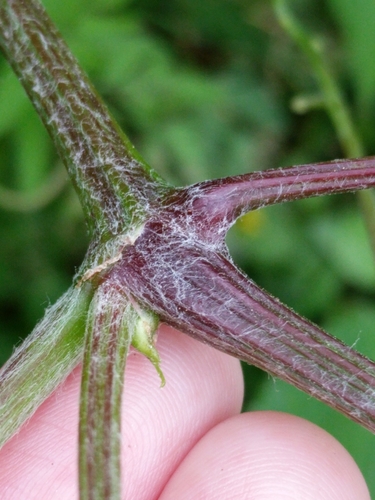
(c) Boson, some rights reserved (CC BY), uploaded by Boson
iNaturalist· cc-by-nc
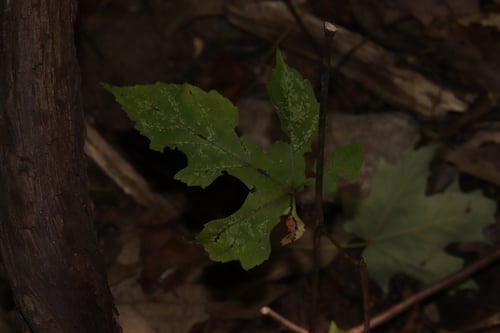
(c) Anil Kumar Verma, some rights reserved (CC BY-NC), uploaded by Anil Kumar Verma
Summary
Source: WikipediaAmpelocissus latifolia is a plant in the Vitoideae subfamily of the grape family native to the Indian subcontinent, including Bangladesh, India, Nepal, and Pakistan. It is the type species for the genus of Ampelocissus and was initially treated under its basionym, Vitis latifolia, which was described scientifically in 1824. In 1884, Jules Émile Planchon reclassified the species under the genus Ampelocissus.
Description
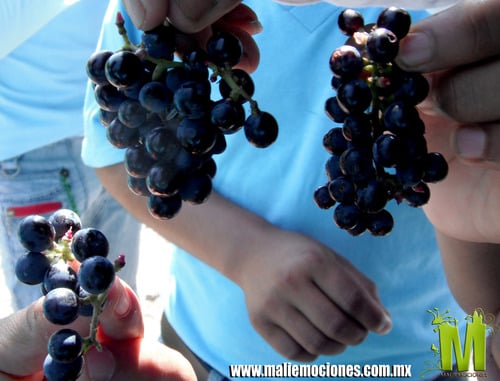
A woody climber. It has a fattened rootstock. It has hollow stems. The leaves are roundish and have 3-7 lobes. The tendrils are forked. The flowers are small and reddish-brown. The fruit are oval and 7-8 mm long. They are black when fully ripe. They have 2 seeds.
Edible Uses
The fruit are eaten raw, though they can be sour. The stems contain drinkable water. Leaves are also edible.
Traditional Uses
The fruit are eaten raw. They can be sour. The stems contain drinking water.
This uses section is brief — help expand it
Medicinal Uses
The leaves are used in medicine.
Distribution
A tropical plant. It grows in moist deciduous forests. It is often in hedges. It grows up to 1,200 m above sea level. It occurs in the Western Ghats in India.
Where It Grows
Africa, Asia, Bangladesh, East Africa, Himalayas, India, Indochina, Indonesia, Nepal, Nigeria, Northeastern India, Indochina, Laos, Pakistan, SE Asia, Uganda, West Africa,
Cultivation
Plants can be grown from seeds.
Production
In India plants flower and fruit from May to August.
Notes
There are about 95 Ampelocissus species. The leaves are used in medicine.
Synonyms
Also Known As
Achiwebetema, Amlavetasah, Bahinicha vel, Ban angur, Bechhuti, Bedasativva, Dhoto pako, Dibroi, Dokela, Golinda, Govila, Govindu, Gowalia lata, Jungle angoor, Jangli drash, Kanjianoi, Kanjinoi, Karantavalli, Kattuk-kodi-mundirikai, Kattukodimindri, Nadena, Nandena, Okela, Okoto, Olok, Panibel, Peribel, Ran draksha
References (24)
- Ambasta S.P. (Ed.), 2000, The Useful Plants of India. CSIR India. p 36
- Aniama, S. O., et al, 2016, Ethnobotanical documentaton of some plants among Igala people of Kogi State (Nigeria). The International Journal Of Engineering And Science (IJES). 5(4) pp 33-42
- Behera, K. K. et al, 2008, Wild Edible Plants of Mayurbhanj District, Orissa, India. J. Econ. Taxon. Bot. Vol. 32 (Suppl,) pp 305-314
- Delang, C. O., 2007, Ecological Succession of Usable Plants in an Eleven-Year Fallow Cycle in North Lao P.D.R., Ethnobotany Research and Applications. Vol. 5:331-350
- Dyani, S.K., & Sharma, R.V., 1987, Exploration of Socio-economic plant resources of Vyasi Valley in Tehri Garwhal. J. Econ. Tax. Bot. Vol. 9 No. 2 pp 299-310
Show all 24 references Hide references
- Hedrick, U.P., 1919, (Ed.), Sturtevant's edible plants of the world. p 684 (As Vitis latifolia)
- Jadhav, R., et al, 2015, Forest Foods of Northern Western Ghats: Mode of Consumption, Nutrition and Availability. Asian Agri-History Vol. 19, No. 4: 293-317
- Kumbhojkar, M.S. & Vartak, V.D., 1988, Ethnobotanical Studies on Wild Edible Grapes from Sacred Groves in Western Maharashtra. J. Econ. Tax. Bot. Vol. 12 No. 2 pp 257-263
- Kuvar, S. D. & Shinde, R. D., 2019, Wild Edible Plants used by Kokni Tribe of Nasik District, Maharashtra. Journal of Global Biosciences. Volume 8, Number 2, 2019, pp. 5936-5945
- Marandi, R. R. & Britto, S. J., 2015, Medicinal Properties of Edible Weeds of Crop Fields and Wild plants Eaten by Oraon Tribals of Latehar District, Jharkhand. International Journal of Life Science and Pharma Research. Vo. 5. (2) April 2015
- Oryema, C., et al, 2013, Edible wild fruit species of Gulu District, Uganda. International Journal of Biology and Biological Sciences Vol 2(4) pp 068-082
- Pasha, M. K. & Uddin, S. B., 2019, Minor Edible Fruits of Bangladesh. Bangladesh J. Plant Taxon. 26(2): 299–313
- Ramakrishna, N. & Singh, DSR, R., 2020, Ethno-Botanical Studies of Edible Plants Used by Tribal Women in Nirmal District. IJSRSET p 308
- Saidulu, P. et al, 2015, Ethnobotanical Knowledge Studied in Pocharam Wildlife Sanctuary, Telangana, India. Not Sci Biol, 2015, 7(2):164 -170
- Shah, G.L. et al, 1981, An account of the Ethnobotany of Saurashtra in Gujarat State (India). J. Econ. Tax. Bot. Vol 2 pp 173-182
- Shah, G.L., 1984, Some economically important plant of Salsette Island near Bombay. J. Econ. Tax. Bot. Vol. 5 No. 4 pp 753-765
- Singh, H.B., Arora R.K.,1978, Wild edible Plants of India. Indian Council of Agricultural Research, New Delhi. p 48
- Singh, V. and Singh, P., 1981, Edible Wild Plants of Eastern Rajasthan. J. Econ. Tax. Bot. Vol 2 pp 197-207
- Singh, V. B., et al, (Ed.) Horticulture for Sustainable Income and Environmental Protection. Vol. 1 p 214
- Sukarya, D. G., (Ed.) 2013, 3,500 Plant Species of the Botanic Gardens of Indonesia. LIPI p 894
- Tiwari, J. K., et al, 2010, Some Promising Wild Edible Plants of Srinagar and its Adjacent Area in Alaknanda Valley of Garhwal Himalaya, India. Journal of American Science 6(4) p 167ff
- Upreti, K., et al, 2010, Diversity and Distribution of Wild Edible Fruit Plants of Uttarakhand. in Biodiversity Potentials of the Himalaya. p 161
- Vigne Amer. Vitic. Eur. 8:374. 1884
- Wild edible plants of Himachal Pradesh