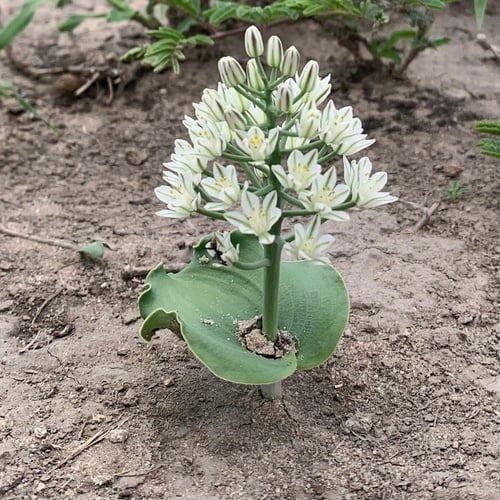
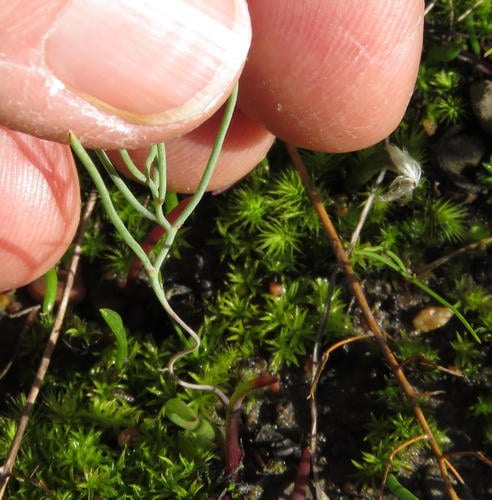
Protasparagus racemosus
Willd.
Native Asparagus, Asparagus fern
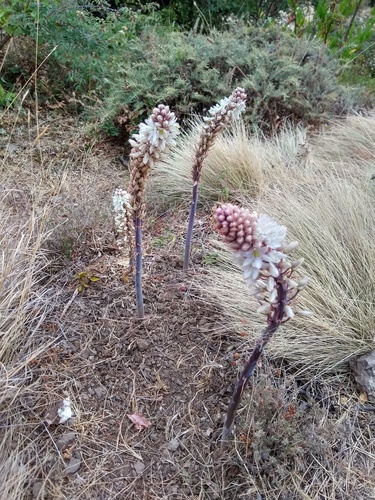
iNaturalist· cc-by-nc
(c) Shiwalee Samant, some rights reserved (CC BY-NC)
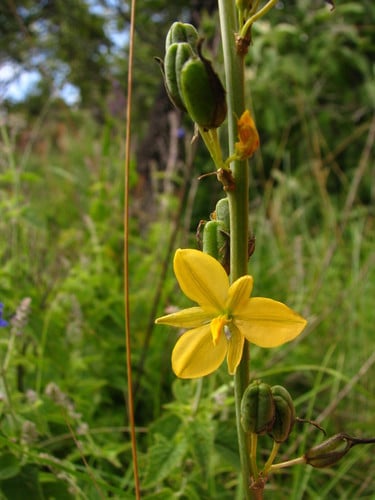
iNaturalist· cc-by-nc
(c) Shiwalee Samant, some rights reserved (CC BY-NC)
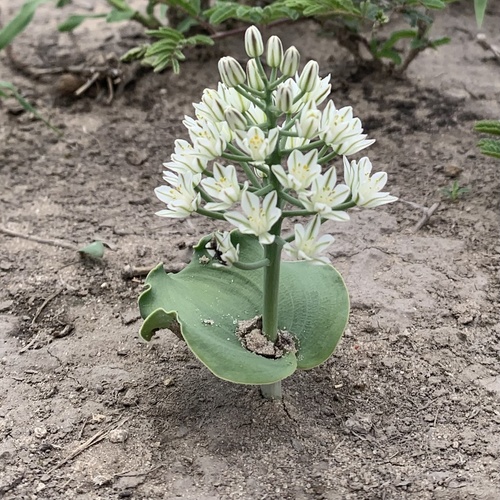
iNaturalist· cc-by-nc
(c) Shiwalee Samant, some rights reserved (CC BY-NC)
Description
A straggling shrub. The roots and underground stems produce fleshy tubers at their ends. The stems are climbing. It has many branches. It is slender and about 1.5 m high. The shoots are covered with spines which curve backwards. They are 1.5-2 cm long on the main stem and smaller on the branches. The stem is leaf like and flattened. It normally has ridges or lines along it. They are curved and with a channel beneath. The flowers are small and white. They have a smell and contain both sexes. The fruit is a berry and round.
Edible Uses
The young shoots are cooked as a vegetable, and the fleshy roots are eaten as a vegetable or candied.
Traditional Uses
The young shoots are cooked as a vegetable. The roots are also eaten as a vegetable. They are candied.
This uses section is brief — help expand it
Known Hazards
It is damaged by frost.
Distribution
A tropical plant. It occurs throughout Nepal from 300-2200 m high. It grows in dry places. In China it grows in broad leafed forest between 2100-2200 m altitude. It grows in rocky and gravely forests. It is drought tolerant. It is damaged by frost. Mt Cootha Botanical Gardens.
Where It Grows
Africa, Asia, Australia, Bhutan, Cambodia, China, East Africa, East Timor, Ethiopia, Himalayas, India, Indochina, Indonesia, Malaysia, Myanmar, Nepal, Northeastern India, Pakistan, SE Asia, Sikkim, Sri Lanka, Sudan, Thailand, Timor-Leste,
Cultivation
It is grown from seed or by dividing the roots.
Synonyms
Also Known As
Chadiu, Challagadda, Chang ci tian men dong, Chuang-khrua, Kuril, Majjige-gadde, Me:m sa:m so'b, Niesie saub, Phaknam, Pilli-telagu, Samsip, Samsit, Sangga langit, Satabari, Satamuli, Satavar, Satavari, Satawar, Satawari, Satawarmul, Seriti, Shatavali, Shimao-shadavari, Skikirie
References (23)
- Ambasta S.P. (Ed.), 2000, The Useful Plants of India. CSIR India. p 59
- Bodkin, F., 1991, Encyclopedia Botanica. Cornstalk publishing, p 109
- Brown, D., 2002, The Royal Horticultural Society encyclopedia of Herbs and their uses. DK Books. p 134
- Burkill, I.H., 1966, A Dictionary of the Economic Products of the Malay Peninsula. Ministry of Agriculture and Cooperatives, Kuala Lumpur, Malaysia. Vol 1 (A-H) p 264
- Chen Xinqi, Liang Songyun, Xu Jiemei, Tamura M.N., Liliaceae. Flora of China. p 141
Show all 23 references Hide references
- Cooper, W. and Cooper, W., 2004, Fruits of the Australian Tropical Rainforest. Nokomis Editions, Victoria, Australia. p 78
- Elliot, W.R., & Jones, D.L., 1982, Encyclopedia of Australian Plants suitable for cultivation. Vol 2. Lothian. p 238
- GUPTA;
- GUPTA & KANODIA,
- Hedrick, U.P., 1919, (Ed.), Sturtevant's edible plants of the world. p 81
- Jardin, C., 1970, List of Foods Used In Africa, FAO Nutrition Information Document Series No 2.p 57
- Jones, D.L. & Gray, B., 1977, Australian Climbing Plants. Reed. p 76
- Manandhar, N.P., 2002, Plants and People of Nepal. Timber Press. Portland, Oregon. p 100
- Martin, F.W. & Ruberte, R.M., 1979, Edible Leaves of the Tropics. Antillian College Press, Mayaguez, Puerto Rico. p 202
- Molla, A., Ethiopian Plant Names. http://www.ethiopic.com/aplants.htm (As Asparagus racemosus)
- Morley, B.D., & Toelken, H.R., (Eds), 1983, Flowering Plants in Australia. Rigby. p 329
- Paczkowska, G. & Chapman, A.R., 2000, The Western Australian Flora. A Descriptive Catalogue. Western Australian Herbarium. p 37
- Plants for a Future database, The Field, Penpol, Lostwithiel, Cornwall, PL22 0NG, UK. http://www.scs.leeds.ac.uk/pfaf/
- PROSEA handbook Volume 9 Plants yielding non-seed carbohydrates. p168
- SAXENA;
- SHANKARNARAYAN & SAXENA.
- Singh, H.B., Arora R.K.,1978, Wild edible Plants of India. Indian Council of Agricultural Research, New Delhi. p11
- Sp. pl. 2(1):152. 1799