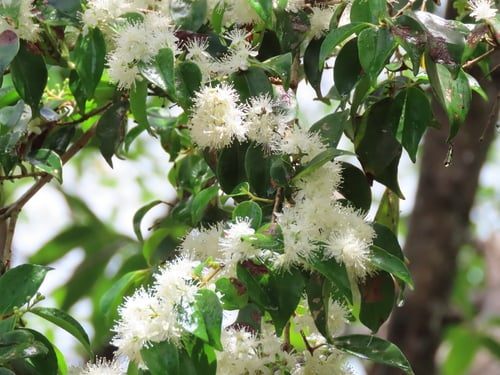
Eugenia patrisii
Vahl
Fox cherry, Turtle cherry, Turtle berry
iNaturalist· cc-by-nc
(c) Sébastien SANT, some rights reserved (CC BY-NC), uploaded by Sébastien SANT
iNaturalist· cc-by-nc
(c) Raissa Reis, some rights reserved (CC BY-NC)
Description
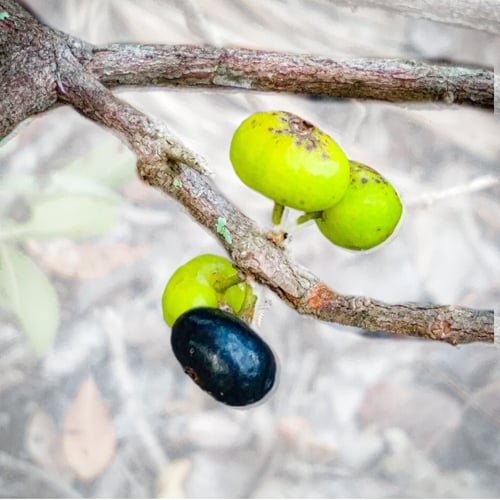
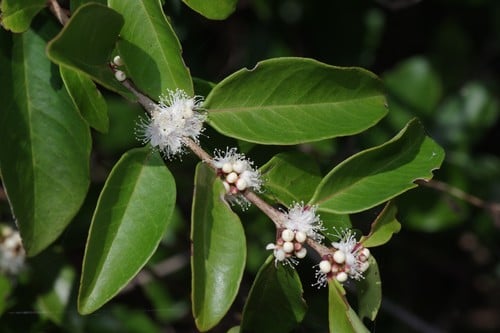
A small evergreen tree. It grows 5-7 m high. It can be 15 m high. Young branches are hairy. The leaves are papery. They are smooth above but slightly hairy underneath. They are 4-6 cm long. The leaf stalk has a groove along it. The flowers are in groups in or near the axils of leaves. The flowers are white. The fruit is round and 1-3 cm across. It has a thin skin and thick pulp. The pulp is edible. There are 1-3 seeds.
Edible Uses
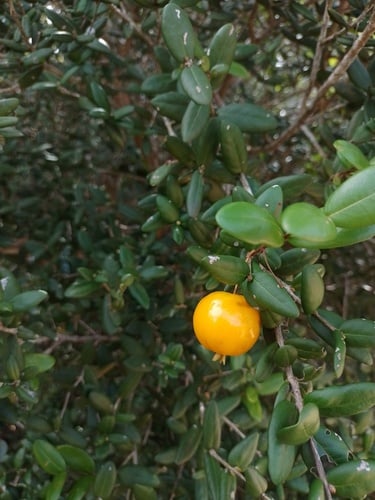
Fruit - raw and made into jellies and ice cream. The thin-skinned fruit has a thick, succulent, juicy pulp with a pleasant, aromatic, bittersweet flavour. Very tasty, children are very fond of them. The red, globose to pear-shaped fruits are around 15 - 40mm in diameter.
Traditional Uses
The fruit are eaten raw. They are also used for jellies and icecream.
This uses section is brief — help expand it
Medicinal Uses
A tea of the leaves, twigs and fruits is used as a remedy for repeated coughs and other respiratory problems.
Distribution
It is a tropical plant. It grows naturally along the Amazon near black rivers.
Where It Grows
Amazon, Bolivia, Brazil*, Colombia, Ecuador, Guiana, Guianas, Guyana, Mexico, Peru, South America, Suriname, Venezuela,
Cultivation
Plants are grown from seed. The seeds are collected from ripe fruit and the pulp removed. Seeds need to be planted fresh. Seedlings emerge in 30-40 days.
Propagation
Seed - best sown as soon as it s ripe in a semi-shaded position. A germination rate of around 50% can be expected, with the seeds sprouting within 30 - 40 days.
Other Uses
The yellow wood is fine-textured, straight-grained, moderately heavy, extremely strong and hard to cut, with good resistance to wood-eating organisms. It is used to make tool handles, cotton spindles, agricultural implements etc. The wood is used for fuel and to make charcoal.
Production
Plants are grown slowly.
Other Information
A popular fruit. It is a cultivated plant.
Notes
There are about 550 Eugenia species. They are mostly in tropical and subtropical South America.
Synonyms
Also Known As
Cambui, Hichu, Hitchu, Kuwapitsyano, Majako shodo, Pendanga, Pendango, Pi kam mere, Sacha guayaba, Ubaia, Waku ahuka
References (24)
- Eclog. amer. 2:35. 1798
- Fouqué, A., 1972, Espèces fruitières d'Amérique tropicale. Institut français de recherches fruitierès outre-mer
- Grandtner, M. M. & Chevrette, J., 2013, Dictionary of Trees, Volume 2: South America: Nomenclature, Taxonomy and Ecology. Academic Press p 241
- Grenand, P., 1992, The Use and Cultural Significance of the Secondary Forest Among the Wayapi Indians. ORSTOM. In Sustainable Harvesting and Marketing of Rainforest Products. Island Press. Washington. p 32
- Hedrick, U.P., 1919, (Ed.), Sturtevant's edible plants of the world. p 297 (As Eugenia inocarpa)
Show all 24 references Hide references
- INFOODSUpdatedFGU-list.xls
- Johnson, M. and Colquhoun, A., 1996, Preliminary Ethnobotanical Survey of Kurupukari: An Amerindian Settlement of Central Guyana. Economic Botany, Vol. 50, No. 2, pp. 182-194
- Kermath, B. M., et al, 2014, Food Plants in the Americas: A survey of the domesticated, cultivated and wild plants used for Human food in North, Central and South America and the Caribbean. On line draft. p 357
- Lopez-Diago, D. & Garcia, N., 2021, Wild edible fruits of Colombia. Biota ColomBiana 22 (2) p 44
- Lorenzi, H., Bacher, L., Lacerda, M. & Sartori, S., 2006, Brazilian Fruits & Cultivated Exotics. Sao Paulo, Instituto Plantarum de Estuados da Flora Ltda. p 208
- Lorenzi, H., 2009, Brazilian Trees. A Guide to the Identification and Cultivation of Brazilian Native Trees. Instituto Plantarum de Estuados da Flora Ltda. Vol. 3 p 249
- Maas, P.J. M., Non-timber forest products of the North-West District of Guyana. Part 1. Nationaal Herbarium Nederland, Universiteit Utrecht.
- Maas, P.J. M., Non-Timber Forest Products of the North-West District of Guyana Part 2. The 85 most important NTFP species. p 90
- Martin, F.W., C.W. Campbell and R.M. Ruberté, 1987, Perennial edible fruits of the tropics - An inventory. United States Department of Agriculture, Agricultural Research Service, Agriculture Handbook No. 642. Washington, D.C., USA (As Eugenia inocarpa)
- NYBG herbarium "edible"
- Omawale, 1973, Guyana's edible plants. Guyana University, Georgetown p 53
- Paz, F. S., et al, 2021, Edible Fruit Plant Species in the Amazon Forest Rely Mostly on Bees and Beetles as Pollinators. Journal of Economic Entomology, XX(XX), 2021, 1–13
- Poset, D. A., 2002, Kayapo Ethnoecology and Culture. Routledge
- Roa, J. A. G. & Boada, D. S. G., 2018, Fundación para el Fortalecimiento de la Fruticultura y Plantas Alimenticias no Convencionales en Colombia.
- Segura, S., et al, 2018, The edible fruit species in Mexico. Genet Resour Crop Evol (2018) 65:1767–1793
- Spichiger, R., et al, 1990, Contribucion a la Flora de la Amazonia Peruana. Boissiera 44. p 277
- TodaFruta.com.br
- van Roosmalen, M.G.M., 1985, Fruits of the Guianan Flora. Utrecht Univ. & Wageningen Univ. p 324
- Villachica, H., (Ed.), 1996, Frutales Y hortalizas promisorios de la Amazonia. FAO, Lima. p 241