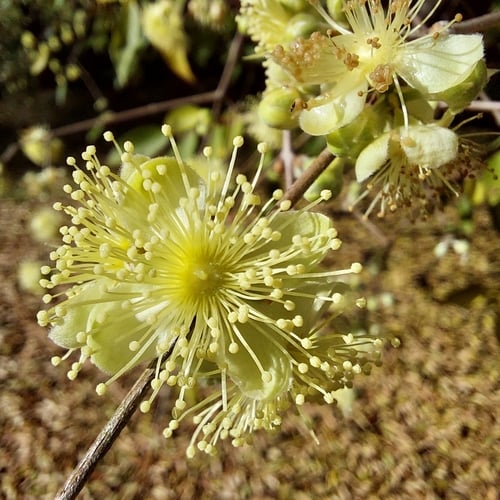
Syzygium owariense
(P. Beauv.) Benth.
Swamp waterberry
iNaturalist· cc-by-nc-sa
(c) Marco Schmidt, some rights reserved (CC BY-NC-SA), uploaded by Marco Schmidt
iNaturalist· cc-by-nc-sa
(c) Marco Schmidt, some rights reserved (CC BY-NC-SA)
Description
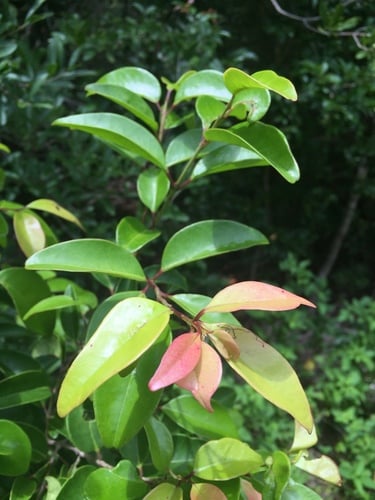
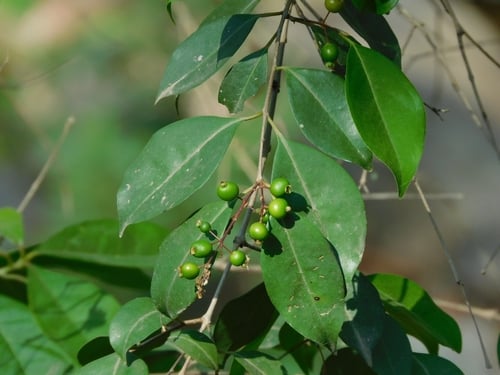
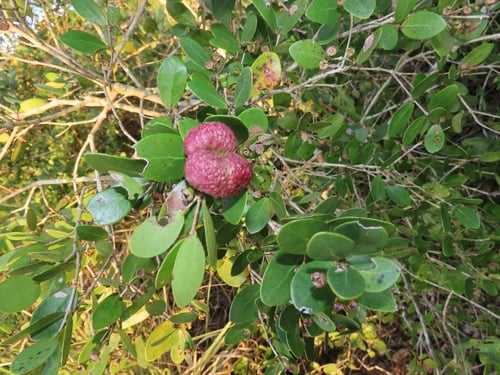
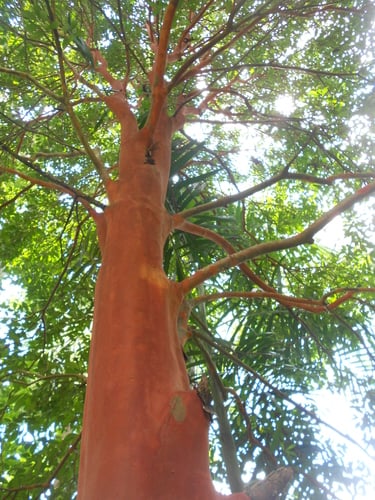
A semi-deciduous tree. It grows up to 8-17 m tall. It has stilt roots. It has branches that point upwards into a bushy crown. The bark is grey and changes from smooth to rough with age. The leaves occur opposite one another along the branch. They are blue-green and thick and leathery. They are about 10 cm long and shiny. The leaf tapers to a long blunt point. The leaf stalk is pink-red and the midrib is pink-yellow on top but clear underneath. The leaf has a smell when crushed. The flowers are creamy white coloured and with many stamens. The flowers have a sweet smell. The flower clusters are up to 15 cm across. They occur on angular square stalks. The fruit is oblong and fleshy. It is about 1.5 cm long by 1 cm wide. The fruit is green at first but becomes purple to black when ripe. The fruit has one seed.
Edible Uses
The ripe fruit are eaten raw with the seed discarded. The leaves and fruit contain eugenol, which is used as a flavouring in food.
Traditional Uses
Leaves and fruit contain the oil eugenol used for flavouring food. The ripe fruit are eaten raw. The seeds are discarded.
This uses section is brief — help expand it
Medicinal Uses
The leaves and fruit contain eugenol, traditionally used for flavouring applications.
Distribution
It is a tropical plant. It grows in swamp forest often not far from the sea. It is most commonly along stream banks. It occurs in southern Africa and in west Africa. It grows at higher altitudes.
Where It Grows
Africa, Benin, Cameroon, Central Africa, Congo, Côte d'Ivoire, East Africa, Ghana, Ivory Coast, Liberia, Malawi, Mozambique, Niger, Nigeria, Senegal, Sierra Leone, Southern Africa, Tanzania, Togo, Uganda, West Africa, Zambia, Zimbabwe,
Cultivation
It can be grown from fresh seed. Seed only remains viable for one day. They can be put in pots then transplanted or planted directly in their final site. Seeds germinate well and within about 30 days. There are 400 seeds per kg.
Propagation
Seed - best sown as soon as it is ripe.
Other Uses
A purple dye is obtained from the fruits. The wood is used to make spoons. The wood is used for fuel.
Production
Fruit are collected at the end of the rainy season and into the early dry season.
Synonyms
Also Known As
Cisombo, Ihugu, Katope, Katubwi, Luwamba, Mafuwa, Malmoa, Mfowo, Mpambwesu, Musu, Muwuwu, Ori-odo, Wurum
References (17)
- Abbiw, D.K., 1990, Useful Plants of Ghana. West African uses of wild and cultivated plants. Intermediate Technology Publications and the Royal Botanic Gardens, Kew. p 48
- Burkill, H. M., 1985, The useful plants of west tropical Africa, Vol. 4. Kew.
- Campbell, B. (Ed.), 1996, The Miombo in Transition: Woodlands and Welfare in Africa. CIFOR p 105
- Flora Zambesiaca. http://apps.kew.org/efloras
- Fowler, D. G., 2007, Zambian Plants: Their Vernacular Names and Uses. Kew. p 50
Show all 17 references Hide references
- Fox, F. W. & Young, M. E. N., 1982, Food from the Veld. Delta Books. p 277
- J. D. Hooker & G. Bentham in W. J. Hooker, Niger Fl. 359. 1849
- Jardin, C., 1970, List of Foods Used In Africa, FAO Nutrition Information Document Series No 2.p 164
- JSTOR Global Plants edible
- Katende, A.B., Birnie, A & Tengnas B., 1995, Useful Trees and Shrubs for Uganda. Identification, Propagation and Management for Agricultural and Pastoral Communities. Technical handbook No 10. Regional Soil Conservation Unit, Nairobi, Kenya. p 606
- Keay, R.W.J., 1989, Trees of Nigeria. Claredon Press, Oxford. p 76
- Mbuya, L.P., Msanga, H.P., Ruffo, C.K., Birnie, A & Tengnas, B., 1994, Useful Trees and Shrubs for Tanzania. Regional Soil Conservation Unit. Technical Handbook No 6. p 468
- Peters, C. R., O'Brien, E. M., and Drummond, R.B., 1992, Edible Wild plants of Sub-saharan Africa. Kew. p 154
- Ruffo, C. K., Birnie, A. & Tengnas, B., 2002, Edible Wild Plants of Tanzania. RELMA p 652
- White, F., Dowsett-Lemaire, F. and Chapman, J. D., 2001, Evergreen Forest Flora of Malawi. Kew. p 414
- Williamson, J., 2005, Useful Plants of Malawi. 3rd. Edition. Mdadzi Book Trust. p 241
- World Checklist of Useful Plant Species 2020. Royal Botanic Gardens, Kew