Grewia lasiocarpa
E. Mey. ex Harv.
Forest raisin
iNaturalist· cc-by-nc
(c) Peter Vos, some rights reserved (CC BY-NC), uploaded by Peter Vos
iNaturalist· cc-by
(c) Presha Soogrim (she/they), some rights reserved (CC BY)
iNaturalist· cc-by
(c) Presha Soogrim (she/they), some rights reserved (CC BY)
Description
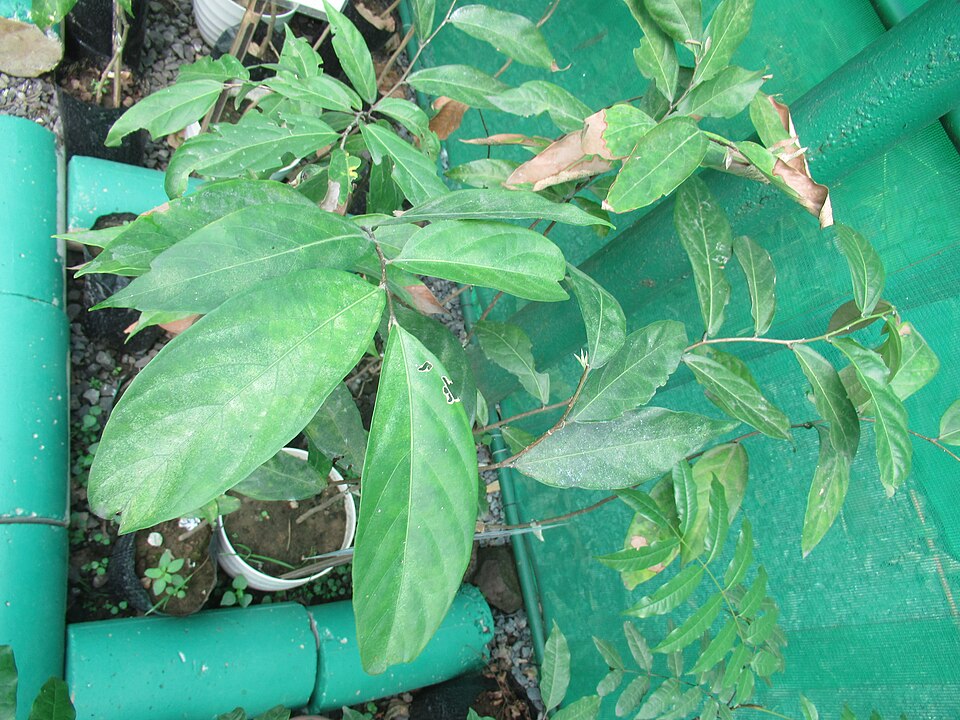
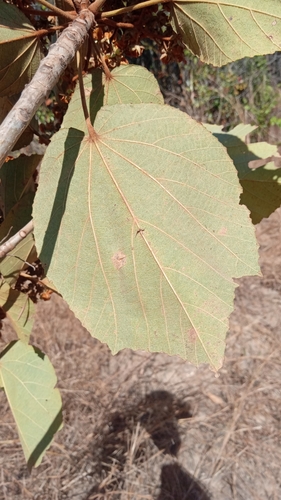
A straggling shrub. It grows to 3-5 m tall. The bark is smooth and grey. The leaves are large and almost round. They have hairs on the surface. The flowers are star shaped and pink. The fruit have 4 lobes and are red. They turn black when ripe.
Edible Uses
The ripe fruit are eaten raw.
Traditional Uses
The fruit are eaten raw.
This uses section is brief — help expand it
Distribution
It is a subtropical to Mediterranean climate plant. It grows on the edges of evergreen forest. In South Africa it grows between 5-1,220 m above sea level. It can tolerate frost. It is best with high rianfall.
Where It Grows
Africa, South Africa*, Southern Africa,
Cultivation
Seeds that have passed through animals germinate easily. Plants can be grown from seed. Seeds germinate in 4-6 weeks. It can also be grown from hardwood cuttings.
Production
It is fast growing.
Notes
There are about 200 Grewia species. They are mostly tropical. The fruit of most may be edible. These were in the Sparrmanniaceae and the Tiliaceae.
Also Known As
Bosrosyntjie, Ilalanyathi, Umhlolo
References (5)
- FAO, 1988, Traditional Food Plants, FAO Food and Nutrition Paper 42. FAO Rome p 310
- Fox, F. W. & Young, M. E. N., 1982, Food from the Veld. Delta Books. p 355
- W. H. Harvey & O. W. Sonder, Fl. cap. 1:226. 1860
- Ruiters-Welcome, A. K., 2019, Food plants of southern Africa. Ph.D. thesis. Univ. of Johannesburg p 76
- Welcome, A. K. & Van Wyk, B.-E., 2019, An inventory and analysis of the food plants of southern Africa. South African Journal of Botany 122 (2019) 136–179