Ficus natalensis
Hochst.
Bark cloth fig, Natal fig
iNaturalist· cc-by
(c) Alan Manson, some rights reserved (CC BY), uploaded by Alan Manson
iNaturalist· cc-by-nc
(c) tracythebushbaby, some rights reserved (CC BY-NC), uploaded by tracythebushbaby
iNaturalist· cc-by-nc
(c) magdastlucia, some rights reserved (CC BY-NC), uploaded by magdastlucia
Summary
Source: WikipediaFicus natalensis is a tree in the family Moraceae. It is commonly known as the natal fig in South Africa. In central and western Uganda, where it has an important cultural value, it is known as omutuba to the Baganda people and omutoma to the Banyakitara peoples. In English is sometimes referred as barkcloth fig. It is commonly mistaken for its cousin the Ficus thonningii also known as mugumo to the Agikuyu. These trees are distributed from north-eastern South Africa to Uganda and Kenya. It is a popular species to cultivate as bonsai due to its fast growth and hardy nature. The bark of the tree is harvested, without harming the tree, to make barkcloth. Artisans incorporate this fabric into many modern uses, including fashion, accessories, housewares, interior design, and art. The bark of F. natalensis has exhibited potent antimicrobial activity against methicillin resistant Staphylococcus aureus (MRSA) in vitro. Mutuba trees can be harvested annually for up to 40 years, yielding up to 200 m2 of cloth individually.
Description
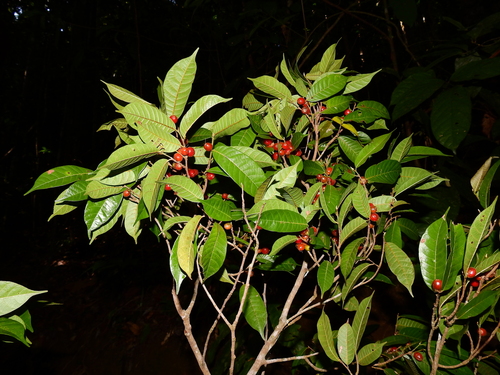
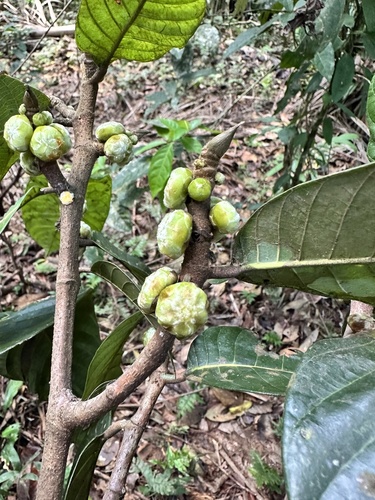
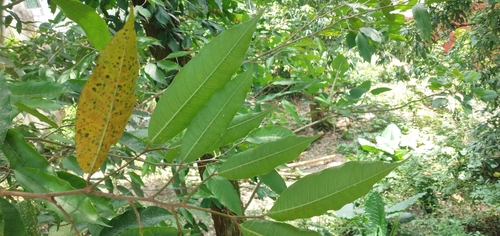
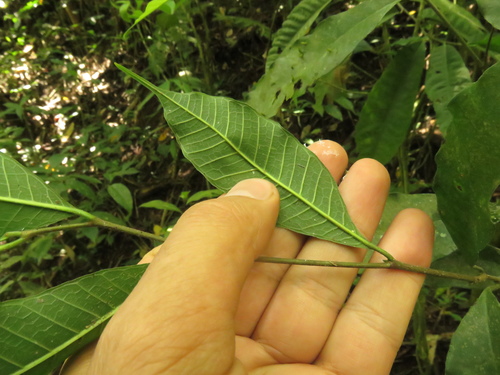
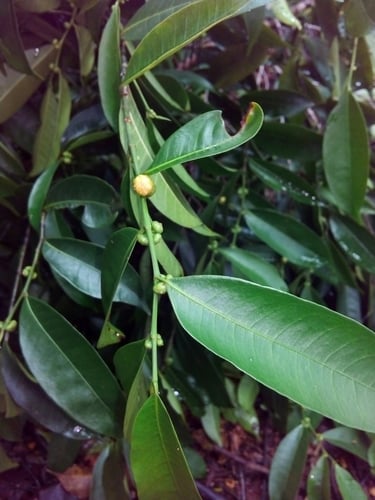
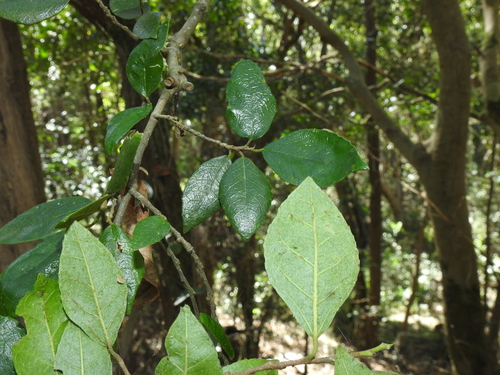
A fig. It is an evergreen tree. It can be a shrub or a strangler. It lives off other plants. It grows up to 8-30 m tall. It can spread 15 m wide. The leaves vary a lot in shape. They are often thick, leathery and triangle shaped. They are 3-9 cm long by 1-4 cm wide. They occur in rings like a four leaf clover. The leaf tip is blunt. The fig fruit are 1.5 cm across. They are rusty brown.
Edible Uses
The small fig fruits are eaten as dessert fruit, particularly by children.
Traditional Uses
The fruit are eaten as dessert fruit.
This uses section is brief — help expand it
Medicinal Uses
The bark is used as medicine for whooping cough, influenza and to induce lactation.
Distribution
A tropical plant. It grows in rocky situations. It grows in tropical and Southern Africa. It grows in areas with a high water-table. It grows between 10-2,200 m above sea level. It grows in areas with an annual rainfall between 600-800 mm. It can grow in arid places. It grows in Miombo woodland in Africa. It suits hardiness zones 10-12.
Where It Grows
Africa, Angola, Asia, Australia, Botswana, Burkina Faso, Cameroon, Central Africa, Congo DR, East Africa, Equatorial Guinea, Eswatini, Gabon, Ghana, Guinea, Guinée, India, Kenya, Malawi, Mozambique, Nigeria, Rwanda, Senegal, Sierra Leone, South Africa, Southern Africa, Sudan, Swaziland, Tanzania, Uganda, West Africa, Zambia, Zimbabwe,
Cultivation
It is grown from seeds. The figs need to be crushed to release the seeds. It can be grown as a hedge. There are 6 pollinator wasp species.
Other Uses
A fibre is obtained from the bark It is used to make cloth, paper and as material for the bookbinder. The bark is used to make bark cloth. For this purpose the trunk is stripped to a height of 2.5 - 3 metres according to the height at which the branches fork. The stripped trunk is smeared with cow-dung and wrapped round with plaintain leaves - a new bark soon forms which is ready to be used for bark cloth within 12 months. The third and fourth barks thus obtained are considered the finest in quality, though the tree might yield up to eight or more barks. The thin outer bark is scraped off the inner bark and discarded. The inner bark is left during the night to dry, and any soft, pulpy substance is scraped off the inside. The strips of bark, which are some 120 - 180cm long and 45cm wide, are laid on a log with a flattened surface and beaten with a mallet until they are the thickness of strong brown paper, by which time they will be 180 - 270cm long and 120cm wide. It is then spread out in the sun to dry, the exposure to light giving the upper surface a tint somewhat like terra-cotta, while the underside is of a lighter shade. Any holes or flaws in the cloth are cut into neat squares and patched with pieces taken from the edges so deftly that in a well-made bark-cloth they are not noticeable. These cloths are usually made up into sheets 2.4 metres square, two lengths being stitched together and pressed in such a manner that the seam is not seen when the cloth is being worn. Strips of fibre from the dry plantain stem are used for thread. The plant (subspecies leprieurii) is grown as a living fence. The tree is often cultivated as a shade tree in coffee plantations in west and south Africa.
Production
It grows quickly.
Other Information
The fruit are especially eaten by children.
Notes
There are about 800-1000 Ficus species. They are mostly in the tropics. There are 120 Ficus species in tropical America.
Nutrition
| Part | Moisture | kJ | kcal | Protein | Vit A | Vit C | Iron | Zinc |
|---|---|---|---|---|---|---|---|---|
| Fruit | 87.1 | — | — | 8.3 | — | — | — | — |
Synonyms
Also Known As
Ecalonyi, Idotsi, Inkiwane, Kachere, Kiditi, Kituba, Mugaire, Mugumo, Mutsamvi, Mutuba, Natal fig, Natalvy, Seepei, Triangle-leaf fig, Utambe, Xilaphane
References (34)
- Acipa, A. et al, 2013, Nutritional Profile of some Selected Food Plants of Otwal and Ngai Counties, Oyam District, Northern Uganda. African Journal or Food, Agriculture, Nutrition and Development. 13(2)
- Barwick, M., 2004, Tropical and Subtropical Trees. A Worldwide Encyclopedic Guide. Thames and Hudson p 185
- Bunderson, W. T. et al, 2002, Common Agroforestry Species in Malawi. Malawi Agroforestry Extension Project, Pubication No. 46, Lilongwe. p 40
- Cundall, P., (ed.), 2004, Gardening Australia: flora: the gardener's bible. ABC Books. p 603
- Dharani, N., 2002, Field Guide to common Trees & Shrubs of East Africa. Struik. p 110
Show all 34 references Hide references
- Etherington, K., & Imwold, D., (Eds), 2001, Botanica's Trees & Shrubs. The illustrated A-Z of over 8500 trees and shrubs. Random House, Australia. p 328
- FAO, 1988, Traditional Food Plants, FAO Food and Nutrition Paper 42. FAO Rome p 283
- Flora 28:88. 1845
- Fowler, D. G., 2007, Zambian Plants: Their Vernacular Names and Uses. Kew. p 49
- Hibbert, M., 2002, The Aussie Plant Finder 2002, Florilegium. p 102
- Ichikawa, M., 1980, The Utilization of Wild Food Plants by the Suiei Dorobo in Northern Kenya. J. Anthrop. Soc. Nippon. 88(1): 25-48
- Krishen P., 2006, Trees of Delhi, A Field Guide. DK Books. p 136 (subsp. leprieurii)
- Long, C., 2005, Swaziland's Flora - siSwati names and Uses http://www.sntc.org.sz/flora/
- Magwede, K., van Wyk, B.-E., & van Wyk, A. E., 2019, An inventory of Vhavenḓa useful plants. South African Journal of Botany 122 (2019) 57–89
- Maroyi, A., 2011, The Gathering and Consumption of Wild Edible Plants in Nhema Communal Area, Midlands Province, Zimbabwe. Ecology of Food and Nutrition 50:6, 506-525
- Maroyi, A. & Cheikhyoussef, A., 2017, Traditional knowledge of wild edible fruit in southern Africa: A comparative use patterns in Namibia and Zimbabwe. Indian Journal of Traditional Knowledge. 16(3): 385-392
- Masters, T., 2021, Traditional food plants of the upper Aswa River catchment of northern Uganda—a cultural crossroads. Journal of Ethnobiology and Ethnomedicine (2021) 17:24
- Maundu, P. et al, 1999, Traditional Food Plants of Kenya. National Museum of Kenya. 288p
- Mutie, F. M., et al, 2023, Important Medicinal and Food Taxa (Orders and Families) in Kenya, Based on Three Quantitative Approaches. Plants 2023, 12, 1145
- Ojelel, S. & Kakudidi, E. K., 2015, Wild edible plant species utilized by a subsistence farming community in the Obalanga sub-county, Amuria district, Uganda. Journal of Ethnobiology and Ethnomedicine. 11:7
- Ojelel, S., et al, 2019, Wild edible plants used by communities in and around selected forest reserves of Teso-Karamoja region, Uganda. Journal of Ethnobiology and Ethnomedicine (2019) 15:3
- Palgrave, K.C., 1996, Trees of Southern Africa. Struik Publishers. p 111
- Royal Botanic Gardens, Kew (1999). Survey of Economic Plants for Arid and Semi-Arid Lands (SEPASAL) database. Published on the Internet; http://www.rbgkew.org.uk/ceb/sepasal/internet [Accessed 4th May 2011]
- Ruiters-Welcome, A. K., 2019, Food plants of southern Africa. Ph.D. thesis. Univ. of Johannesburg p 79
- Schmidt, E., Lotter, M., & McCleland, W., 2007, Trees and shrubs of Mpumalanga and Kruger National Park. Jacana Media p 80
- Swaziland's Flora Database http://www.sntc.org.sz/flora
- van Wyk, B, van Wyk, P, and van Wyk B., 2000, Photographic guide to Trees of Southern Africa. Briza. p 154
- von Katja Rembold, 2011, Conservation status of the vascular plants in East African rain forests. Dissertation Universitat Koblenz-Landau p 166
- Welcome, A. K. & Van Wyk, B.-E., 2019, An inventory and analysis of the food plants of southern Africa. South African Journal of Botany 122 (2019) 136–179
- Williamson, J., 2005, Useful Plants of Malawi. 3rd. Edition. Mdadzi Book Trust. p 117
- Wilson, A. L. & Downs, C. T., 2012, Fruit nutritional composition and non-nutritive traits of indigenous South African tree species. South African Journal of Botany. 78:30-36
- World Checklist of Useful Plant Species 2020. Royal Botanic Gardens, Kew
- www.figweb.org
- www.zimbabweflora.co.zw 2011