Dipcadi longifolium
(Lindl.) Baker
iNaturalist· cc-by-nc-nd
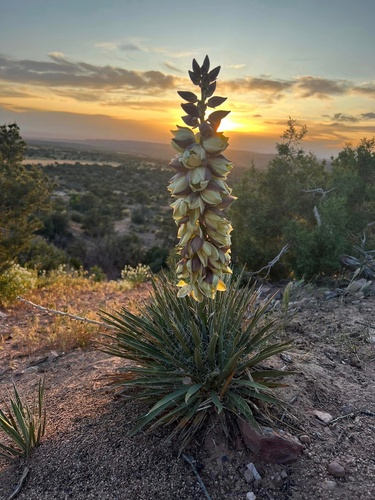
(c) David Gwynne-Evans, some rights reserved (CC BY-NC-ND), uploaded by David Gwynne-Evans
iNaturalist· cc-by-nc
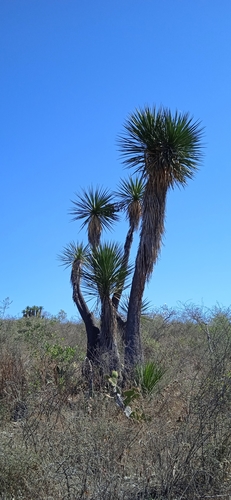
(c) Nick Helme, some rights reserved (CC BY-NC)
Description
A bulb herb. The leaves are twisted. It grows 20-90 cm high. The bulb is 1-4 cm across. There are 2-7 leaves. They are narrow and 75 cm long by 3-9 mm wide. The flowering stalks are 60 cm high. There are 4-15 flowers They are yellowish green. The fruit is a capsule 8-15 mm long by 13018 mm wide. The seeds are 5-7 mm long.
Edible Uses
The bulbs and leaves are eaten raw after pounding.
Traditional Uses
The bulbs and leaves are eaten raw after pounding.
This uses section is brief — help expand it
Distribution
It is a tropical and subtropical plant. It grows in the savannah. In East Africa it grows between 1,000-1,350 m above sea level.
Where It Grows
Africa, Angola, Botswana, Burkina Faso, Central Africa, East Africa, Ghana, Guinea, Guinée, Guinea-Bissau, Malawi, Mozambique, Namibia, South Africa, Southern Africa, Tanzania, West Africa, Zimbabwe,
Other Information
A staple food of the Bushmen.
Notes
They have also been put in the families Hyacinthaceae and Liliaceae.
Nutrition
| Part | Moisture | kJ | kcal | Protein | Vit A | Vit C | Iron | Zinc |
|---|---|---|---|---|---|---|---|---|
| Leaves | 70.9 | 457 | 109 | 2.3 | — | 8.3 | 0.9 | 0.5 |
Synonyms
Also Known As
Enequeneque
References (9)
- FAO, 1988, Traditional Food Plants, FAO Food and Nutrition Paper 42. FAO Rome p 250
- Fox, F. W. & Young, M. E. N., 1982, Food from the Veld. Delta Books. p 250
- Heinz & Maguire, 1974,
- Lee, 1979,
- Peters, C. R., O'Brien, E. M., and Drummond, R.B., 1992, Edible Wild plants of Sub-saharan Africa. Kew. p 30
Show all 9 references Hide references
- Ruiters-Welcome, A. K., 2019, Food plants of southern Africa. Ph.D. thesis. Univ. of Johannesburg p 65
- Story, 1958,
- Wehmeyer, A. S, 1986, Edible Wild Plants of Southern Africa. Data on the Nutrient Contents of over 300 species
- Welcome, A. K. & Van Wyk, B.-E., 2019, An inventory and analysis of the food plants of southern Africa. South African Journal of Botany 122 (2019) 136–179