Dypsis pilulifera
(Becc.) Beentje
wikimedia· pd
Franz Eugen Köhler, Köhler's Medizinal-Pflanzen (via Wikimedia Commons)
Summary
Source: WikipediaDypsis pilulifera is a species of flowering plant in the family Arecaceae. It is found only in Madagascar. It is threatened by habitat loss.
Description
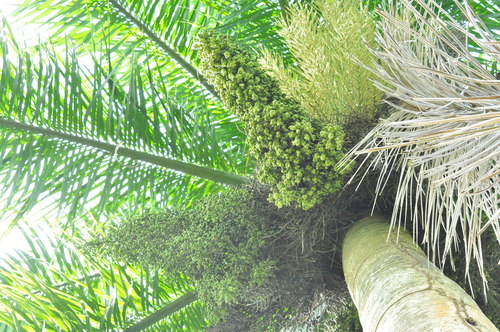
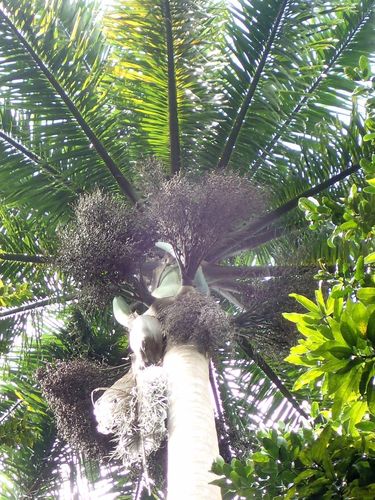
A solitary palm. It grows 8-30 m tall. The trunk is 10-40 cm across. Young parts are green and older parts are brown or dark grey. There are distinct rings of old leaf base scars. The crown-shaft is 1-1.6 m long. It bulges at the base. There are only a few leaves and they are 4-5 m long. They are spreading and slightly arching. The leaflets are deep green. They are 1-1.3 m long. They grow in widely spaced groups and hang down.
Edible Uses
Leaves - cooked. The apical bud, known as a 'palm heart', is eaten as a vegetable. Eating this bud leads to the death of the plant because it is unable to make side-shoots.
Medicinal Uses
The plant (parts not specified but probably the bark and/or the fruits) is used in the treatment of headaches, jaundice and hepatitis; and also as an aid to lactation.
Distribution
A tropical plant. It grows from 750-950 m altitude in Madagascar. It grows in rainforest. It suits humid locations. It does best in good soil and with adequate moisture. It is a tropical plant.
Where It Grows
Africa, East Africa, Madagascar*,
Cultivation
Probably not very cold tolerant. Prefers a sunny, moist, but well drained position.
Production
It grows quickly.
Notes
There are 140 Dypsis species.
Synonyms
Also Known As
Hozatanana, Lavaboko, Ovomamy, Tavila
References (6)
- Balick, M.J. and Beck, H.T., (Ed.), 1990, Useful palms of the World. A Synoptic Bibliography. Colombia p 334 (As Chrysalidocarpus paucifolius and Chrysalidocarpus pilulifera),
- Dransfield, J. & Beentje, H., 1995, The Palms of Madagascar. Royal Botanical Gardens, Kew and The International Palm Society. p 161
- Haynes, J., & McLaughlin, J., 2000, Edible palms and Their Uses. University of Florida Fact sheet MCDE-00-50-1 p 6
- Johnson, D.V., 1998, Tropical palms. Non-wood Forest products 10. FAO Rome. p 114
- Riffle, R.L. & Craft, P., 2003, An Encyclopedia of Cultivated Palms. Timber Press. p 331
Show all 6 references Hide references
- World Checklist of Useful Plant Species 2020. Royal Botanic Gardens, Kew