Arenga microcarpa
Beccari
Arenga palm, Baruk sago palm
iNaturalist· cc-by
(c) coenobita, some rights reserved (CC BY), uploaded by coenobita
iNaturalist· cc-by
(c) coenobita, some rights reserved (CC BY), uploaded by coenobita
Summary
Source: WikipediaArenga microcarpa, also known aren sagu or Sagu Baruk, is a perennial densely clumping palm native to the Moluccas and Papua New Guinea and cultivated in open lowland areas in northern Australia and Indonesia. The palm grows to 7 meters. It has dark glossy green leaves with whitish undersides and small red fruit. The Sagu Baruk palm is cultivated on the Talaud and Sangihe Islands for extraction of starch from the pith. It is reported that Sagu flour is the primary food source for 88% of the Sangihe Island population.
Description
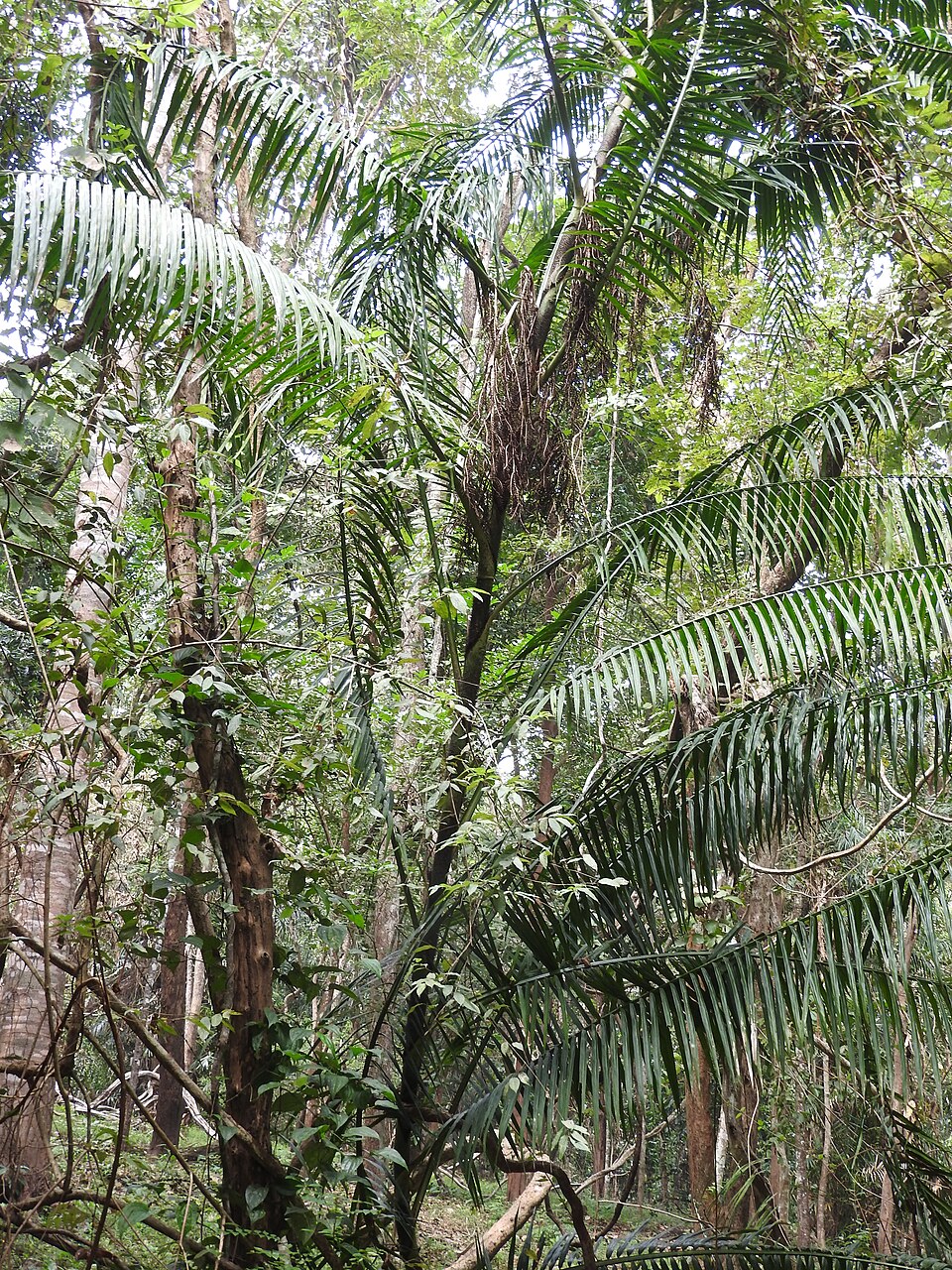
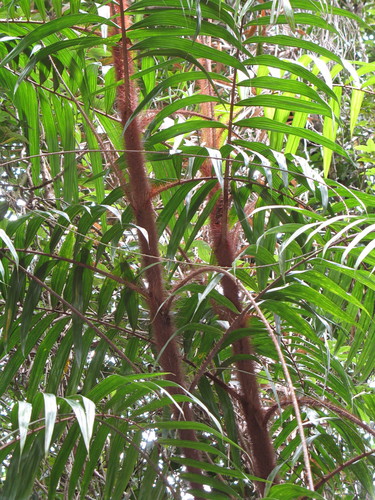
A small clumpy palm with several stems. The palm is 8 m tall and the stems are 10 cm across. It has leaves which are once branched (uni-pinnate) and with narrow, long, leaflets along the leaf stalk. The leaflets form a V shape along the midrib. The leaflet at the end is often triangular. The leaf fronds arch over. The flower stalk is like fishtail palm but smaller. This stalk is produced from among the leaves. The flower stalk is large and with simple branching. The highest flowers are female and the lower ones can be male or of both sexes. The fruit spikes hang over and are densely clustered with fruit. The fruit are red and juicy. They are 1.5 cm across. There are 2-3 seeds inside a fruit.
Edible Uses
The shoots (palm heart/cabbage) are commonly eaten. The male flowers can be tapped to collect sap, which can be boiled to concentrate the sugar. Sago starch can be extracted from the trunk.
Traditional Uses
The shoots are eaten. It is probable that the male flower could be cut off and the sap collected and boiled to concentrate the sugar. Sago starch can probably also be processed from the trunk. CAUTION The juice of the fleshy fruit irritates the skin.
Known Hazards
The juice of the fleshy fruit irritates the skin. The fruit and seeds contain stinging crystals that can be irritating and poisonous.
Distribution
A tropical plant. They are widespread and common in the lowlands of Papua New Guinea. It occurs on rocky shores and in lowland forest. It is often near streams.
Where It Grows
Asia, Australia, Indonesia*, Pacific, Papua New Guinea, PNG, SE Asia, USA,
Cultivation
They normally grow wild. Plants can be grown from seeds. They can also be grown from suckers.
Propagation
Seed - a deep root is formed before the seedling emerges above soil level, and so the seed should be sown in individual, deep containers. Pre-soak the seed for 24 hours in warm water before sowing. It can take 3 - 6 months or more before signs of growth are seen above soil level.
Other Uses
The leaves are used for thatching and wickerwork.
Other Information
A common palm used for edible shoots in several areas of Papua New Guinea.
Notes
The fruit and seeds have stinging crystals which can be irritating and poisonous. There are 17-20 Arenga species.
Synonyms
Also Known As
Aren sagu, Palem sagu baruk
References (17)
- Baker, W.J. and Dransfield, J., 2006, Field Guide to Palms of New Guinea. Kew p 54
- Barfod, A.S., Banka R., and Dowe, J. L., 2001, Field Guide to Palms in Papua New Guinea. AAU Reports 40 Department of Systematic Botany University of Aarhus. Denmark. p 36
- Borrell, O.W., 1989, An Annotated Checklist of the Flora of Kairiru Island, New Guinea. Marcellin College, Victoria Australia. p 36, 100+2,
- Checklist of NT Vascular Plant Species. January 2003.
- French, B., 1986, Food Plants of Papua New Guinea, Asia Pacific Science Foundation p 130
Show all 17 references Hide references
- Haynes, J., & McLaughlin, J., 2000, Edible palms and Their Uses. University of Florida Fact sheet MCDE-00-50-1 p 2
- Henty, E.E., 1980, Harmful Plants in Papua New Guinea. Botany Bulletin No 12. Division Botany, Lae, Papua New Guinea. p 114, Pl. 41
- Hibbert, M., 2002, The Aussie Plant Finder 2002, Florilegium. p 32
- Johnson, D.V., 1998, Tropical palms. Non-wood Forest products 10. FAO Rome. p 46, 79
- Jones, D.L., 1994, Palms throughout the World. Smithtonian Institution, Washington. p 135
- Jones, D.L., 2000, Palms of Australia 3rd edition. Reed/New Holland. p 118
- Powell, J.M., Ethnobotany. In Paijmans, K., 1976, New Guinea Vegetation. Australian National University Press. p 108
- Riffle, R.L. & Craft, P., 2003, An Encyclopedia of Cultivated Palms. Timber Press. p 259
- K. M. Schumann & U. M. Hollrung, Fl. Kais. Wilh. Land 16. 1889
- Sukarya, D. G., (Ed.) 2013, 3,500 Plant Species of the Botanic Gardens of Indonesia. LIPI p 753
- Wiersema, J. H. & Leon, B., 2013, World Economic Plants. A Standard Reference CRC Press. 2nd Ed. p 66
- World Checklist of Useful Plant Species 2020. Royal Botanic Gardens, Kew