Plectocomiopsis geminiflora
(Griff.) Becc.
Rattan palm
iNaturalist· cc-by-sa
(c) Steve Fitzgerald, some rights reserved (CC BY-SA), uploaded by Steve Fitzgerald
gbif· cc-by
Royal Botanic Gardens, Kew
iNaturalist· cc-by-nc
(c) Han-Ting Liu, some rights reserved (CC BY-NC), uploaded by Han-Ting Liu
wikimedia· cc-by
Wikimedia Commons - Paul K from Sydney, Australia
Description
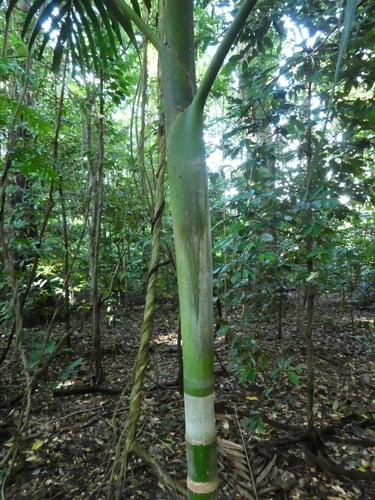
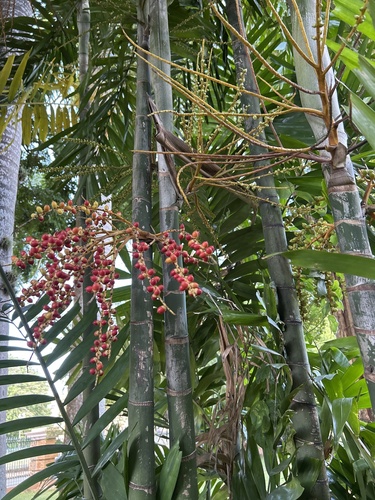
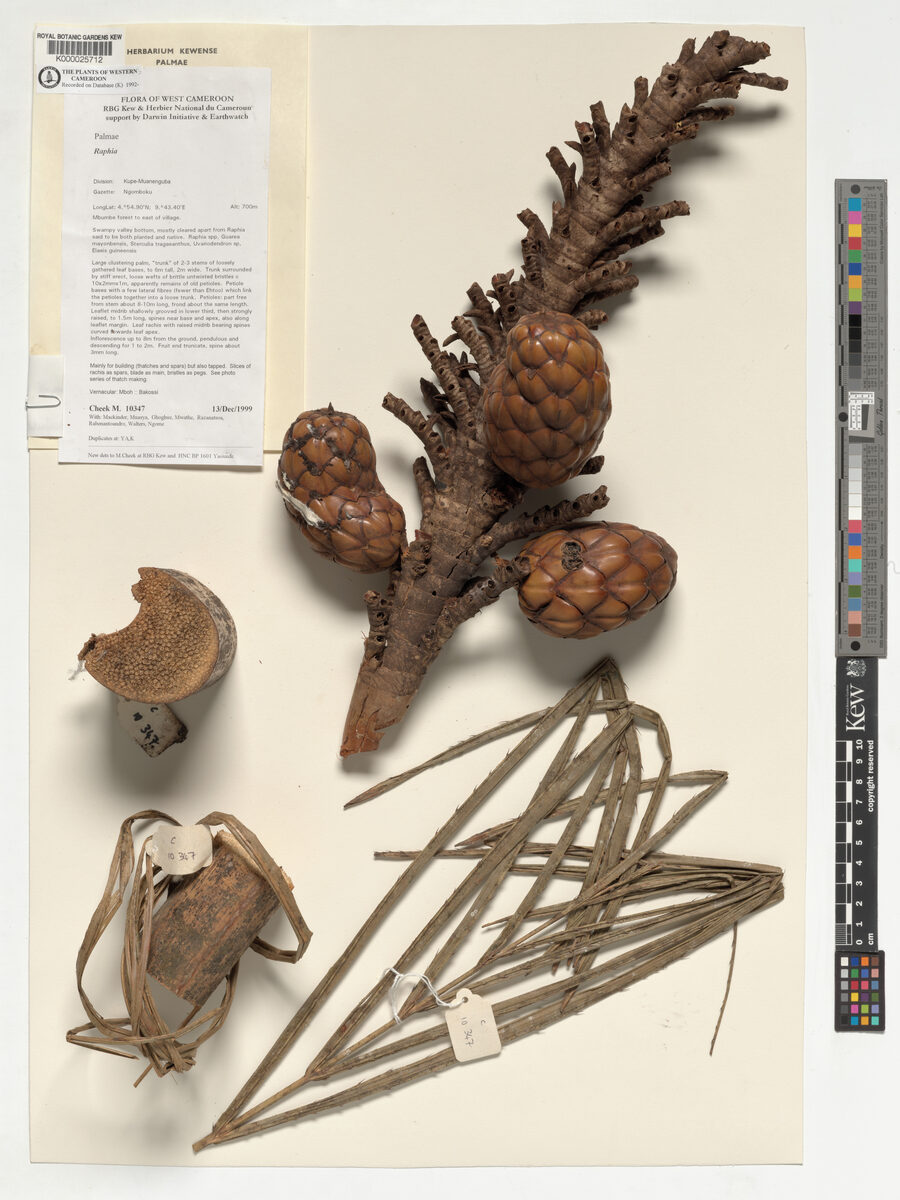
A cane or rattan. It can grow 30 m long. It has several shoots. The cane is almost triangle shaped in cross section. It has leaflets along the stalk. The stalks die after fruiting. The stems are spiny. The male and female flowers are on separate plants. They climb by a tendril. The flowering stalk grows from the end nodes of the stem. It has one thick main axis and two branches which hang down. The female plants produce fig shaped scaly fruit.
Edible Uses
The shoots are cooked and eaten as a vegetable, and are also harvested as palm heart or cabbage and sold in markets; they are bitter but enjoyed as food.
Traditional Uses
CAUTION: The fruit and seed contain alkaloids or saponins. The shoots are cooked and eaten as a vegetable.
This uses section is brief — help expand it
Medicinal Uses
The shoots and cabbage are used as edible vegetables.
Known Hazards
The apical bud has a bitter flavour. It is locally esteemed as a food in Sarawak, though in Peninsular Malaysia it is considered to be poisonous.
Distribution
A tropical plant. In Indochina it grows in evergreen forest between 200-800 m altitude.
Where It Grows
Asia, Brunei, Indochina, Indonesia, Laos, Malaysia, Myanmar, Sarawak, SE Asia, Singapore, Thailand, Vietnam,
Other Uses
The cane seems only to be used for coarse basketware and cordage. The stems are of little value, being prone to split when bent, and are used only in coarse basketry.
Other Information
The shoots or cabbage is sold in markets. It is bitter but enjoyed.
Notes
There are 5 Plectocomiopsis species.
Nutrition
| Part | Moisture | kJ | kcal | Protein | Vit A | Vit C | Iron | Zinc |
|---|---|---|---|---|---|---|---|---|
| Shoots | 90.2 | 150 | 36 | 3.7 | — | 0 | 1.3 | 21.8 |
Synonyms
Also Known As
Ambarua, Huwi puporan, Lalih, Lalis, Laris, May dot dang, Rotan lowa, Rotan pa, Rotan relang, Rotan tiga juru, Wai deng, Wai dengnoy, Wai nou, Wi laris
References (12)
- Balick, M.J. and Beck, H.T., (Ed.), 1990, Useful palms of the World. A Synoptic Bibliography. Colombia p 65
- Burkill, I.H., 1966, A Dictionary of the Economic Products of the Malay Peninsula. Ministry of Agriculture and Cooperatives, Kuala Lumpur, Malaysia. Vol 2 (I-Z) p 1800
- Chai, P. P. K. (Ed), et al, 2000, A checklist of Flora, Fauna, Food and Medicinal Plants. Lanjak Entimau Wildlife Sanctuary, Sarawak. Forestry Malaysia & ITTO. p 164, 169
- Dransfield, J., 1992, The Rattans of Sarawak, Kew. p 210
- Evans, T. D., et al, 2002, A Synopsis of the Rattans (Arecaceae: Calamoideae) of Laos and Neighbouring Parts of Indochina. Kew Bulletin, Vol. 57, No. 1 (2002), pp. 1-84
Show all 12 references Hide references
- Haynes, J., & McLaughlin, J., 2000, Edible palms and Their Uses. University of Florida Fact sheet MCDE-00-50-1 p 11
- Hoe, V. B. & Siong, K. H., 1999, The nutritional value of indigenous fruit and vegetables in Sarawak. Asia Pacific J. Clin. Nutr. 8(1):24-31
- Johnson, D.V., 1998, Tropical palms. Non-wood Forest products 10. FAO Rome. p 66
- Kulip, J., 2003, An ethnobotanical survey of medicinal and other useful plants of Muruts in Sabah, Malaysia. Telopea 10(1) p 92
- Mulyoutami, E., et al, 2009, Local knowledge and management os simpikng (forest gardens) among the Dayak people in East Kalimatan, Indonesia. Forest Ecology and Management. 257:2054-2061
- Riffle, R.L. & Craft, P., 2003, An Encyclopedia of Cultivated Palms. Timber Press. p 417
- Sang, D. T., & Mizoue, K. O. N., 2012, Use of Edible Forest Plants among Indigenous Ethnic Minorities in Cat Tien Biosphere Reserve, Vietnam. Asian Journal of Biodiversity Vol. 3 (1), p 23-49