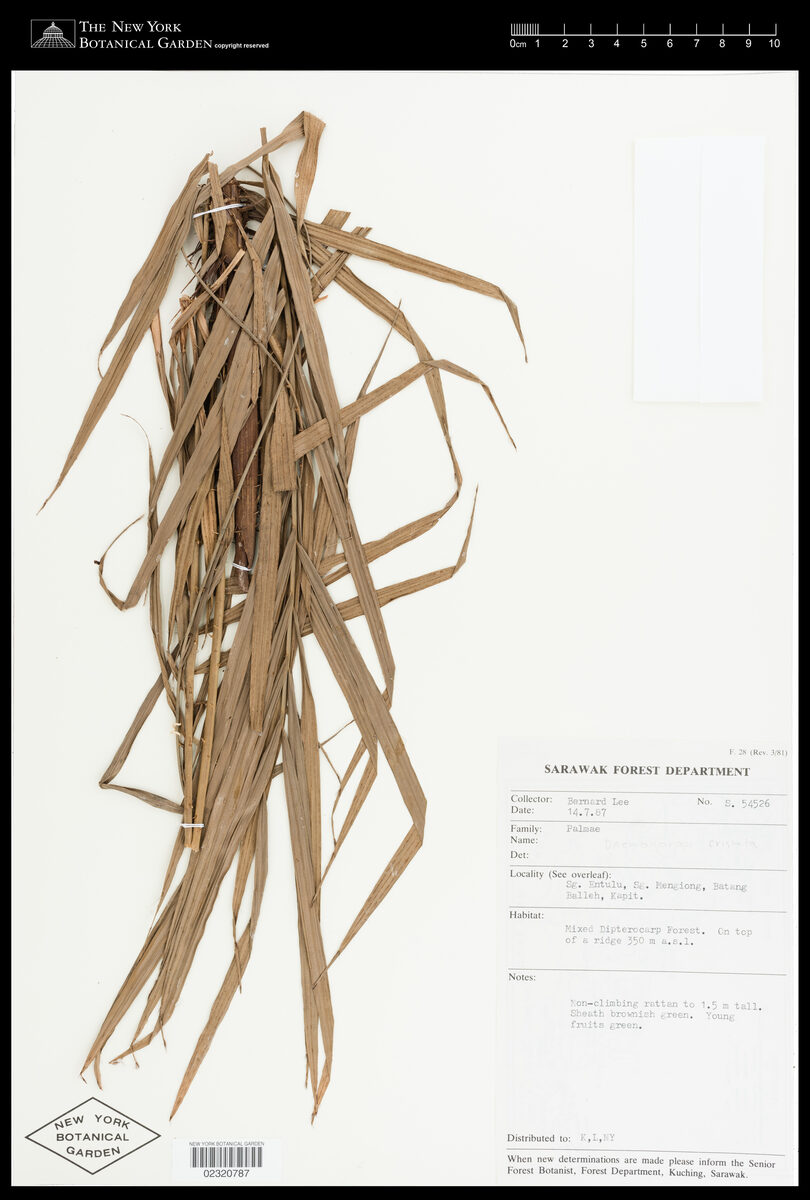
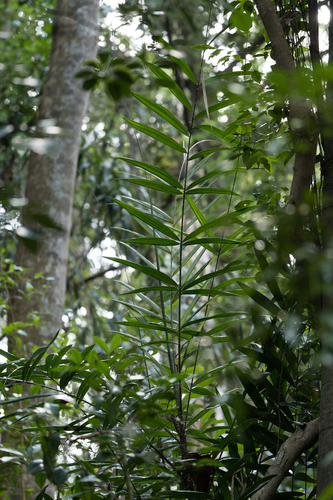
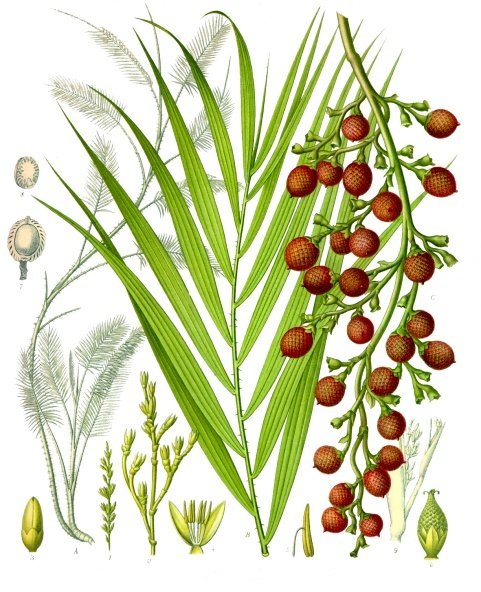
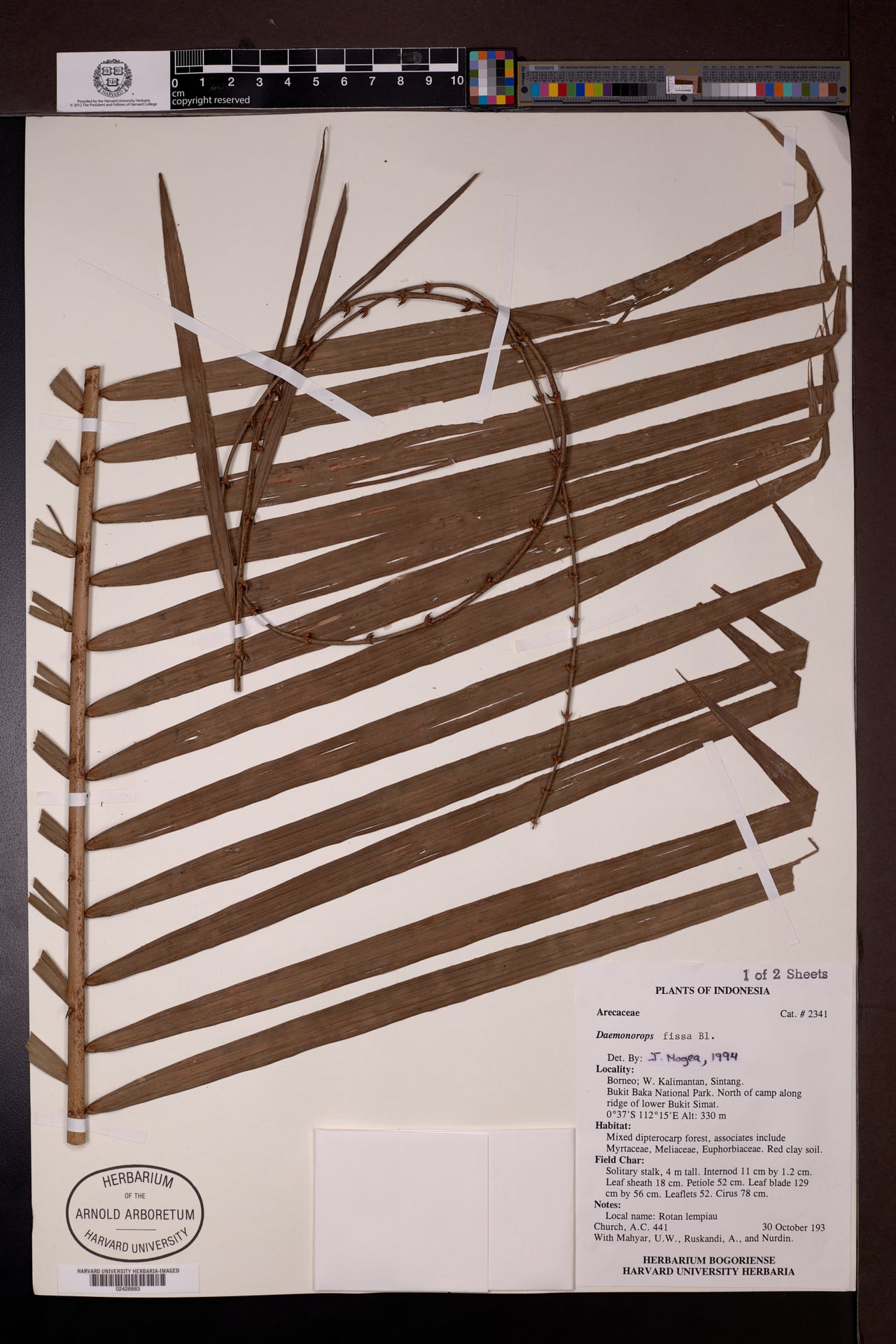
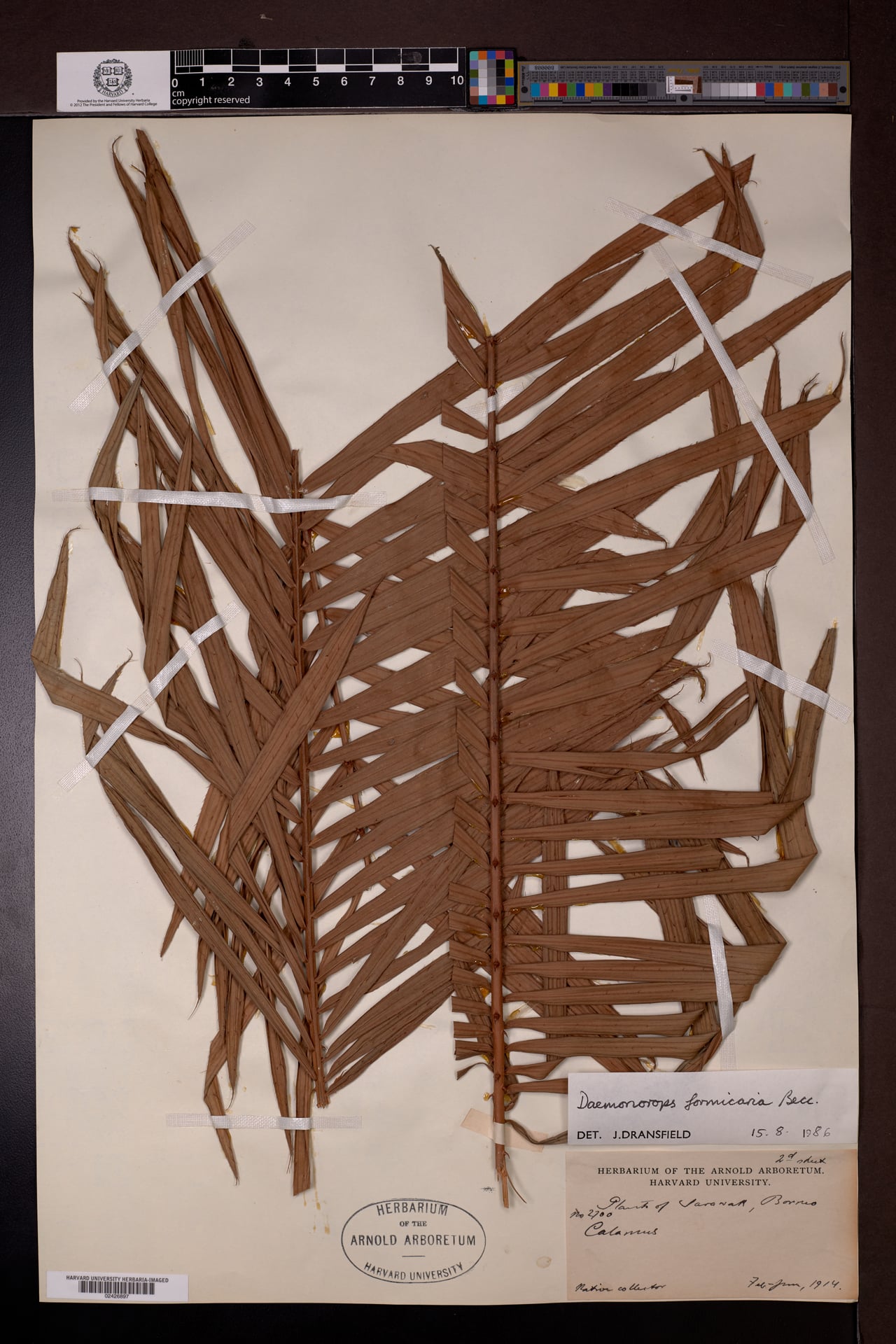
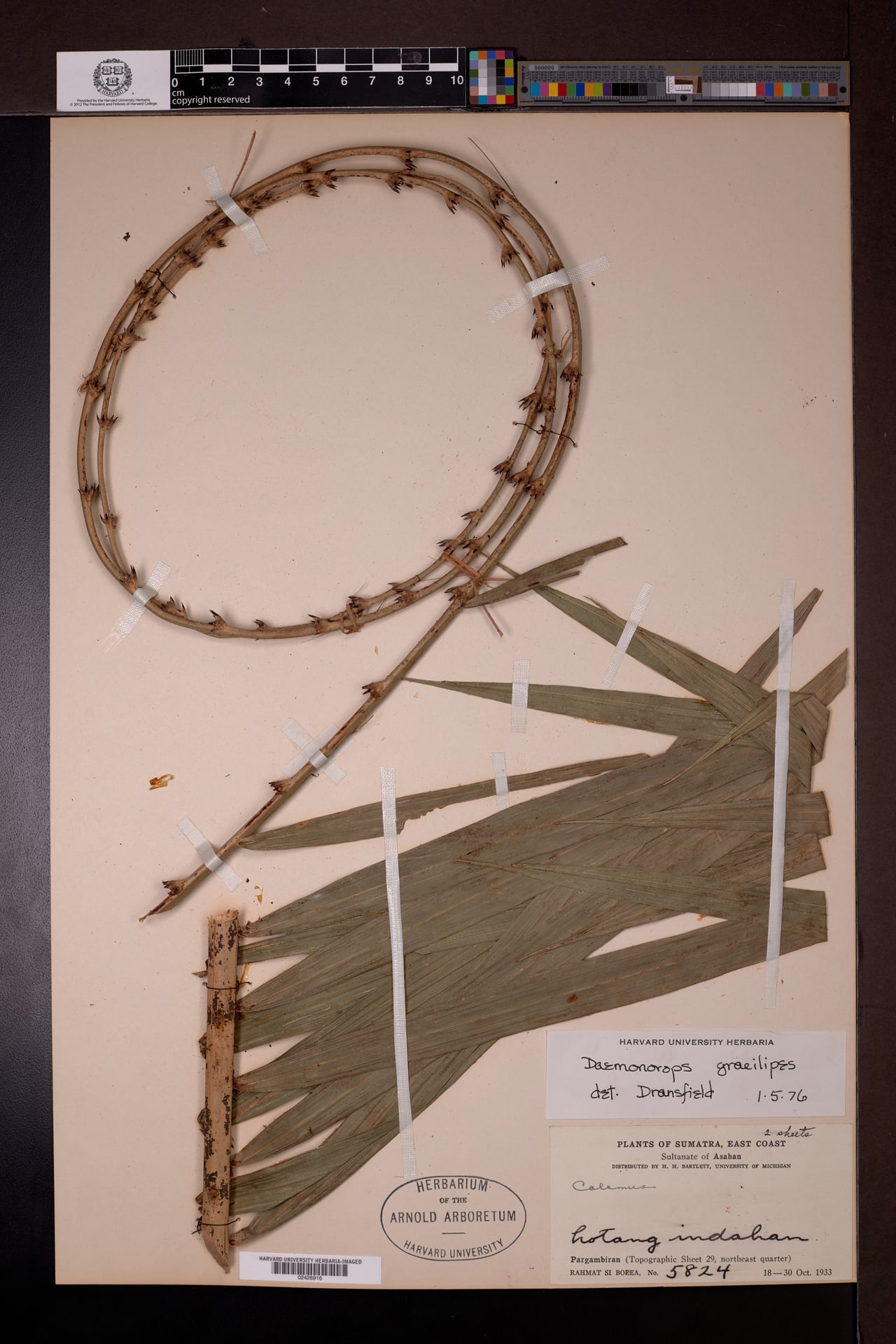
Calamus subinermis
H. Wendl. ex Becc.
Rotan batu
gbif· cc-by
Royal Botanic Gardens, Kew
gbif· cc-by
Royal Botanic Gardens, Kew
gbif· cc-by
Royal Botanic Gardens, Kew
Description
A tropical climbing rattan palm belonging to a genus of 375-400 species, with about 175 species found in tropical Asia.
This description is brief — help expand it
Edible Uses
In forests where rattan grows, its economic value can play a crucial role in conservation efforts. By offering an alternative source of income, rattan harvesting can deter loggers from engaging in timber logging. Harvesting rattan canes is simpler and requires less sophisticated tools compared to logging operations. Furthermore, rattan grows rapidly, which facilitates quicker replenishment compared to tropical wood species.This economic incentive supports forest maintenance by providing a profitable crop that complements rather than competes with trees. However, the long-term profitability and utility of rattan compared to other alternatives remain subjects of ongoing evaluation and study. Cleaned rattan stems with the leaf sheaths removed are superficially similar to bamboo. Unlike bamboo, rattan stems are not hollow. Most (70%) of the world's rattan population exists in Indonesia, distributed among the islands Borneo, Sulawesi, and Sumbawa. The rest of the world's supply comes from the Philippines, Sri Lanka, Malaysia, Bangladesh and Assam, India.
Medicinal Uses
In early 2010, scientists in Italy announced that rattan wood would be used in a new "wood to bone" process for the production of artificial bone. The process takes small pieces of rattan and places them in a furnace. Calcium and carbon are added. The wood is then further heated under intense pressure in another oven-like machine, and a phosphate solution is introduced. This process produces almost an exact replica of bone material. The process takes about 10 days. At the time of the announcement the bone was being tested in sheep, and there had been no signs of rejection. Particles from the sheep's bodies have migrated to the "wood bone" and formed long, continuous bones. The new bone-from-wood programme is being funded by the European Union. By 2023, experimental implants into humans were taking place.
Distribution
A tropical plant.
Where It Grows
Asia, Indonesia, Malaysia, SE Asia,
Cultivation
Most species in this genus are more or less vigorous climbing plants in rainforests. Leaves of young plants are normally damaged if exposed to too much light, though leaves of older plants will usually tolerate full sun. In general, plants are likely to grow best with their roots in the shade but with enough gap in the canopy to encourage their stems to grow up towards the light. They are also likely to grow best in a humus-rich soil. Many of the species require fairly moist conditions for good growth, in fact several of them grow in wet soils or in areas with seasonal inundation - where we have the information it will be included under the plant’s habitat. Overhead shade should be manipulated at about 6-monthly intervals for the first 2 - 3 years of a young plant’s life to ensure they receive sufficient light to grow vigorously. About 40 - 50% light penetration is generally considered to be ideal for promoting stem growth. Little care is needed once the seedlings are established. It is important, however, to weed the area surrounding the seedlings occasionally until the plants are more than 2 metres tall. After germination, forked leaflets are produced, followed by leaves with regularly arranged leaflets. By the third year an aerial stem may be produced. If clustering, leafy suckers normally remain dormant, rarely 2 - 3 stems elongate at the same time. First flowering takes place about the 6th year after sowing. Scattered clumps with spineless leaf-sheaths occur among normal clumps with spiny sheaths. These should be selected for plantations for ease of harvesting canes. Some plants are single-stemmed throughout their life, whereas others produce several suckers. Young plants may be planted under rubber trees or in secondary forest at a spacing of 2 metres x 10 metres or wider. In secondary forest, lanes 3 metres wide are cut and staked before planting. Canopy manipulation is carried out so that sufficient light reaches the seedlings to stimulate early stem elongation. When harvesting, the cane is cut at the base and pulled. Only the length reachable by the harvester is extracted and the rest left behind to rot. The leaf-sheaths are removed and the cane is then cut into 350cm long poles. There is a scarcity of high quality large-diameter canes throughout South-East Asia, due to extensive and intensive harvesting. A dioecious species, both male and female forms need to be grown if fruit and seed are required.
Propagation
Seed - it has a fairly short viability and is best sown as soon as it is ripe. Soon after harvest, the fruits are crushed and rubbed over quarter-inch wire mesh and under running water to remove the scaly pericarp and the fleshy sarcotesta. The cleaned seeds are then spread in seed-beds filled with either loam, loam and sawdust or sawdust only, and watered twice a day. The beds are also sprayed with fungicide to prevent fungal attack. After planting, most seeds germinate in about one month, although some do not germinate until 18 months later. Seed-beds are given full overhead shade. When seedlings are 5cm tall, they are potted into polybags 15cm deep and about 15cm in diameter filled with forest topsoil. They are watered twice a day and 50% overhead shade is provided by netting. Fertilizers and fungal sprays are applied whenever necessary. Seedlings are ready for planting 12 months after potting into polybags.
Other Uses
The stems are highly valued. They are used mainly as a structural cane in the manufacture of furniture. Very little of the stems are used for handicrafts. Apart from its slightly smaller diameter, this species is similar to the high quality stems obtained from Calamus manan. It is a hard cane suitable for nailing, with a smooth, yellowish surface and an even diameter, and is much sought after as a structural cane in furniture manufacture. The long and slender stems of Calamus species are put to various uses according to their size, length, flexibility, elasticity and toughness. The most slender canes are employed entire for binding purposes, and in making chairs, blinds, mats, wicker or basketwork, fishing implements, etc. Twisted together, they make very strong cables. The largest and more resistent canes are used entire as cables, the framework of wicker chairs etc. Usually, however, for many purposes the stems are split throughout their length into 2 - 4 or more strips from which the inner soft brittle and spongy portion is removed by means of a knife or same other instrument, so as to leave the external portion, which is hard, tough, flexible, elastic and has its outer surface very clean and smooth as if it had been varnished. Strips vary in width according to the use to which they are to be put. Those for delicate work, such as the network of furniture, small bags, hats, etc, are from 1 - 3mm wide; those employed as lashings in native housebuilding or in fastening the removable head of the Malay axe to its handle are from 5-6 mm wide. Collecting and preparing the stems is very simple. The stem is cut near the ground and detached from the trees by taking a strong hold of its base and thus pulling down the entire plant with its leaves. The most recent growth at the top of the plant is removed and then, handling it from the upper end, the stem is forcibly drawn in the opposite direction between two pieces of wood, thus removing the spiny coverings. It is then cut into lengths of about 5 metres, each piece is bent into two equal parts and the stems are fastened into bundles ready for market. The most valued stems are not thicker than a man's little finger and have a fine polished straw-yellow glassy surface.
Notes
There are 375-400 Calamus species. There are 175 species in tropical Asia.
References (3)
- Johnson, D.V., 1998, Tropical palms. Non-wood Forest products 10. FAO Rome. p 66
- Milow, P., et al, 2013, Malaysian species of plants with edible fruits or seeds and their evaluation. International Journal of Fruit Science. 14:1, 1-27
- Rec. Bot. Surv. India 2:212. 1902