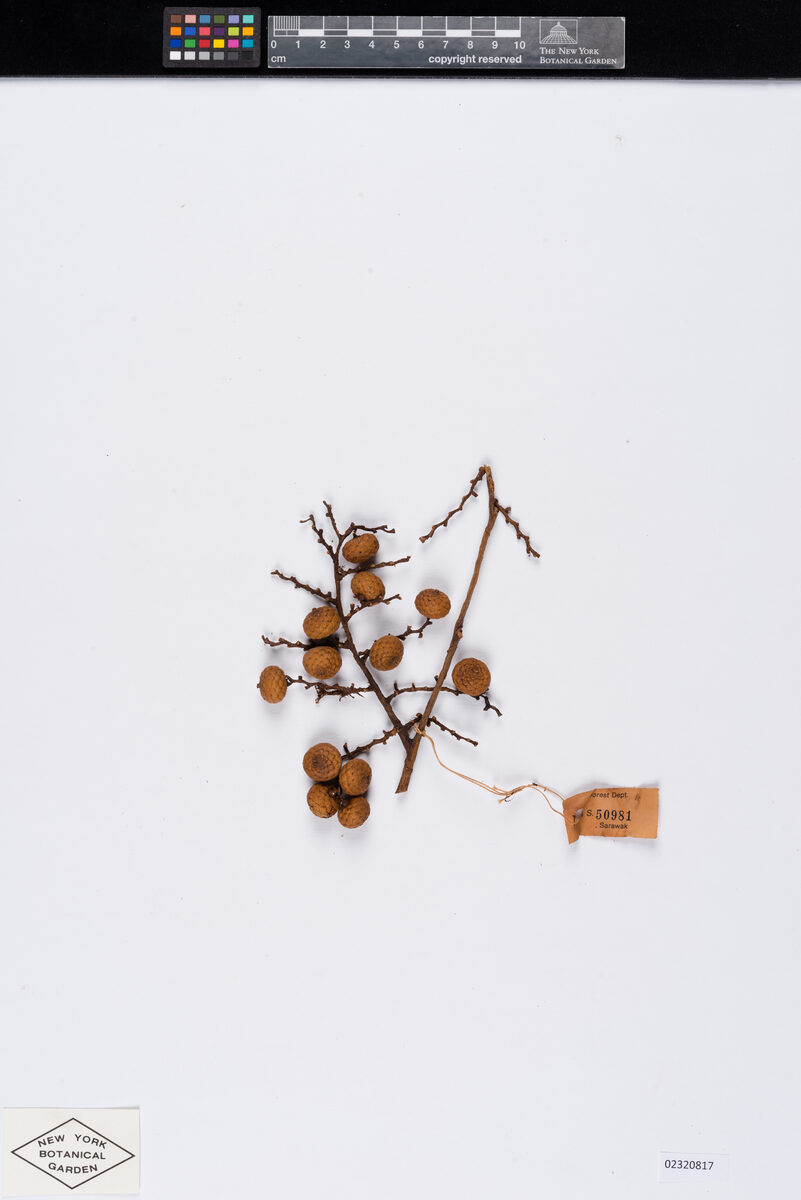
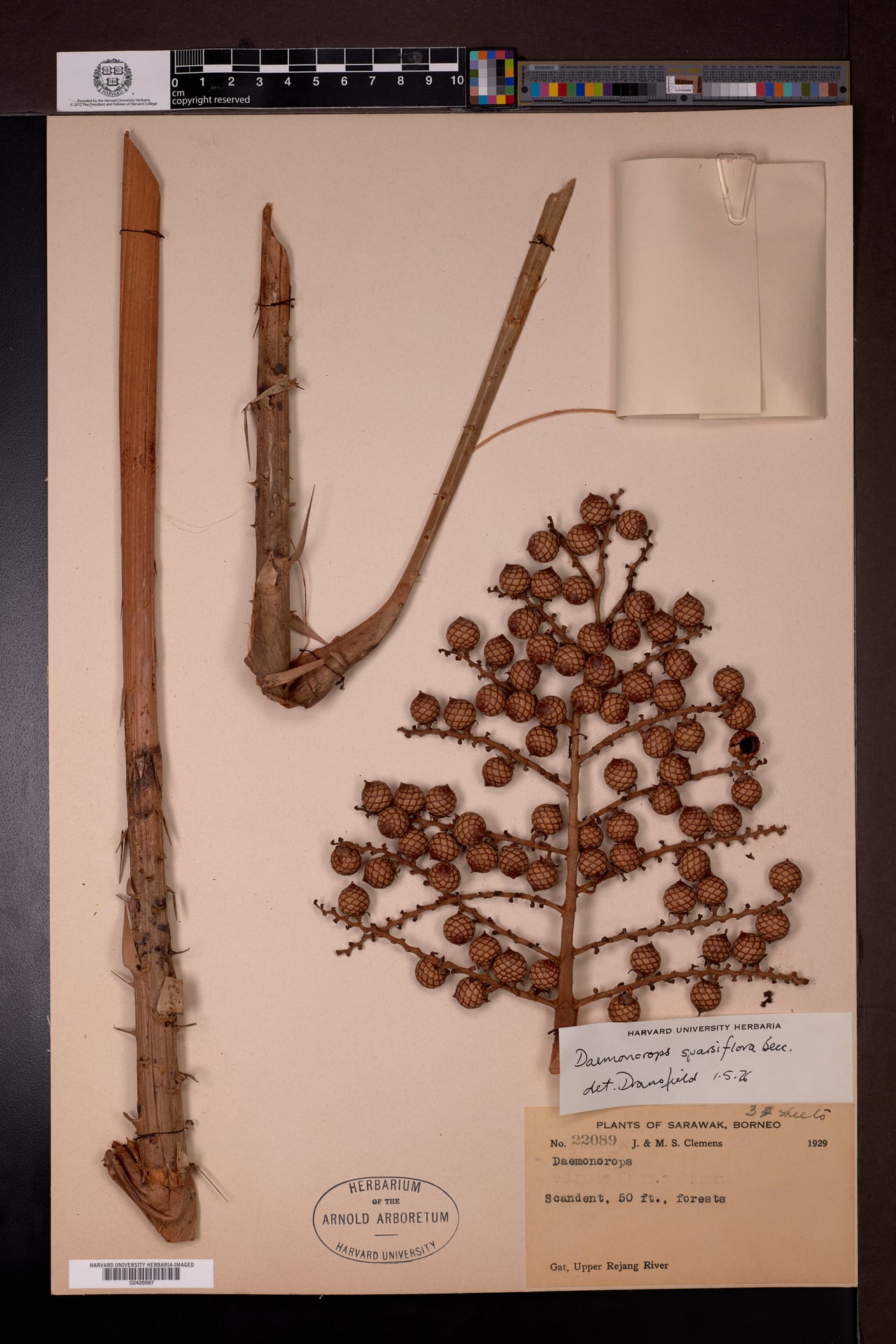
Calamus simplicifolius
C. F. Wei
Danye shengteng
gbif· cc-by
The New York Botanical Garden
gbif· cc-by
The New York Botanical Garden
Description
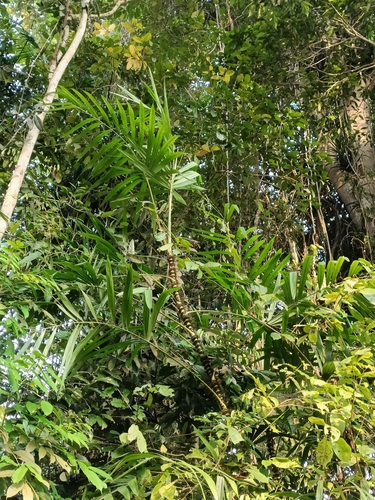
A climbing palm or rattan. The stems are in clusters. It is climbing and grows 50 m long. The stems are 3-6 cm wide. The leaf sheath is green with brown hairs. It has downward pointing spines 4 cm long. The leafy stalk is 2 m long with 14-22 broadly sword shaped leaflets in each side. The middle ones are 36-40 cm long by 2-5 cm wide.
Edible Uses
New shoots can be eaten as a vegetable. Although we have no further specific information for this species, many members of this genus have potentially edible young shoots. Indeed, in Laos the shoots are considered to be a delicacy and over half the species growing there are said to be cooked and eaten as a vegetable. The top 100cm of the plant is used. If the leaf sheaths are left in place until just before cooking then the shoot will remain fresh for up to one week.
Distribution
A tropical plant. It grows in lowland rain forests in Hainan.
Where It Grows
Asia, China,
Cultivation
The plant succeeds in subtropical to tropical climates. It is moderately frost tolerant, though young leaves and new shoots may easily be damaged by temperatures of below -2°c. Prefers moisture in abundance and adequate light. Although seedlings require the support of pre-existing tree crops and forest canopy, they also require adequate sunlight for healthy and fast growth. The annual average growth rate of the stems growing under semi-shade canopy conditions is three times as high as that of stems growing in dense forest. However, young seedlings cannot withstand full sunlight throughout the day as young leaves may become scorched. Planting lines have to be cleared and the forest canopy has to be thinned to allow sufficient light through to reach the seedlings in the first three years after planting On a small scale, seedlings can be planted in scattered clumps in agroforestry systems; on a commercial scale the species can be planted in lines, on a grid of about 4 metres x 5 metres in logged-over forests or in planted broadleaved forests but the forest canopy should be manipulated to allow light to reach the seedlings. Group planting, 2 - 3 seedlings per clump, is considered to be suitable for this species. Three years after sowing, the first stem may exceed 1 metre in length, the first climbing whips are produced and 1 - 2 suckers in a clump may appear from very short horizontal rhizomes. Three to four years after establishment, the stem may grow at rates exceeding 200 - 250cm a year under suitable conditions. At 10 years old, a clump may consist of 12 aerial stems. Flowering begins in the 5th year after sowing, and is annual thereafter. In humid rain forest, its prime habitat, only one of the stems in a clump, rarely two, grows up to be a long aerial stem, reaching the forest canopy. Harvesting is carried out in the wild by dragging the stem out of the canopy, removing of the leaves, leaf-sheaths and debris, cutting the cane into lengths of about 4 - 5 metres, tying in bundles and transporting to the village for sale. It is estimated that 10 - 11 years after establishment the plantation will be ready for initial harvest, with an estimated yield of about 3.5 tonnes per hectare. It is also estimated that within a 25-year management period, canes may be harvested 5 times in a rotation of 5 years, providing a total yield of about 11.5 tonnes per hectare.
Propagation
Seed - it has a fairly short viability and is best sown as soon as it is ripe. It germinates 5 - 60 days after sowing with a few seeds germinating after 120 days; after 2 - 3 months the seedling-leaf emerges; after 3 years, the first stem may exceed 1 metre in length. Seed propagation includes removing the fruit wall and fleshy seed-coat, cleaning the seeds, sowing seeds in sand beds for germination, and transporting the sprouted seed (the first foliage leaf unexpanded) in potting bags into a nursery under semi-shade. Seedlings 11 - 15 months old and with 6 - 7 leaves are usually ready for planting out. The plant can be propagated by sucker shoots but propagation is best effected from seeds.
Other Uses
An excellent quality stem of medium diameter, it is supreme for all types of binding and weaving in the furniture industry and, when available, is widely used locally for cordage, house construction and the finest basketware. The stem has an excellent appearance with its creamy yellow colour and highly glossy surface. Its uniform texture makes it particularly suited to being split into strips or being used whole for furniture making. The long and slender stems of Calamus species are put to various uses according to their size, length, flexibility, elasticity and toughness. The most slender canes are employed entire for binding purposes, and in making chairs, blinds, mats, wicker or basketwork, fishing implements, etc. Twisted together, they make very strong cables. The largest and more resistent canes are used entire as cables, the framework of wicker chairs etc. Usually, however, for many purposes the stems are split throughout their length into 2 - 4 or more strips from which the inner soft brittle and spongy portion is removed by means of a knife or same other instrument, so as to leave the external portion, which is hard, tough, flexible, elastic and has its outer surface very clean and smooth as if it had been varnished. Strips vary in width according to the use to which they are to be put. Those for delicate work, such as the network of furniture, small bags, hats, etc, are from 1 - 3mm wide; those employed as lashings in native housebuilding or in fastening the removable head of the Malay axe to its handle are from 5-6 mm wide. Collecting and preparing the stems is very simple. The stem is cut near the ground and detached from the trees by taking a strong hold of its base and thus pulling down the entire plant with its leaves. The most recent growth at the top of the plant is removed and then, handling it from the upper end, the stem is forcibly drawn in the opposite direction between two pieces of wood, thus removing the spiny coverings. It is then cut into lengths of about 5 metres, each piece is bent into two equal parts and the stems are fastened into bundles ready for market. The most valued stems are not thicker than a man's little finger and have a fine polished straw-yellow glassy surface.
Notes
There are 375-400 Calamus species. There are 175 species in tropical Asia.
References (1)
- Johnson, D.V., 1998, Tropical palms. Non-wood Forest products 10. FAO Rome. p 66