Arenga obtusifolia
Mart.
Langkap
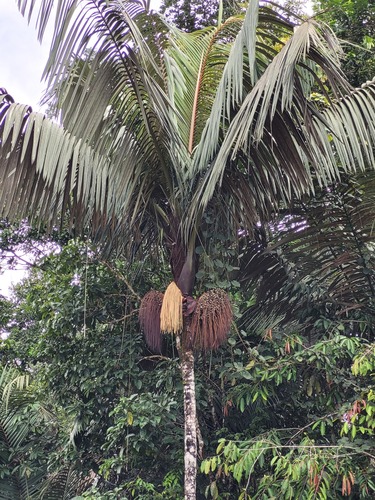
iNaturalist· cc-by-nc
(c) Rafidah Abdul Rahman, some rights reserved (CC BY-NC), uploaded by Rafidah Abdul Rahman
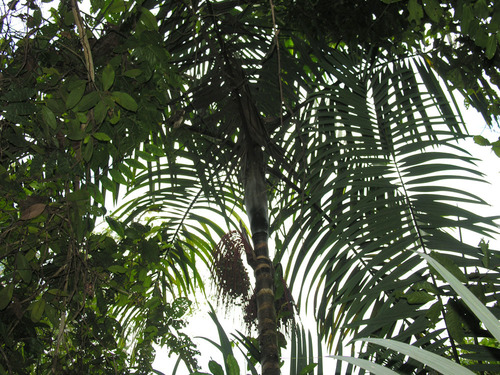
iNaturalist· cc-by-nc
(c) tansh91, some rights reserved (CC BY-NC), uploaded by tansh91
Summary
Source: WikipediaArenga obtusifolia is a flowering plant in the palm family Arecaceae native to Thailand, Malaysia, Borneo and Java. It is unusual among palms in that it forms rhizomes up to 9 m (30 ft) in length, forming clonal colonies.
Description
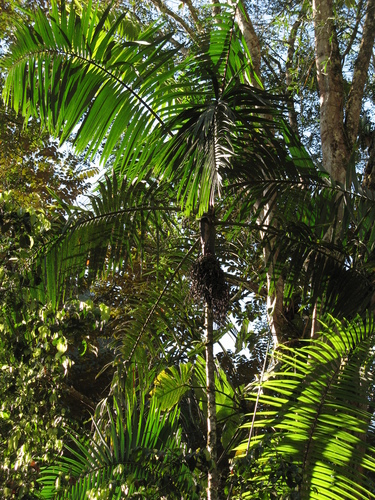
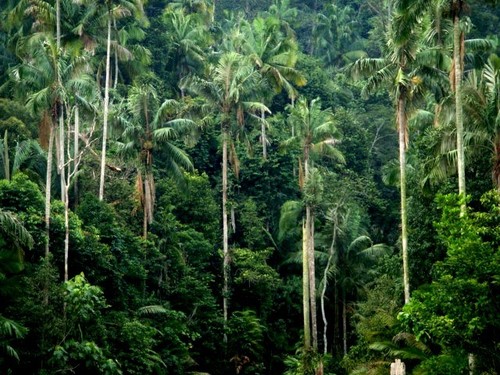
A clumping palm. The trunks are stout and fibrous. They can be 8 m tall and 17-30 cm across. The fronds are 6 m long by 3 m wide. The trunks become bare and have steps up them. The leaflets are leathery and crowded. They are long and narrow. They are 1.6 m long by 8 cm wide. They are bright green on the upper surface and silvery underneath. The flowering stalks are 1.2-1.5 m long. The flowers are yellowish-brown. The flowers extend upwards. The fruit are large and black. They are the size of a small apple.
Edible Uses
The palm heart, fruit endosperm, and pith are edible; the pith is sweet and can also be processed for starch.
Traditional Uses
The palm heart is edible. The endosperm of the fruit is edible. The pith is sweet and edible.
This uses section is brief — help expand it
Known Hazards
The fruits of most species in this genus are poisonous and are sometimes used criminally. The fleshy mesocarp of the fruits usually contains many oxalate crystals, making the flesh inedible.
Distribution
It is a tropical plant. It needs an open sunny position. It grows in Peninsula Malaysia and Sumatra, in coastal locations. It suits hardiness zones 11-12. In Townsville arboretum.
Where It Grows
Asia, Australia, India, Indonesia*, Malaysia*, SE Asia, Singapore, Thailand, USA,
Cultivation
Plants can be grown from seeds or suckers.
Propagation
Seed - a deep root is formed before the seedling emerges above soil level, and so the seed should be sown in individual, deep containers. Pre-soak the seed for 24 hours in warm water before sowing. It can take 3 - 6 months or more before signs of growth are seen above soil level.
Other Uses
The leaves are used for thatching and wickerwork. The wood is used to make small utensils, or is even used in construction, but it is said not to be durable.
Notes
There are 17-20 Arenga species.
Also Known As
Palem langkap, Umbut puli
References (11)
- Ambasta S.P. (Ed.), 2000, The Useful Plants of India. CSIR India. p 51
- Blomberry, A. & Rodd, T., 1982, Palms. An informative practical guide. Angus & Robertson. p 55
- Cundall, P., (ed.), 2004, Gardening Australia: flora: the gardener's bible. ABC Books. p 181
- Haynes, J., & McLaughlin, J., 2000, Edible palms and Their Uses. University of Florida Fact sheet MCDE-00-50-1 p 2
- Hist. nat. palm. 3:191, t. 147-148. 1838
Show all 11 references Hide references
- Johnson, D.V., 1998, Tropical palms. Non-wood Forest products 10. FAO Rome. p 46
- Jones, D.L., 1994, Palms throughout the World. Smithtonian Institution, Washington. p 135
- Pawera, L., et al, 2020, Wild Food Plants and Trends in Their Use: From Knowledge and Perceptions to Drivers of Change in West Sumatra, Indonesia, Foods. 2020, 9, 1240
- Riffle, R.L. & Craft, P., 2003, An Encyclopedia of Cultivated Palms. Timber Press. p 36, 259
- Sukarya, D. G., (Ed.) 2013, 3,500 Plant Species of the Botanic Gardens of Indonesia. LIPI p 753
- World Checklist of Useful Plant Species 2020. Royal Botanic Gardens, Kew