Ziziphus mucronata
Willd.
Buffalo thorn, Cape thorn
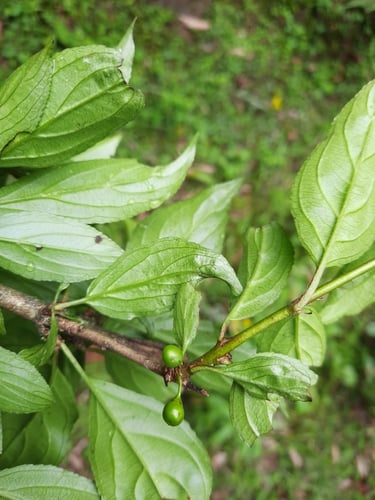
iNaturalist· cc-by-nc
(c) graham_g, some rights reserved (CC BY-NC)
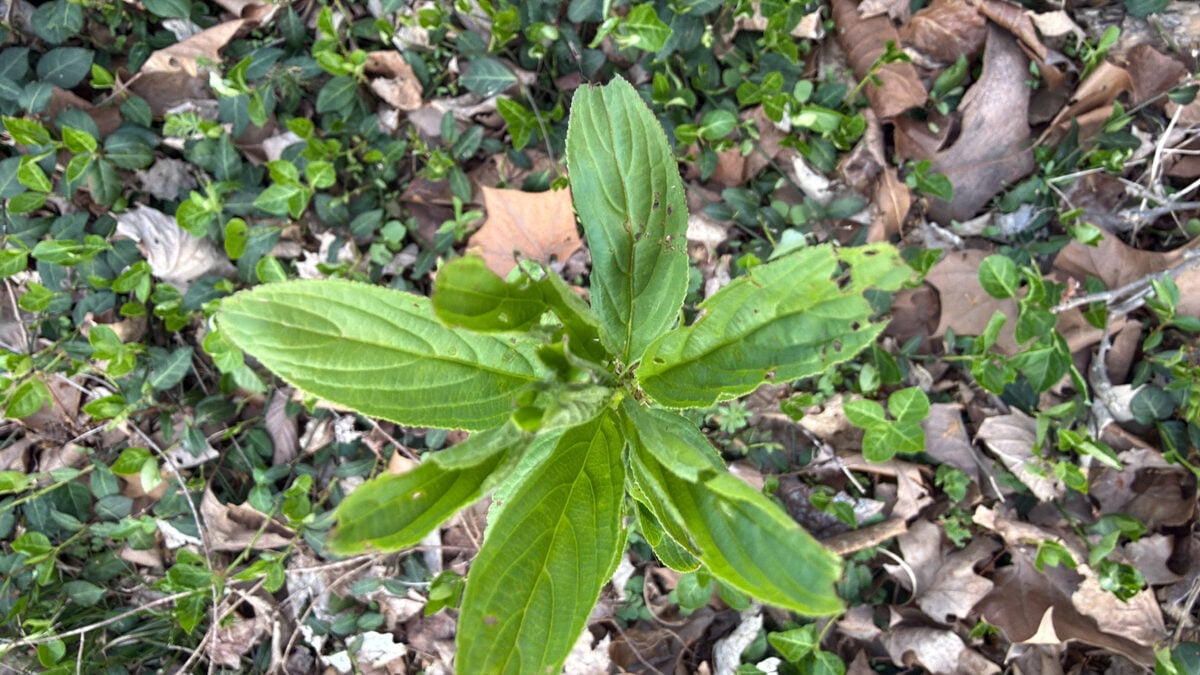
iNaturalist· cc-by-nc
(c) Ben VanderWeide, some rights reserved (CC BY-NC), uploaded by Ben VanderWeide
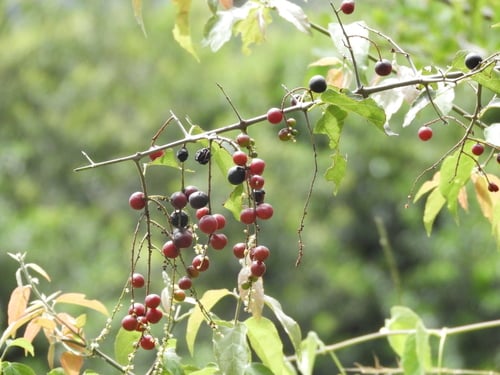
iNaturalist· cc-by-nc
(c) riana60, some rights reserved (CC BY-NC), uploaded by riana60
Summary
Source: WikipediaZiziphus mucronata, known as the buffalo thorn, is a species of tree in the family Rhamnaceae, native to southern Africa. It is deciduous and may grow up to 17 metres tall. It can survive in a variety of soil types, occurring in many habitats, mostly open woodlands, often on soils deposited by rivers, and grows frequently on termite mounds. Its Zulu name “umLahlankosi” alludes to its use as a grave marker for tribal chiefs, while the Afrikaans name “Blinkblaar-wag-'n-bietjie” alludes to the shiny light green leaves and the hooked thorns.
Description
A shrub or small tree. It grows up to 9 m tall. It has many sharp thorns. It has spreading and often drooping branches. The trunk is often crooked. The leaves are simple and alternate. They are shiny and have 3 veins from the base. The leaves are 2.5-8 cm long by 1.9-8 cm wide. Leaves and young plant parts can be hairy. There can be thorns at the nodes. The flowers are small and green. The flowers are in small clusters in the axils of leaves. The fruit are round. They are red and shiny. There is a sweet mealy pulp around a large seed.
Edible Uses
The leaves are edible and can be cooked into spinach. The seeds can be roasted and ground as a substitute for coffee. The fruit are not very tasty, though a type of beer can be made from them. The Ovambo people use it to distill ombike, a traditional liquor. The leaves and fruits are also a valuable source of forage for livestock.
Traditional Uses
The fruit are eaten fresh or dried. Often they are eaten in porridge. They can be used for drinks. The fruit are also ground and used in coffee. The roasted seeds are crushed and used as a coffee substitute. The fruit have been fermented for beer. The leaves are cooked as a vegetable.
Medicinal Uses
A blend made from the roots is used as a painkiller and for dysentery while the bark and leaves are used for respiratory ailments and sepsis on the skin. A paste made from the roots and leaves will treat boils, sores and swelling. The above may be attributed to the peptide alkaloids and antifungals isolated from the bark and leaves. Branches are used for protection of cattle kraal and sometimes on the graves of dead tribal members. The wood is used for implements and fuel. The leaves bark and roots are used medicinally and magically for pain relief, respiratory complaints and skin infections, especially for chest and stomach disorders. The leaves if crushed may be used to stop bleeding. Steam baths from the bark are used to purify and improve the complexion. In East Africa, roots are used for treating snake bites.
Distribution
A tropical plant. It grows in the lowlands and the highlands. It grows in tropical Africa. It grows in the Sahel. It grows in open scrub. It can grow on a range of soils. It is often on embankments and termite mounds. In East Africa it grows up to 2,000 m above sea level. It is drought resistant. It can grow in arid places. It grows in Miombo woodland. Mt Lofty Botanical Gardens. Melbourne Botanical gardens. It suits hardiness zones 7-9.
Where It Grows
Africa*, Angola, Australia, Botswana, Burkina Faso, Cameroon, Central Africa, Chad, Côte d'Ivoire, East Africa, Eritrea, Eswatini, Ethiopia, Gambia, Ghana, Guinea, Guinée, Ivory Coast, Kenya, Lesotho, Madagascar, Malawi, Mali, Middle East, Mozambique, Namibia, Niger, Nigeria, Rwanda, Sahel, Saudi Arabia, Senegal, Somalia, South Africa, Southern Africa, Sudan, Swaziland, Tanzania, Togo, Uganda, West Africa, Yemen, Zambia, Zimbabwe,
Cultivation
Plants can be grown by seeds or cuttings. It is best to remove the seeds from the stone by cracking with a hammer. Seeds germinate in 2-3 weeks when outside the stone or 2 months when inside the stone.
Propagation
Seed - remove the flesh from around the seed then soak the seed in cold water for 6 hours. Cover the seed in seedling trays with a thin layer of river sand and keep moist. Seeds usually germinate in 2 - 3 weeks with a minimum of 75% germination. Seedlings transplant easily into black nursery soil but they have long taproots and care should be taken not to damage them. Root suckers.
Other Uses
The bark contains 12 - 15% tannin. The seeds are used in rosaries. The yellow-pink wood is hard, tough and bends well. Although it is termite-resistant, it is not very durable in the ground. It is used for building poles and posts, live and dry fences, and for hunting and fishing weaponry. Whips and bows are made from saplings and from the flexible shoots. Thorny branches are sometimes used to make kraals. The wood makes a good fuel and charcoal A useful species to plant as a hedge around camps. It forms an impenetrable hedge for at least 10 years before the crown is too high off the ground to act as a barrier. The root system is not aggressive. The plant has been used to stabilize soils along the banks of rivers. When the plant is growing wild, it is often seen as an indication of underground water.
Production
Seedlings grow quickly. They can be 4-6 m high in 4-5 years.
Other Information
The fruit are eaten especially by children. It is a commonly used fruit in Mozambique.
Notes
Chemical composition: Protein (crude): 2.8% (dry). Fat = 2.1% (dry). Ash (insoluble) = 4.4% (dry). Fibre (crude) = 4.1%. Carbohydrate (soluble): Starch = 29.5% (dry). Sucrose = 48,5% (dry). D-glucose = 1.1% (dry). D-fructose = 1.0% (dry). Amino acids (g [16g N]-1): Aspartic acid = 16.6g. Threonine = 3.4g. Serine = 3.9g. Glutamic acid = 17.6g. Proline = 5.3g. Glycine = 4.9g. Alanine = 7.5g. Valine= 5.1g. Cysteine = 1.0g. Methionine = 1.0g. Isoleucine = 4.3g. Leucine = 8.5g. Tyrosine = 3.6g. Phenylalanine = 4.3g. Lysine = 3.9g. Histidine = 1.4g. Arginine = 4.7g. Minerals: Sulphur = 0.05% (dry). Potassium = 0.12% (dry). Magnesium = 0.10% (dry). Calcium = 0.27% (dry). Na = 0.01% (dry). K = 2.08% (dry). Zinc = 6mg/kg-1 (dry). Iron = 289 mg/kg-1 (dry). Manganese = 10mg/kg-1 (dry). Copper = 3mg/kg-1 (dry).
Nutrition
| Part | Moisture | kJ | kcal | Protein | Vit A | Vit C | Iron | Zinc |
|---|---|---|---|---|---|---|---|---|
| Fruit | 1200 | 287 | 3.2 | — | — | — | — | — |
| Fruit | 56.4 | 659 | 158 | 3.8 | — | 42.6 | 1 | 0.5 |
Synonyms
Also Known As
Angaw, Bokxalo, Buqunqura, Chinanga, Cidir, Djabi fourou, Ghaghari, Imphafa, Ireme bale, Kagowole, Kangwa, Kangwa, Kankona, Kitola usuu, Kitoloussuu, Kobta, Koopta, Kurkura hado, Kurquura, Kusia-a, Lango, Langu, Loilalei, Mausu, Mgugune, Mkunazi, Mnyangwe, Mokekete, Mokgalo, Mokhalo, Mothalo, Msarakanga, Muae, Mubuyu, Muchecheni, Mughughunu, Mugugune, Mukala, Mukekete, Mukhalu, Mukwata, Mupakwe, Mupasamala, Mutanula, Mutshetshate, Mutsotsomba, Ngorloki-govong, Ngugunu, Nphasamhala, Olango, Ol-oilale, Oloilahi, Oloilalei, Omukaru, Omukekete, Qurqura, Souroukou tomonon, Umlah’abantfu, Umpafa, Umpakwe, Umpatle, Umphafa
References (82)
- andELMUTI,
- Addis, G., et al, 2005, Ethnobotanical Study of Edible Wild Plants in Some Selected Districts of Ethiopia. Human Ecology, Vol. 33, No. 1, pp. 83-118
- Addis, G., Asfaw, Z & Woldu, Z., 2013, Ethnobotany of Wild and Semi-wild Edible Plants of Konso Ethnic Community, South Ethiopia. Ethnobotany Research and Applications. 11:121-141
- Addis, G., et al, 2013, The Role of Wild and Semi-wild Edible Plants in Household Food Sovereignty in Hamer and Konso Communities, South Ethiopia. Ethnobotany Research & Applications. 11:251-271
- Alfarhan, A. H., 2005, Flora of Jizan Region. AR 17-7. King andulaziz City for Science and Technology (KACST). p 260
Show all 82 references Hide references
- Anywar, G., et al, 2014, Wild Plants Used as Nutraceuticals from Nebbi District, Uganda. European Journal of medicinal Plants. 4(6):641-660
- Asfaw, Z. and Tadesse, M., 2001, Prospects for Sustainable Use and Development of Wild Food Plants in Ethiopia. Economic Botany, Vol. 55, No. 1, pp. 47-62
- Assefa, A. & Abebe, T., 2010, Wild Edible Trees and Shrubs in the Semi-arid Lowlands of Southern Ethiopia. Journal of Science and Development 1 (1) 2010
- Atato, A., et al, 2010, Diversity of Edible Wild Fruit Tree Species of Togo. Global Science Books.
- Bahru, T., et al, 2013, Wild Edible Plants: Sustainable Use and Management by Indigenous Communities in and the Buffer Area of Awah National Park, Ethiopia. Ethiop. J. Sci., 36(2): 93-108
- Balemie, K., & Kebebew, F., 2006, Ethnobotanical study of wild edible plants in Derashe and Kucha Districts, South Ethiopia. Journal of Ethnobiology and Ethnomedicine. 2:53
- Bekele-Tesemma A., Birnie, A., & Tengnas, B., 1993, Useful Trees and Shrubs for Ethiopia. Regional Soil Conservation Unit. Technical Handbook No 5. p 454
- Bunderson, W. T. et al, 2002, Common Agroforestry Species in Malawi. Malawi Agroforestry Extension Project, Pubication No. 46, Lilongwe. p 40
- Burkill, H. M., 1985, The useful plants of west tropical Africa, Vol. 4. Kew.
- Cheikhyoussef, A & Embashu, W., 2013, Ethnobotanical knowledge on Indigenous fruits in Ohangwena and Oshito regions in Northern Namibia. Journal of Ethnobiology and Ethnomedicine 9:34
- Cundall, P., (ed.), 2004, Gardening Australia: flora: the gardener's bible. ABC Books. p 1498
- Dale, I. R. and Greenway, P. J., 1961, Kenya Trees and Shrubs. Nairobi. p 394
- Dalziel, J. M., 1937, The Useful plants of west tropical Africa. Crown Agents for the Colonies London.
- Demise, S. & Asfaw, Z., 2020, Ethno Botanical Study of Wild Edible Plants in Adola District, Southern, Ethiopia. International Journal of Research and Analytical Reviews (IJRAR) 7(2).
- Dharani, N., 2002, Field Guide to common Trees & Shrubs of East Africa. Struik. p 281
- Diarra, N. et al, 2016, Etude ethnobotanique des plantes alimentaires utilisées en période de soudure dans les régions Sud du Mali. Int. J. Biol. Chem. Sci. 10(1): 184-197
- Drummond, R. B., 1981, Common Trees of the Central Watershed Woodlands of Zimbabwe, National Herbarium Salisbury. p 132
- Emire, A., et al, 2021, Ethnobotanical Study of Wild Edible Fruit Tree and Shrub Species in Adola Rede and Odo Shakiso Midland Districts of Guji Zone, Southern Ethiopia. Int. J. Adv. Res. Biol. Sci. (2021). 8(12): 96-109
- Enum. pl. 1:251. 1809
- Ethiopia: Famine Food Field Guide. http://www.africa.upenn.edu/faminefood/category3.htm
- Facciola, S., 1998, Cornucopia 2: a Source Book of Edible Plants. Kampong Publications, p 192
- Fowler, D. G., 2007, Zambian Plants: Their Vernacular Names and Uses. Kew. p 55
- Fox, F. W. & Young, M. E. N., 1982, Food from the Veld. Delta Books. p 314
- Gallagher, D. E., 2010, Farming beyond the escarpment: Society, Environment, and Mobility in Precolonial Southeastern Burkina Faso. PhD University of Michigan.
- Gemedo-Dalle, T., et al, 2005, Plant Biodiversity and Ethnobotany of Borana Pastoralists in Southern Oromia, Ethiopia. Economic Botany 59(1) pp. 43-65
- Gilbert, T., et al, 2017, Diversity and local transformation of indigenous edible fruits in sahelian domain of Cameroon. Journal of Animal & Plant Sciences Vol. 26 (2): 5289-5300
- Hedrick, U.P., 1919, (Ed.), Sturtevant's edible plants of the world. p 706
- https://growwild.co.za Edible Indigenous plants
- Ichikawa, M., 1980, The Utilization of Wild Food Plants by the Suiei Dorobo in Northern Kenya. J. Anthrop. Soc. Nippon. 88(1): 25-48
- INFOODS:FAO/INFOODS Databases
- Jardin, C., 1970, List of Foods Used In Africa, FAO Nutrition Information Document Series No 2.p 169
- Joffe, P., 2007, Creative Gardening with Indigenous Plants. A South African Guide. Briza. p 115
- Kebebew, M. & Leta, G., 2016, Wild Edible Plant Bio-diversity and Utilization System in Nech Sar National Park, Ethiopia. International Journal of Bio-resource and Stress Management 2016, 7(4):885-896
- Larson, T. J., 1970, Hambukushu Ethno-botany. Botswana Notes and Records. Vol 13.
- Leger, S., 1997, A Description of Today's Use of Plants in West Bushmanland (Namibia). German Development Service. PO Box 220035, 14061 Berlin, Germany. http://www.sigridleger.de/book/
- Long, C., 2005, Swaziland's Flora - siSwati names and Uses http://www.sntc.org.sz/flora/
- Lovett, J. C. et al, Field Guide to the Moist Forest Trees of Tanzania. p 125
- Lulekal, E., et al, 2011, Wild edible plants in Ethiopia: a review on their potential to combat food insecurity. Afrika Focus - Vol. 24, No 2. pp 71-121
- Magwede, K., van Wyk, B.-E., & van Wyk, A. E., 2019, An inventory of Vhavenḓa useful plants. South African Journal of Botany 122 (2019) 57–89
- Malaisse, F., 1997, Se nourrir en floret claire africaine. Approche ecologique et nutritionnelle. CTA., p 69 (Var. rhodesica)
- Mannheimer, C. A. & Curtis. B.A. (eds), 2009, Le Roux and Muller's Field Guide to the Trees and Shrubs of Namibia. Windhoek: Macmillan Education Namibia. p 304
- Maroyi, A., 2011, The Gathering and Consumption of Wild Edible Plants in Nhema Communal Area, Midlands Province, Zimbabwe. Ecology of Food and Nutrition 50:6, 506-525
- Maroyi, A. & Cheikhyoussef, A., 2017, Traditional knowledge of wild edible fruit in southern Africa: A comparative use patterns in Namibia and Zimbabwe. Indian Journal of Traditional Knowledge. 16(3): 385-392
- Mashile, S. P., et al, 2019, Indigenous fruit plants species of the Mapulana of Ehlanzeni district in Mpumalanga province, South Africa. South African Journal of Botany 122 (2019) 180–183
- Masters, T., 2021, Traditional food plants of the upper Aswa River catchment of northern Uganda—a cultural crossroads. Journal of Ethnobiology and Ethnomedicine (2021) 17:24
- Maundu, P. et al, 1999, Traditional Food Plants of Kenya. National Museum of Kenya. 288p
- Maydell, H. von, 1990, Trees and shrubs of the Sahel: their characteristics and uses. Margraf. p 405
- Mbuya, L.P., Msanga, H.P., Ruffo, C.K., Birnie, A & Tengnas, B., 1994, Useful Trees and Shrubs for Tanzania. Regional Soil Conservation Unit. Technical Handbook No 6. p 522
- Mengistu, F. & Hager, H., 2008, Wild Edible Fruit Species Cultural Domain, Informant Species Competence and Preference in Three Districts of Amhara Region, Ethiopia. Ethnobotany Research & Applications 6:487-502
- Motlhanka, D. M. T., et al, 2008, Edible Indigenous Fruit Plants of Eastern Botswana. International Journal of Poultry Science. 7(5): 457-460
- Mutie, F. G., 2020, Conservation of Wild Food Plants and Their Potential for Combatting Food Insecurity in Kenya as Exemplified by the Drylands of Kitui County. Plants 2020, 9, 1017
- Mutie, F. M., et al, 2023, Important Medicinal and Food Taxa (Orders and Families) in Kenya, Based on Three Quantitative Approaches. Plants 2023, 12, 1145
- Njana, M. A., et al, 2013, Are miombo woodlands vital to livelihoods of rural households? Evidence from Urumwa and surrounding communities, Tabora, Tanzania. Forests, Trees and Livelihoods, 22:2, 124-140
- Ojelel, S., et al, 2019, Wild edible plants used by communities in and around selected forest reserves of Teso-Karamoja region, Uganda. Journal of Ethnobiology and Ethnomedicine (2019) 15:3
- Pakia, M., 2000, Plant Ecology and Ethnobotany of two sacred forests (Kayas) at the Kenya Coast. M. Sc. Thesis.
- Palgrave, K.C., 1996, Trees of Southern Africa. Struik Publishers. p 550
- Palmer, E and Pitman, N., 1972, Trees of Southern Africa. Vol. 2. A.A. Balkema, Cape Town p 1391
- Peters, C. R., O'Brien, E. M., and Drummond, R.B., 1992, Edible Wild plants of Sub-saharan Africa. Kew. p 166
- Roodt, V., 1998, Trees & Shrubs of the Okavango Delta. Medicinal Uses and Nutritional value. The Shell Field Guide Series: Part 1. Shell Botswana. p 91
- Royal Botanic Gardens, Kew (1999). Survey of Economic Plants for Arid and Semi-Arid Lands (SEPASAL) database. Published on the Internet; http://www.rbgkew.org.uk/ceb/sepasal/internet [Accessed 10th June 2011]
- Ruffo, C. K., Birnie, A. & Tengnas, B., 2002, Edible Wild Plants of Tanzania. RELMA p 740
- Ruiters-Welcome, A. K., 2019, Food plants of southern Africa. Ph.D. thesis. Univ. of Johannesburg p 94
- Schmidt, E., Lotter, M., & McCleland, W., 2007, Trees and shrubs of Mpumalanga and Kruger National Park. Jacana Media p 382
- Seyoum, Y., et al, 2015, Edible Wild Fruit Trees and Shrubs and Their Socioeconomic Significance in Central Ethiopia. Ethnobotany Research & Applications. 14:183-197
- Shumsky, S., et al, 2014, Institutional factors affecting wild edible plant (WEP) harvest and consumption in semi-arid Kenya. Land Use Policy 38(2014) 48-69
- Swaziland's Flora Database http://www.sntc.org.sz/flora
- Termote, C., et al, 2014, Assessing the potential of wild foods to reduce the cost of a nutritionally adequate diet: An example from eastern Baringo District, Kenya. Food and Nutrition Bulletin, vol. 35, no. 4
- Tredgold, M.H., 1986, Food Plants of Zimbabwe. Mambo Press. p 138
- van Wyk, B, van Wyk, P, and van Wyk B., 2000, Photographic guide to Trees of Southern Africa. Briza. p 327
- van Wyk, B., 2005, Food Plants of the World. An illustrated guide. Timber press. p 391
- van Wyk, B-E., 2011, The potential of South African plants in the development of new food and beverage products. South African Journal of Botany 77 (2011) 857–868
- Venter, F & J., 2009, Making the most of Indigenous Trees. Briza. p 300
- Vivien, J., & Faure, J.J., 1996, Fruitiers Sauvages d'Afrique. Especes du Cameroun. CTA p 272
- Welcome, A. K. & Van Wyk, B.-E., 2019, An inventory and analysis of the food plants of southern Africa. South African Journal of Botany 122 (2019) 136–179
- Williamson, J., 2005, Useful Plants of Malawi. 3rd. Edition. Mdadzi Book Trust. p 284
- World Checklist of Useful Plant Species 2020. Royal Botanic Gardens, Kew
- www.worldagroforestrycentre.org/treedb/