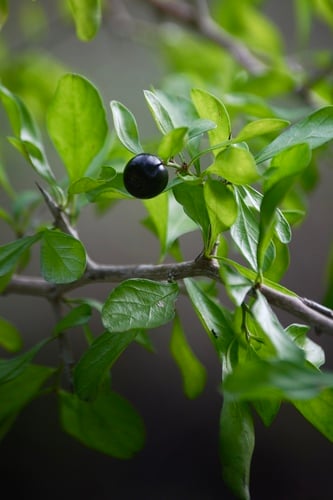
Paliurus spina-christi
Mill.
Christ's thorn, Jerusalem thorn
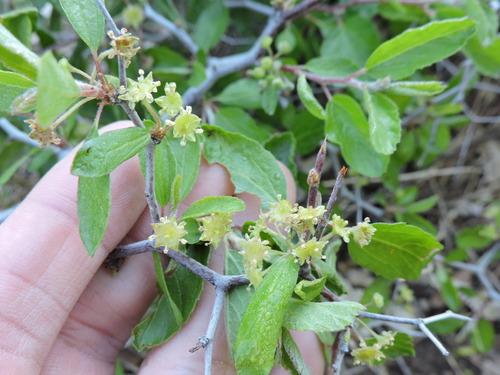
iNaturalist· cc0
no rights reserved, uploaded by Paul Braun
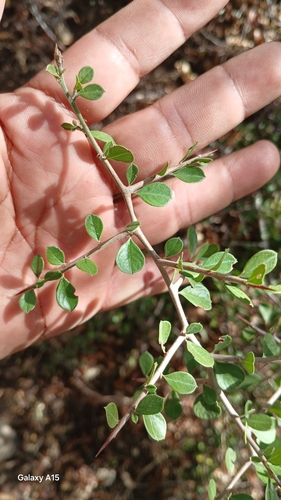
iNaturalist· cc-by-nc
(c) josefwirth, some rights reserved (CC BY-NC), uploaded by josefwirth
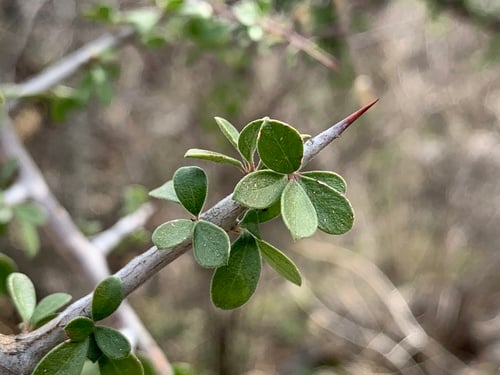
iNaturalist· cc-by-nc
(c) Yael Orgad, some rights reserved (CC BY-NC), uploaded by Yael Orgad
Summary
Source: WikipediaA deciduous shrub growing 5 m tall and wide at medium rate. Hardy to UK zone 8. Flowers July to August with seeds ripening October to December. Hermaphrodite. Adapts to light sandy, medium loamy, and heavy clay soils with mildly acid to very alkaline pH. Tolerates semi-shade or full sun, and grows in dry or moist soil with drought tolerance.
Description
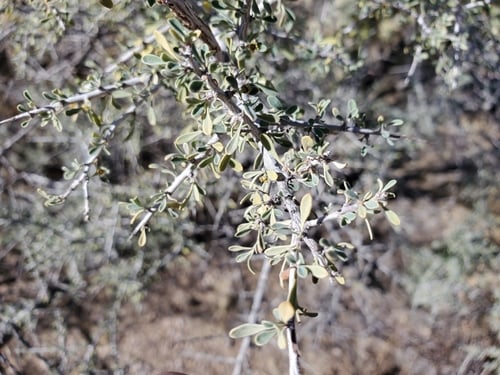
A slender straggling shrub. It grows to 5 m high. The branches are very spiny. They have many pairs of thorns, one straight and one curved over. The stems arch over. The stems are zigzag. The leaves are alternate and arranged in 2 opposite ranks. They are oval and have teeth and have 3 veins along them. They are shiny green and have short stalks. The flowers are yellowish-green and borne in clusters. The flowers have a slight perfume. The woody fruit is up to 3 cm across. They are flat and circular. The fruit are red.
Edible Uses
It is viewed as an ornamental curiosity, grown for its odd-looking discus-like fruit, and is cultivated in some areas outside its native range, including western Europe north to Great Britain. It is locally naturalised in northwestern Africa, northern India, Hungary, and in the United States in Texas.
Traditional Uses
The fruit is eaten fresh or dried.
This uses section is brief — help expand it
Medicinal Uses
Root is anticathartic, astringent, diuretic, and tonic.
Distribution
It is a warm temperate plant. On dry sandy hills up to 3000 m altitude. It grows best in well drained soil in full sunlight. It prefers soil with lime. It can tolerate drought once established. It suits hardiness zones 8-10.
Where It Grows
Asia, Australia, Balkans, Bosnia, Central Asia, China, Croatia, Europe, France, Georgia, Greece, Iraq, Italy, Mediterranean, Middle East, Portugal, San Marino, Spain, Tajikistan, Turkey, Türkiye,
Cultivation
Plants can be grown from seed. They are best sown when freshly ripe. Plants cna be grown from cuttings of half ripe wood. They can also be grown from root cuttings. Plants can also be grown by layering.
Propagation
Seed sown fresh in cold frame, moved to greenhouse in February with fair to good germination. Prick out seedlings into individual pots when large enough and overwinter in greenhouse for first year before early summer planting. Half-ripe cuttings taken July/August in frame. Root cuttings 4cm long taken December in greenhouse with fair to good success. Layering also possible.
Other Uses
Used for hedging with loose but bushy growth habit. Scented plant.
Other Information
Young fruit are especially eaten by children.
Notes
There are 8 Paliuris species.
Synonyms
Also Known As
Astre, Crna draca, Dalike, Darzee, Draca, Karacali, Kolacci, Kolaci, Navadni derak, Zee
References (16)
- Ahiskali, M., Ari, C. & Selvi, S., Edible wild plants and their consumption during winterin a rural village of Kazdagi (Mount Ida)
- Blamey, M and Grey-Wilson, C., 2005, Wild flowers of the Mediterranean. A & C Black London. p 129 (As Paliuris spina-christi)
- Cundall, P., (ed.), 2004, Gardening Australia: flora: the gardener's bible. ABC Books. p 978 (As Paliuris spina-christi)
- Dolina, K. & Luczaj, L., 2014, Wild food plants used on the Dubrovnik coast (south-eastern Croatia) Acta Soc Bot Pol 83(3):175–181
- Ertug, F, Yenen Bitkiler. Resimli Türkiye Florası -I- Flora of Turkey - Ethnobotany supplement
Show all 16 references Hide references
- Etherington, K., & Imwold, D., (Eds), 2001, Botanica's Trees & Shrubs. The illustrated A-Z of over 8500 trees and shrubs. Random House, Australia. p 510 (As Paliuris spina-christi)
- Facciola, S., 1998, Cornucopia 2: a Source Book of Edible Plants. Kampong Publications, p 191
- Galalaey, A. M. K., et al, 2021, Ethnobotanical study of some wild edible plants in Hujran Bason, Kurdistan Region of Iraq. ZANCO Journal of Pure and Applied Sciences. Salahaddin University-Erbil p 27
- http://www.botanic-gardens-ljubljana.com/en/plants
- Kiple, K.F. & Ornelas, K.C., (eds), 2000, The Cambridge World History of Food. CUP p 1756 (As Paliuris spina-christi)
- Luczaj, L. et al, 2014, Wild Food Plants of Dalmatia (Croatia). in A. Pieroni, C. L. Quave (eds.), Ethnobotany and Biocultural Diversities in the Balkans, p 138
- Plants for a Future database, The Field, Penpol, Lostwithiel, Cornwall, PL22 0NG, UK. http://www.scs.leeds.ac.uk/pfaf/ (As Paliuris spina-christi)
- Polat, R., et al, 2015, Survey of wild food plants for human consumption in Elazig (Turkey). Indian Journal of Traditional Knowledge. Vol. 1(1): 69-75
- Redzic, S. J., 2006, Wild Edible Plants and their Traditional Use in the Human Nutrition in Bosnia-Herzegovina. Ecology of Food and Nutrition, 45:189-232 (As Paliurus spina-christi)
- Sfikas, G., 1984, Trees and shrubs of Greece. Efstathiadis Group. Athens. p 158 (As Paliuris spina-christi)
- World Checklist of Useful Plant Species 2020. Royal Botanic Gardens, Kew