Zantedeschia aethiopica
(L.) Sprengel
White Arum Lily
iNaturalist· cc-by-nc-sa
(c) flipsockgrrl, some rights reserved (CC BY-NC-SA)
iNaturalist· cc-by-nc
(c) joanamota, some rights reserved (CC BY-NC)
iNaturalist· cc-by-nc
(c) joanamota, some rights reserved (CC BY-NC)
Summary
Source: WikipediaZantedeschia aethiopica, commonly known as calla lily and arum lily, is a species of flowering plant in the family Araceae, native to southern Africa in Lesotho, South Africa, and Eswatini.
Description
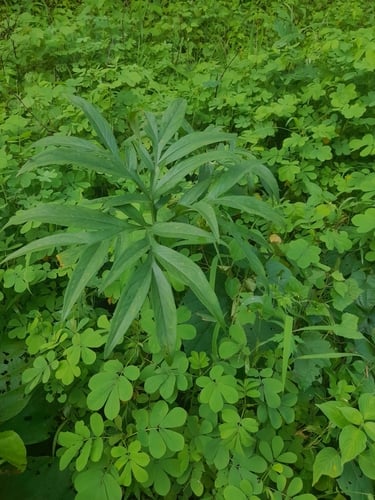
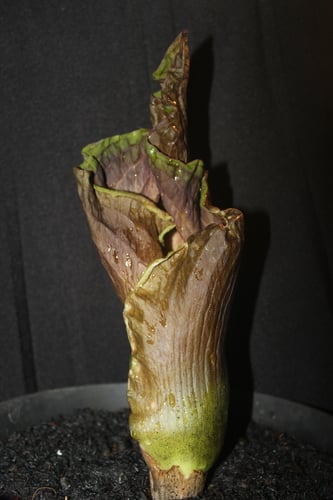
A succulent herb. It is a perennial plant. The roots are fleshy and form underground storage organs. It grows 90-120 cm high and 50-75 cm wide. Plants form dense clumps of leaves. The leaves are glossy and arrow-shaped. They are 40 cm long. The leaves are on stalks arising from the base of the plant. The stalks can be 40 cm long. The leaf stalks have a sticky sap when broken. The flowers have white spathes and a yellow spadix. The white spathes are funnel shaped with a split down the side. The stalk or spadix in the centre has true flowers are clustered along this. After flowering oval yellow berries form and these have round seed.
Edible Uses
Young leaves can be eaten cooked. Some caution is advised — see notes on toxicity.
Traditional Uses
CAUTION: The flower stalk and the roots are poisonous if eaten raw. Like many plants in this family they contain oxalates that need special processing to remove these. The young leaves and leaf stalks are eaten as a vegetable. Roasting and boiling removes the toxicity.
Medicinal Uses
None known.
Distribution
It is a temperate plant. It can stand light frosts. It can grow naturally along watercourses. It suits swampy areas. They can grow in full sun or light shade. In Argentina it grows from sea level to 1,000 m above sea level. It suits hardiness zones 8-11. Tasmania Herbarium.
Where It Grows
Africa, Albania, Algeria, Argentina, Asia, Australia, Bermuda, Botswana, Brazil, Britain, Canary Is.,Central America, Chile, Colombia, Costa Rica, Dominican Republic, East Africa, Ecuador, Eswatini, Ethiopia, Greece, Guatemala, Hawaii, Himalayas, India, Indonesia, Italy, Lesotho, Mexico, Morocco, Mozambique, Pakistan, New Zealand, Nicaragua, Norfolk Island, North America, Northeastern India, Philippines, Portugal, Puerto Rico, Reunion, SE Asia, Sicily, Slovenia, South Africa*, Southern Africa, South America, Spain, St Helena, Swaziland, Tasmania, Trinidad-Tobago, Tunisia, Turkey, Türkiye, Uruguay, USA, Yugoslavia, Zambia, Zimbabwe,
Cultivation
Plants can be grown from seed sown as soon as ripe and at 21-27°C. They can be grown by division of the clump. The tubers are planted 30-40 cm apart and 10 cm deep.
Propagation
Seed is best sown as soon as ripe in a greenhouse. Stored seed should be pre-soaked in warm water for 24 hours and sown in moist soil in spring under glass. Prick seedlings into individual pots when large enough and grow on in the greenhouse for at least their first winter. Plant out in late spring or early summer after the last expected frosts. Division, preferably in spring, works well; larger divisions can go straight to permanent positions, while smaller ones are best potted and grown in light shade until well established, then planted out in summer or the following spring.
Other Uses
None known.
Other Information
It is a famine food.
Notes
There are 6-8 Zantedeschia species. It can be invasive.
Synonyms
Also Known As
Calla, Common calla, Inyibiba, Lili arum, Lily-of-the-Nile, Navadni škrnicelj
References (43)
- Ambasta, S.P. (Ed.), 2000, The Useful Plants of India. CSIR India. p 697
- Bodkin, F., 1991, Encyclopedia Botanica. Cornstalk publishing, p 1033
- Borrell, O.W., 1989, An Annotated Checklist of the Flora of Kairiru Island, New Guinea. Marcellin College, Victoria Australia. p 18
- Brickell, C. (Ed.), 1999, The Royal Horticultural Society A-Z Encyclopedia of Garden Plants. Convent Garden Books. p 1067
- Burkill, I.H., 1966, A Dictionary of the Economic Products of the Malay Peninsula. Ministry of Agriculture and Cooperatives, Kuala Lumpur, Malaysia. Vol 2 (I-Z) p 2326
Show all 43 references Hide references
- Burnie, G.(Ed.), 2003, Annuals and Bulbs. The Gardener's Handbooks. Fog City Press. p 306
- Cundall, P., (ed.), 2004, Gardening Australia: flora: the gardener's bible. ABC Books. p 1494
- Dashorst, G.R.M., and Jessop, J.P., 1998, Plants of the Adelaide Plains & Hills. Botanic Gardens of Adelaide and State Herbarium. p 162
- Flora of Australia Volume 49, Oceanic Islands 1, Australian Government Publishing Service, Canberra. (1994) p 416
- Fox, F. W. & Young, M. E. N., 1982, Food from the Veld. Delta Books. p 96
- Harris, S., Buchanan, A., Connolly, A., 2001, One Hundred Islands: The Flora of the Outer Furneaux. Tas Govt. p 249
- Harter, J.(Ed.), 1988, Plants. 2400 copyright free illustrations. Dover p 26.4, 26.7
- Hibbert, M., 2002, The Aussie Plant Finder 2002, Florilegium. p 310
- https://growwild.co.za Edible Indigenous plants
- http://www.botanic-gardens-ljubljana.com/en/plants
- Hussey, B.M.J., Keighery, G.J., Cousens, R.D., Dodd, J., Lloyd, S.G., 1997, Western Weeds. A guide to the weeds of Western Australia. Plant Protection Society of Western Australia. p 20
- Jardin, C., 1970, List of Foods Used In Africa, FAO Nutrition Information Document Series No 2.p 111
- Joyce, D., 1998, The Garden Plant Selector. Ryland, Peters and Small. p 278
- Kew Plants of the World Online
- Lamp, C & Collet F., 1989, Field Guide to Weeds in Australia. Inkata Press. p 331
- Larios, et al., 2013, Plant management and biodiversity conservation in Náhuatl homegardens of the Tehuacán Valley, Mexico. Journal of Ethnobiology and Ethnomedicine 2013 9:74.
- Lazarides, M. & Hince, B., 1993, Handbook of Economic Plants of Australia, CSIRO. p 251
- Llamas, K.A., 2003, Tropical Flowering Plants. Timber Press. p 87
- Long, C., 2005, Swaziland's Flora - siSwati names and Uses http://www.sntc.org.sz/flora/
- Marinelli, J. (Ed), 2004, Plant. DK. p 259, 471
- Martin, F.W. & Ruberte, R.M., 1979, Edible Leaves of the Tropics. Antillian College Press, Mayaguez, Puerto Rico. p 176
- Molla, A., Ethiopian Plant Names. http://www.ethiopic.com/aplants.htm
- Morley, B. & Everard, B., 1970, Wild Flowers of the World. Ebury press. Plate 88
- Okigbo, B.N., Vegetables in Tropical Africa, in Opena, R.T. & Kyomo, M.L., 1990, Vegetable Research and development in SADCC countries. Asian Vegetable Research and development Centre. Taiwan. p 38
- Paczkowska, G. & Chapman, A.R., 2000, The Western Australian Flora. A Descriptive Calatogue. Western Australian Herbarium. p 36
- Peters, C. R., O'Brien, E. M., and Drummond, R.B., 1992, Edible Wild plants of Sub-saharan Africa. Kew. p 12
- Plants for a Future database, The Field, Penpol, Lostwithiel, Cornwall, PL22 0NG, UK. http://www.scs.leeds.ac.uk/pfaf/
- Romanowski, N., 2007, Edible Water Gardens. Hyland House. p 117
- Ruiters-Welcome, A. K., 2019, Food plants of southern Africa. Ph.D. thesis. Univ. of Johannesburg p 28
- Sainty, G.R. & Jacobs, S.W.L., 1981, Waterplants of New South Wales. Water Resources Commission. NSW p 68
- Slocum, P.D. & Robinson, P., 1999, Water Gardening. Water Lilies and Lotuses. Timber Press. p 103
- Sukarya, D. G., (Ed.) 2013, 3,500 Plant Species of the Botanic Gardens of Indonesia. LIPI p 1143
- Syst. veg. 3:765. 1826
- Tasmanian Herbarium Vascular Plants list p 59
- van Wyk, B., 2000, A Photographic Guide to Wild Flowers of South Africa. Struik Nature. p 9
- Welcome, A. K. & Van Wyk, B.-E., 2019, An inventory and analysis of the food plants of southern Africa. South African Journal of Botany 122 (2019) 136–179
- World Checklist of Useful Plant Species 2020. Royal Botanic Gardens, Kew
- Zuchowski W., 2007, Tropical Plants of Costa Rica. A Zona Tropical Publication, Comstock Publishing. p 365