Amorphophallus gomboczianus
Pic.Serm.
iNaturalist· cc-by-nc
(c) Christian Gilli, some rights reserved (CC BY-NC), uploaded by Christian Gilli
Description
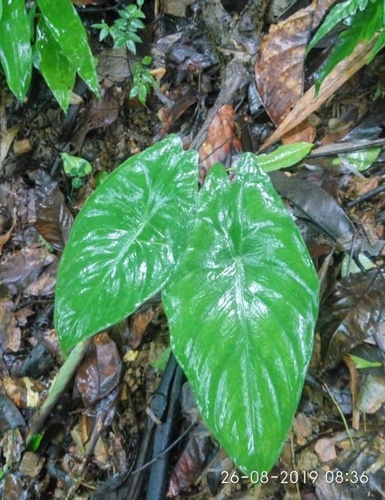
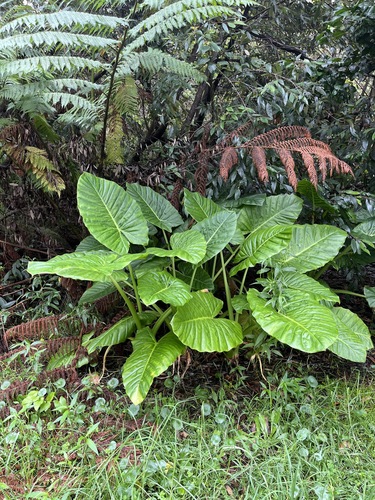
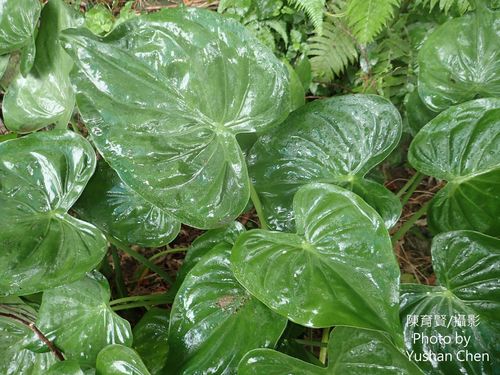
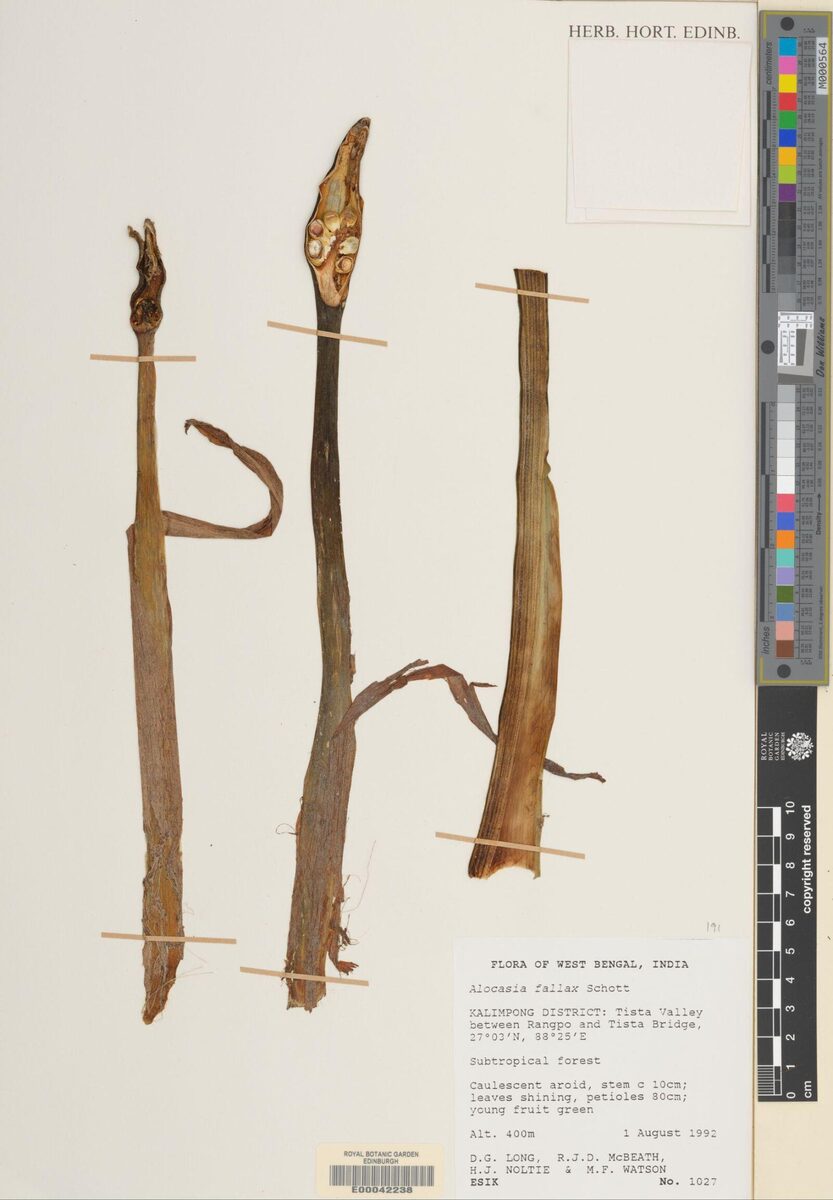
A herb. It has a disk shaped tuber. This is 10-25 cm across and 5-10 cm deep. It is dark red brown. The leaf is 1-1.5 m tall and 1 m across. The leaf appears after the flower. The leaf stalk is 1 m long and 4 cm across and purple black with dark green and cream spots. The leaf blade is divided into leaflets and the end leaflets are 6-12 cm long by 2-5 cm wide. They have a tip at the end. Underneath the leaflets are reddish and the veins are raised. The edges can be wavy. The flowering stalk is 30-100 cm long and 1-3 cm across. It is light purple with dark purple spots. The spathe is erect and 18-35 cm long. It forms a cone shaped tube without a constriction. The inside at the base is dark violet. The spadix is 15-40 cm long.
Edible Uses
The corms and tubers are eaten only after extensive processing and in combination with other foods, as the plant is dried before preparation.
Traditional Uses
The corms or tubers are only eaten along with other foods and after extensive processing. They contain oxalates and the plant is dried before preparation.
Medicinal Uses
Used as a famine food.
Known Hazards
The plant contains oxalates, requiring careful processing before consumption.
Distribution
It is a tropical plant.
Where It Grows
Africa, East Africa, Ethiopia,
Other Information
It is a famine food.
Nutrition
| Part | Moisture | kJ | kcal | Protein | Vit A | Vit C | Iron | Zinc |
|---|---|---|---|---|---|---|---|---|
| Tubers | 84.5 | — | — | 0.9 | — | — | 1.4 | 0.2 |
Also Known As
Laye, Paganna, Pakanna, Poganna, Qachama
References (5)
- Addis, G., et al, 2013, Dietary values of wild and semi-wild edible plants in Southern Ethiopia. African Journal of Food, Agriculture, Nutrition and Development. 13(2)
- Addis, G., Asfaw, Z & Woldu, Z., 2013, Ethnobotany of Wild and Semi-wild Edible Plants of Konso Ethnic Community, South Ethiopia. Ethnobotany Research and Applications. 11:121-141
- Ashagre, M., et al, 2016, Ethnobotanical study of wild edible plants in Burji District, Segan Area Zone of Southern Nations, Nationalities and Peoples Region (SNNPR), Ethiopia. Journal of Ethnobiology and Ethnomedicine (2016) 12:32
- Lulekal, E., et al, 2011, Wild edible plants in Ethiopia: a review on their potential to combat food insecurity. Afrika Focus - Vol. 24, No 2. pp 71-121
- Ocho, D. L., et al, 2012, Assessing the levels of food shortage using the traffic light metaphor by analyzing the gathering and consumption of wild food plants, crop parts and crop residues in Konso, Ethiopia. Journal of Ethnobiology and Ethnomedicine 8:30