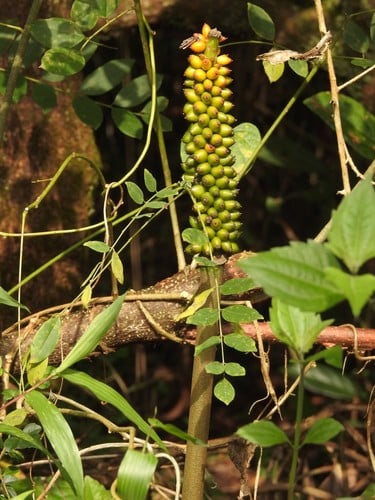
Xanthosoma brasiliense
(Deaf.) Engl.
Tannia spinach
iNaturalist· cc-by
(c) Alan Rockefeller, some rights reserved (CC BY), uploaded by Alan Rockefeller
iNaturalist· cc-by
(c) Alan Rockefeller, some rights reserved (CC BY), uploaded by Alan Rockefeller
Summary
Source: WikipediaXanthosoma brasiliense is a species of flowering plant in the Araceae. Common names include Tahitian spinach, tannier spinach, belembe, and Tahitian taro. It is one of several leaf vegetables used to make callaloo, and it may be called calalu in Puerto Rico. This plant is a perennial herb with large leaf blades borne on long petioles up to 60 centimeters (nearly 2 feet). The plant can reach one meter (3.28 feet) in height. This plant was domesticated in the Amazon and it is now grown throughout tropical regions of the world. The leaves and stems are cooked and eaten as vegetables. It is cooked to remove calcium oxalate crystals, which are present in the leaves of aroids. Unlike some other tannia (Xanthosoma spp.), the corms are not used for food because they are small and underdeveloped.
Description
A large herb. It grows about 1 m tall. It keeps growing from year to year. The tubers are tiny but not acrid. The plant is usually grown for its edible leaves. The leaf stalks are 60 cm long.
Edible Uses
Leaves and stems - cooked. The tender young leaves have a mild flavour and are preferred by some people to the older leaves. However, the stronger flavour of the older leaves is usually preferred by people who have become accustomed to them. The leaves make an excellent spinach so long as they are not overcooked, and are widely seen as a very superior type of spinach. The leaves wilt quite rapidly after harvesting and so should either be consumed immediately or stored in a cool place wrapped in banana leaves or something similar in order to keep them fresh. A good source of calcium, phosphorus, vitamins A and C, though they contain only 3% protein. See notes above on toxicity before eating the corm. Corms - cooked. The corms are quite small and not very starchy, so they are not often used as a food. See notes above on toxicity before eating the leaves.
Traditional Uses
The leaves, stems and upper portion of the leaf stalks are used as potherbs.
This uses section is brief — help expand it
Known Hazards
All parts of the plant contain calcium oxalate crystals. This substance is toxic fresh and, if eaten, makes the mouth, tongue and throat feel as if hundreds of small needles are digging in to them. However, calcium oxalate is easily broken down either by thoroughly cooking the plant or by fully drying it and, in either of these states, it is safe to eat the plant. People with a tendency to rheumatism, arthritis, gout, kidney stones and hyperacidity should take especial caution if including this plant in their diet.
Distribution
A tropical plant. It thrives in hot wet conditions. It will not grow well in sandy soils or soils low in organic matter. It will grow in soils with a pH between 5.0 - 8.0. It can tolerate shade and be intercropped with bananas or coconut.
Where It Grows
Amazon, Brazil, Caribbean, Central America, Colombia, Curacao, Dominican Republic, FSM, Guyana, Haiti, Hawaii, Leeward Is., Lesser Antilles, Pacific, Pohnpei, Puerto Rico, South America, Trinidad-Tobago, Tuvalu, West Indies,
Cultivation
It is grown as a leaf vegetable. It take a about 0.5 share metres of space or 20,000 plants per hectare. It is usually grown from corms or stem cuttings.
Propagation
Seed - Division. The small corms can be removed from the main plant and then replanted at any time of the year when there is sufficient moisture in the soil.
Production
It produces nutritious green leaves year round and will continue to produce for up to 2 years.
Other Information
It is a commercially cultivated vegetable.
Notes
There are 57 Xanthosoma species.
Nutrition
| Part | Moisture | kJ | kcal | Protein | Vit A | Vit C | Iron | Zinc |
|---|---|---|---|---|---|---|---|---|
| Leaves | 92 | 100 | 24 | 2.2 | 573 | 43 | 2.9 | 0.3 |
Synonyms
Also Known As
Belembe, Calalu, Carib cabbage, Tahitian spinach, Quelembe
References (21)
- Barrau, J., 1976, Subsistence Agriculture in Polynesia and Micronesia. Bernice P. Bishop Museu, Bulletin 223 Honolulu Hawaii. Kraus reprint. p 56
- Brown, D., 2000, Aroids. Plants of the Arum family. Timber Press. (Second edition) p 261
- Facciola, S., 1998, Cornucopia 2: a Source Book of Edible Plants. Kampong Publications, p 25
- Hermandez Bermejo, J.E., and Leon, J. (Eds.), 1994, Neglected Crops. 1492 from a different perspective. FAO Plant Production and Protection Series No 26. FAO, Rome. p17
- Kays, S. J., and Dias, J. C. S., 1995, Common Names of Commercially Cultivated Vegetables of the World in 15 languages. Economic Botany, Vol. 49, No. 2, pp. 115-152
Show all 21 references Hide references
- Kermath, B. M., et al, 2014, Food Plants in the Americas: A survey of the domesticated, cultivated and wild plants used for Human food in North, Central and South America and the Caribbean. On line draft. p 926
- Kew Plants of the World Online
- Omawale, 1973, Guyana's edible plants. Guyana University, Georgetown p 108
- Martin, F.W., & Ruberte, R.M., 1979, Edible Leaves of the Tropics. Mayaguez, Puerto Rico p 20, 176
- Massal, E. and Barrau, J., 1973, Food Plants of the South Sea Islands. SPC Technical Paper No 94. Nounea, New Caledonia. p 34
- Oomen, H.A.P.C., & Grubben, G.J.H., 1978, Tropical Leaf Vegetables in Human Nutrition, Communication 69, Department of Agricultural research, RTI Amsterdam, p 79
- Pflanzenr. IV. 23E(Heft 71):58. 1920
- Purseglove, J.W., 1972, Tropical Crops. Monocotyledons. Longmans p 69
- Terra, G.J.A., 1973, Tropical Vegetables. Communication 54e Royal Tropical Institute, Amsterdam, p 82
- Thaman, R. R, 2016, The flora of Tuvalu. Atoll Research Bulletin No. 611. Smithsonian Institute p 41
- The Pacific Islands Food Composition Tables http://www.fao.org/docrep No C083
- Tindall, H.D., & Williams, J.T., 1977, Tropical Vegetables and their Genetic Resources, International Board for Plant Genetic Resources, Rome, p 107
- USDA, ARS, National Genetic Resources Program. Germplasm Resources Information Network - (GRIN). [Online Database] National Germplasm Resources Laboratory, Beltsville, Maryland. Available: www.ars-grin.gov/cgi-bin/npgs/html/econ.pl (10 April 2000)
- Wiersema, J. H. & Leon, B., 2013, World Economic Plants. A Standard Reference CRC Press. 2nd Ed. p 730
- Woodward, P., 2000, Asian Herbs and Vegetables. Hyland House. p 134
- World Checklist of Useful Plant Species 2020. Royal Botanic Gardens, Kew