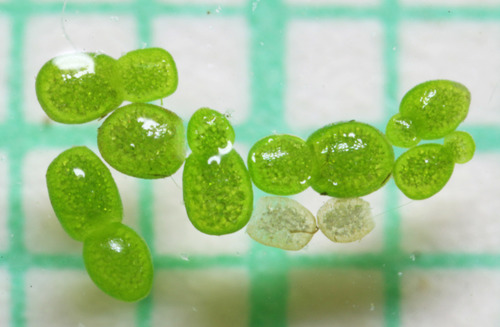
Amorphophallus albus
P. Y. Liu & J. F. Chen
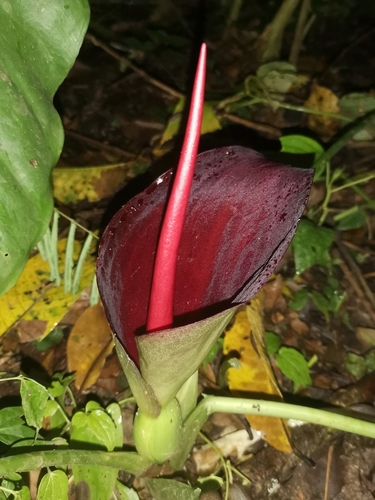
iNaturalist· cc-by-nc
(c) konrad-m-a-kaczmarek, some rights reserved (CC BY-NC)
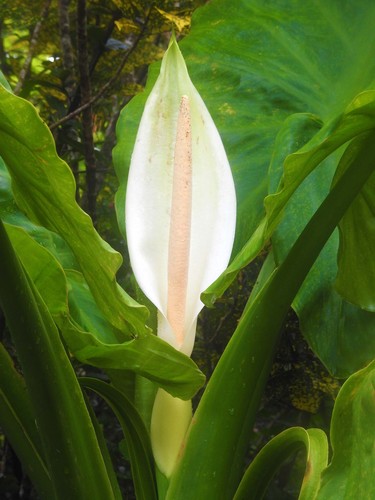
iNaturalist· cc-by-nc
(c) konrad-m-a-kaczmarek, some rights reserved (CC BY-NC)
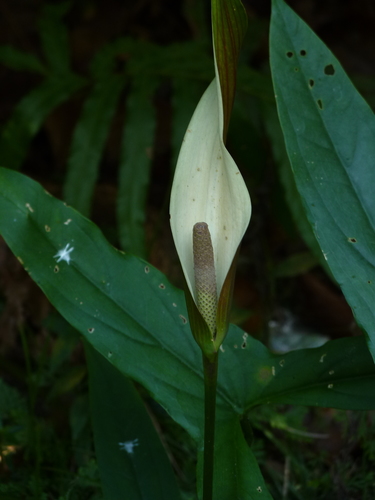
iNaturalist· cc-by-nc
(c) 刘光裕 Liu Guangyu, some rights reserved (CC BY-NC), uploaded by 刘光裕 Liu Guangyu
Summary
Source: WikipediaAmorphophallus albus, the white voodoo lily or dwarf white voodoo lily, is a species of flowering plant in the family Araceae. It is native to southern Sichuan and northeastern Yunnan. A tuberous geophyte, it is typically found in dry thickets and open woodlands at elevations from 800 to 1,000 m (2,600 to 3,300 ft). It is grown as a crop in Yunnan, and is occasionally available elsewhere from specialty nurseries.
Description
A large herb that keeps growing from year to year. It has one leaf on a stalk 70 cm long. The leaf is 80 cm across. It has a large tuber under the ground. The tuber is 7-10 cm wide and 5-6 cm tall.
Edible Uses
Tuber - cooked. The corm must be thoroughly boiled or baked, it is acrid when raw (see notes above on 'Known Hazards'). The fresh corms are turned into curd, or are chopped then dried. The curd is relatively tasteless, but it absorbs flavours well and so can be used as a carbohydrate element in a wide range of other foods. The tuber can be 7 - 10cm in diameter and 5 - 6cm tall.
Traditional Uses
The tuber is cooked and eaten. The tuber can be chopped and dried. Caution: It probably contains oxalates.
This uses section is brief — help expand it
Known Hazards
Although no specific mention has been seen for this species, it belongs to a family where most of the members contain calcium oxalate crystals. This substance is toxic fresh and, if eaten, makes the mouth, tongue and throat feel as if hundreds of small needles are digging in to them. However, calcium oxalate is easily broken down either by thoroughly cooking the plant or by fully drying it and, in either of these states, it is safe to eat the plant. People with a tendency to rheumatism, arthritis, gout, kidney stones and hyperacidity should take especial caution if including this plant in their diet.
Distribution
It is a tropical plant. It grows in open forest. It occurs between 800-1,000 m in southern China. In Sichuan and Yunnan.
Where It Grows
Asia, China,
Cultivation
It is grown from small tubers. Plants can be grown from seed.
Propagation
Seed - usually germinates easily and well.
Other Information
It is occasionally cultivated.
References (2)
- Brown,
- Fern, K., 2012, Tropical Species Database http://theferns.info/tropical/