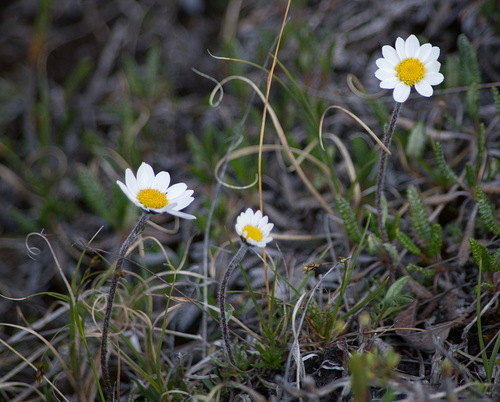
Wollastonia biflora
(L.) DC
Wedelia, Sunflower daisy, Beach Sunflower
iNaturalist· cc0
no rights reserved, uploaded by 葉子
iNaturalist· cc0
no rights reserved, uploaded by 葉子
iNaturalist· cc0
no rights reserved, uploaded by 葉子
Summary
Source: WikipediaWollastonia biflora (syn. Melanthera biflora) also known as sea daisy, beach daisy and sea ox-eye, is a species of flowering plant in the family Asteraceae. It is a scandent, rough-looking and fast-growing plant with a wide distribution.
Description
A trailing shrub which is rough to the touch. It grows to 2m long. The leaves are opposite and shallowly toothed. They are up to 10-15 cm long and 8-10 cm wide. The stalks are long. There are three nerves near the base. The leaf stalk is 3-4 cm long. The flower heads are about 2.5 cm wide. These develop at the ends of branches or from the axils of the upper leaves. There are about 8 flowers around the edge then 20-30 flowers in the central disk. The fruit are wedge shaped and 2-3 mm long.
Edible Uses
Young leaves are cooked with fish for flavouring and eaten. The leaves and roots are used to make a tea drink, though only small amounts should be consumed.
Traditional Uses
The young leaves are cooked with fish to give it flavour, then eaten. The leaves and roots are used to make a tea drink. Only small amounts should be eaten. CAUTION: The flowers and old leaves are claimed to be poisonous.
Medicinal Uses
Despite the rough appearance of the plant, the leaves are edible. In Malaysian cuisine the shoots are eaten cooked as a leaf vegetable and in Langkawi they are eaten raw with chilli and sambal shrimp paste. Leaves also have traditional medicinal uses as poultice or as decoction. Wollastonia biflora has traditionally been used as a medicinal plant in many cultures, including in Marovo in the Solomon Islands. Leaves are especially valued against stomachache. In Fiji the leaves are used to treat acne. Root extracts have anthelmintic properties and flowers can be used as a purgative. This plant is also used as fodder for rabbits.
Known Hazards
The flowers and old leaves are claimed to be poisonous.
Distribution
A tropical plant. They are mostly along rocky shores. In Papua New Guinea they occur from sea level to 700 m altitude. In Sichuan and Yunnan.
Where It Grows
Africa, American Samoa, Asia, Australia, China, East Africa, Fiji, India, Indochina, Indonesia, Japan, Kiribati, Malaysia, Maldives, Marshall Islands, Micronesia, New Caledonia, Pacific, Papua New Guinea, PNG, Philippines, Rotuma, SE Asia, Solomon Islands, Taiwan, Thailand, Tibet, Tonga, Tuvalu, Vanuatu, Vietnam, Yap,
Notes
It is used in medicine.
Synonyms
Also Known As
Ateate, Atiat, Bunga butang, Butsu kaune, Eatheuth, Etuwet, Masigmasig, Merihi, Pak-krat-talay, Pokok serunai, Saruni, Seremai, Serunai laut, Sonki, Te kaura, Thuh, Vuenue, Wal, Yatuyet
References (25)
- Altschul, S.V.R., 1973, Drugs and Foods from Little-known Plants. Notes in Harvard University Herbaria. Harvard Univ. Press. Massachusetts. no. 4805 (As Wedelia biflora)
- Ambasta, S.P. (Ed.), 2000, The Useful Plants of India. CSIR India. p 687 (As Wedelia biflora)
- Barrau, J., 1976, Subsistence Agriculture in Melanesia. Bernice P. Bishop Museu, Bulletin 219 Honolulu Hawaii. Kraus reprint. p 59 (As Wedelia biflora)
- Borrell, O.W., 1989, An Annotated Checklist of the Flora of Kairiru Island, New Guinea. Marcellin College, Victoria Australia. p 64 (As Wedelia biflora)
- Burkill, I.H., 1966, A Dictionary of the Economic Products of the Malay Peninsula. Ministry of Agriculture and Cooperatives, Kuala Lumpur, Malaysia. Vol 2 (I-Z) p 2294 (As Wedelia biflora)
Show all 25 references Hide references
- Cabalion, P. and Morat, P., 1983, Introduction le vegetation, la flore et aux noms vernaculaires de l'ile de Pentcoste (Vanuatu), In: Journal d'agriculture traditionnelle et de botanique appliquee JATBA Vol. 30, 3-4
- Facciola, S., 1998, Cornucopia 2: a Source Book of Edible Plants. Kampong Publications, p 45 (As Wedelia biflora)
- French, B.R., 2010, Food Plants of Solomon Islands. A Compendium. Food Plants International Inc. p 394 (As Wedelia biflora)
- Henty, E.E., & Pritchard, G.S., 1973, Weeds of New Guinea and their control. Botany Bulletin No 7, Division of Botany, Lae, PNG. p 88 (As Wedelia biflora)
- Kuo, W. H. J., (Ed.) Taiwan's Ethnobotanical Database (1900-2000), http://tk.agron.ntu.edu.tw/ethnobot/DB1.htm (As Wedelia biflora)
- Lebot, V. & Sam, C., Green desert or ‘all you can eat’? How diverse and edible was the flora of Vanuatu before human introductions?. Terra australis 52 p 410
- Martin, F.W. & Ruberte, R.M., 1979, Edible Leaves of the Tropics. Antillian College Press, Mayaguez, Puerto Rico. p 186 (As Wedelia biflora)
- Massal, E. and Barrau, J., 1973, Food Plants of the South Sea Islands. SPC Technical Paper No 94. Noumea, New Caledonia. p 36 (As Wedelia biflora)
- McClatchey, W. C., 2012, Wild food plants of Remote Oceania. Acta Societatis Botanicorum Poloniae. 81(4):371-380
- McMakin, P.D., 2000, Flowering Plants of Thailand. A Field Guide. White Lotus. p 74 (As Wedelia biflora)
- Peekel, P.G., 1984, (Translation E.E.Henty), Flora of the Bismarck Archipelago for Naturalists, Division of Botany, Lae, PNG. p 561, 560 (As Wedelia biflora)
- Scarth-Johnson, V., 2000, National Treasures. Flowering Plants of Cooktown and Northern Australia. Vera Scarth-Johnson Gallery Association. Cooktown, Australia. p 50 (As Wedelia biflora)
- Sujanapal, P., & Sankaran, K. V., 2016, Common Plants of Maldives. FAO & Kerala FRI, p 282
- Thaman, R. R., 1987, Plants of Kiribati: A listing and analysis of vernacular names. Atoll Research Bulletin No. 296 (As Wollastonia)
- Thaman, R. R, 2016, The flora of Tuvalu. Atoll Research Bulletin No. 611. Smithsonian Institute p 70
- R. Wight, Contr. bot. India 18. 1834 (As Wedelia biflora)
- Williams, K.A.W., 1999, Native Plants of Queensland Volume 4. Keith A.W. Williams North Ipswich, Australia. p 382 (As Wedelia biflora)
- World Checklist of Useful Plant Species 2020. Royal Botanic Gardens, Kew
- www.manoa.hawaii.edu/botany/plants of micronesia
- Yuncker, T.G., 1959, Plants of Tonga, Bernice P. Bishop Museum, Hawaii, Bulletin 220. p 267 (As Wedelia biflora)