Eutrema japonicum
(Miq.) Koidz.
Wasabi, Japanese horseradish
iNaturalist· cc-by-nc-nd
(c) noe**, some rights reserved (CC BY-NC-ND)
iNaturalist· cc0
no rights reserved
iNaturalist· cc0
no rights reserved
Description
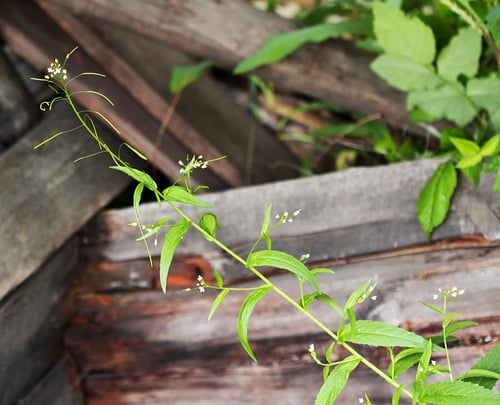
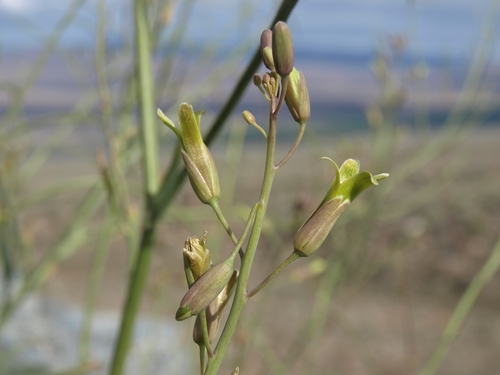
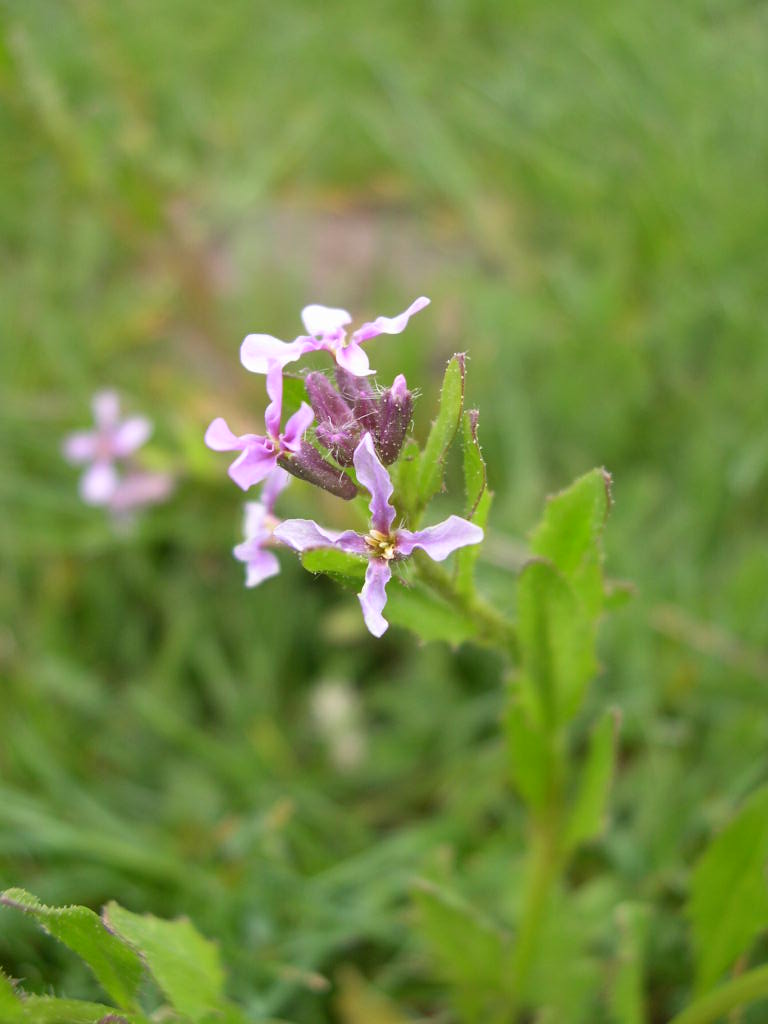
A cabbage family herb. It is a small plant which grows up to 40-60 cm high. It keeps growing from year to year. The plant has a stout rhizome. It has thick stems. It is knobbly and grey-green. The leaves are crinkled and heart shaped. They are like pumpkin leaves. The flowers are small and white. They have 4 petals. The fruit are long narrow seed pods.
Edible Uses
The rhizome is scraped and finely ground to make wasabi, a pungent spice. The leaves, flowers, leaf stalks, and freshly sliced rhizome are also used, typically soaked in salt water to make pickles.
Traditional Uses
The underground stems or rhizomes are used as a spice called wasabi. It has a strong fiery taste. The outer skin is scraped off and the green inner part finely ground. The leaves, flowers are leaf stalks and freshly sliced rhizome are soaked in salt water then used to make a pickle.
Medicinal Uses
Traditional uses indicate culinary and preservative applications through pickling.
Known Hazards
The rhizome has a very strong, fiery taste due to sinigrin content.
Distribution
It is a temperate plant. It grows beside cold mountain streams. The small roots grow best in clear streams. It needs good aeration around the roots. Wasabi requires cool shady conditions. It is cultivated, also naturalised in wet areas along streams in mountains; near sea level to 2500 m altitude in China.
Where It Grows
Asia, Australia, China, Japan, Korea, New Zealand, North America, Russia, Taiwan, Tasmania, USA,
Production
The rhizomes take 2-3 years to develop. The rhizome should be used fresh as it quickly loses its flavour.
Other Information
It is a cultivated food plant.
Notes
Chemical composition: Protein = 5.1%. Fat = 0.2%. Carbohydrate = 22.3%. Ash = 1.27%. The main compound causing the pungent taste is sinigrin.
Nutrition
| Part | Moisture | kJ | kcal | Protein | Vit A | Vit C | Iron | Zinc |
|---|---|---|---|---|---|---|---|---|
| Root | 69.1 | 456 | 109 | 4.8 | 0 | 41.9 | 1 | 1.6 |
Synonyms
Also Known As
Asian horseradish, Kuai jing shan yu cai, Mountain hollyhock, Raifort du japon, Shan yu cai
References (28)
- Arora, R. K., 2014, Diversity in Underutilized Plant Species - An Asia-Pacific Perspective. Bioversity International. p 51, 110 (As Wasabia japonica)
- Bremness, L., 1994, Herbs. Collins Eyewitness Handbooks. Harper Collins. p 226 (As Wasabia japonica)
- Bull. Acad. Imp. Sci. Saint-Petersbourg 18:283. 1873 (Diagn. pl. nov. jap.)
- Chen, B. & Qiu, Z., Consumer's Attitudes towards Edible Wild Plants, Ishikawa Prefecture, Japan. p 23 www.hindawi.com/journals/ijfr/aip/872413.pdf (As Eutrema japonica)
- Chew, M. & Morgan, W., 1999, Access to Asian Foods Newsletter, Vic Govt., Australia Issue 5 (As Wasabia japonica)
Show all 28 references Hide references
- Facciola, S., 1998, Cornucopia 2: a Source Book of Edible Plants. Kampong Publications, p 58
- Flora of China. www.eFloras.org (As Eutrema wasabi)
- Food Composition Tables for use in East Asia FAO http://www.fao.org/infoods/directory No. 788
- Fujime, Y., 2012, Introduction to Some Indigenous Vegetables in Japan. HortScience Vol. 47(7) July 2012. p 831 (As Wasabia japonica)
- Hedrick, U.P., 1919, (Ed.), Sturtevant's edible plants of the world. p 304
- Hemphill, I, 2002, Spice Notes. Macmillan. p 206 (As Wasabia japonica)
- Hu, Shiu-ying, 2005, Food Plants of China. The Chinese University Press. p 416, and 422 (As Wasabia japonica)
- Hui, Y. H., Handbook of Food Science, Technology, and Engineering. Volume 2. Table 98:8 (As Eutrema wasabi)
- Kays, S. J., and Dias, J. C. S., 1995, Common Names of Commercially Cultivated Vegetables of the World in 15 languages. Economic Botany, Vol. 49, No. 2, pp. 115-152 (As Wasabia japonica)
- Kiple, K.F. & Ornelas, K.C., (eds), 2000, The Cambridge World History of Food. CUP p 1876 (As Wasabia japonica)
- Larkcom, J., 1991, Oriental Vegetables, John Murray, London, p 131 (As Wasabia japonica)
- Lim, T. K., 2015, Edible Medicinal and Non Medicinal Plants. Volume 9, Modified Stems, Roots, Bulbs. Springer p 42, 86
- Ong, H. G., et al, 2015, Ethnobotany of the wild edible plants gathered in Ulleung Island, South Korea. Genet Resourc Crop Evol. Springer (As Eutrema wasabi)
- Plants for a Future database, The Field, Penpol, Lostwithiel, Cornwall, PL22 0NG, UK. http://www.scs.leeds.ac.uk/pfaf/ (As Wasabia japonica)
- READ,
- Romanowski, N., 2007, Edible Water Gardens. Hyland House. p 78 (As Wasabia japonica)
- Solomon, C., 2001, Encyclopedia of Asian Food. New Holland. p 403 (As Wasabia japonica)
- Thomson, G. & Morgan, W., (Ed.) 1999, Access to Asian Foods Newsletter, Vic Govt., Australia Issue 7; 2001 Issue 9 (As Wasabia japonica)
- van Wyk, B., 2005, Food Plants of the World. An illustrated guide. Timber press. p 385 (As Wasabia japonica)
- Wiersema, J. H. & Leon, B., 2013, World Economic Plants. A Standard Reference CRC Press. 2nd Ed. p 297
- World Checklist of Useful Plant Species 2020. Royal Botanic Gardens, Kew
- Zeven, A. C. & de West, J. M. J., 1982, Dictionary of cultivated plants and their regions of diversity. Wageningen. p 35
- Zhou Taiyan, Lu Lianli, Yang Guang; Ihsan A. Al-Shehbaz, BRASSICACEAE (CRUCIFERAE), Flora of China. Vol. 8 p 177