Asarum canadense
Linn.
Wild ginger, Canada Snakeroot, Vermont snakeroot, Heart snakeroot, American wild ginger
iNaturalist· cc-by
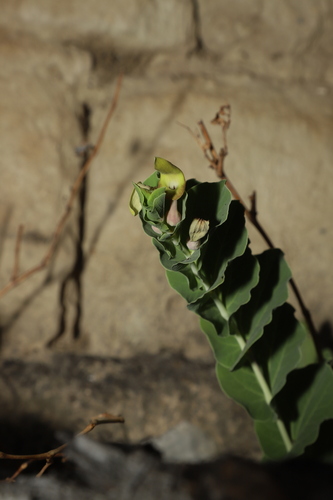
(c) Nathan Aaron, some rights reserved (CC BY), uploaded by Nathan Aaron
iNaturalist· cc-by
(c) Ryan Sorrells, some rights reserved (CC BY), uploaded by Ryan Sorrells
iNaturalist· cc-by-nc
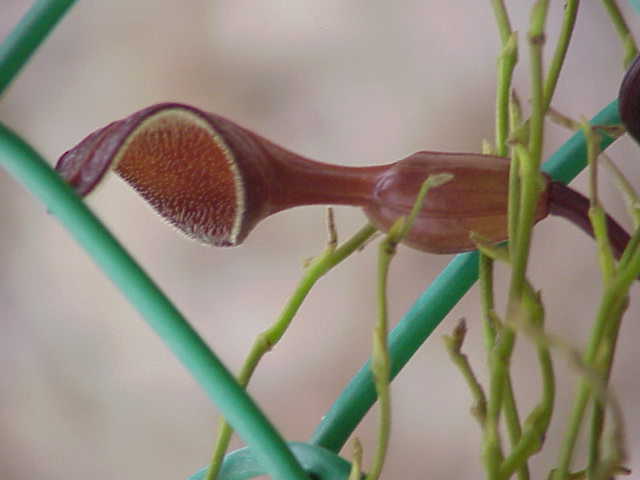
(c) ap90, some rights reserved (CC BY-NC), uploaded by ap90
Summary
Source: WikipediaAsarum canadense, commonly known as Canada wild ginger, Canadian snakeroot, Indian Ginger, Coltsfoot, and Broad-Leaved Asarabacca, is a herbaceous, perennial plant. It should not be confused for Asarum reflexum, a closely related species, or Asarum acuminatum, a variety of A. canadense. It forms dense colonies in the understory of deciduous forests throughout its native range in eastern North America. It is protected as a threatened species in Maine due to habitat loss. The species has been used by Native Americans for cooking and medicine, although recent research has suggested that compounds within the plant could cause negative health problems.
Description
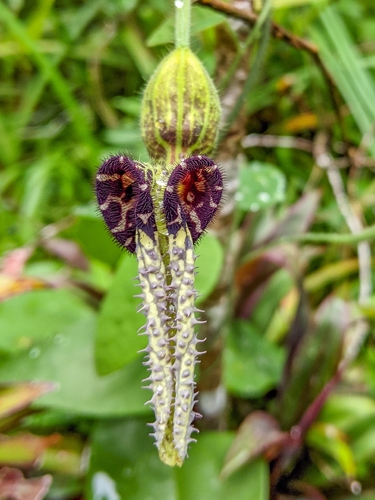
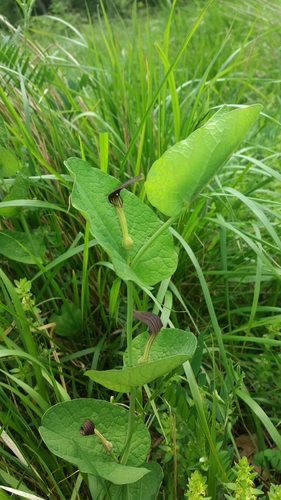
A small evergreen herb. It can grow 1 m tall. It lies along the ground and has a ginger smell. It has a slender underground stem or rhizome. The leaves are dark green, hairy and heart shaped. They are 5-20 cm across. The flowers are urn shaped and purple brown. They are on short stalks near the ground.
Edible Uses
Edible Parts: Edible Uses: Condiment The underground stem and the flowers are used as a ginger substitute. The root, especially when quite dry, has a pungent, aromatic smell like mild pepper and ginger mixed, but more strongly aromatic. The root is best harvested in autumn but is available all year round. It can be dried for later use.
Traditional Uses
The young rootstocks are cut into pieces and boiled for an hour then simmered for 20-30 minutes in a rich sugar solution. These make a sweet. The dried and rushed rootstocks can be used as a substitute for ginger. The flowers can also be used as flavouring. Caution: It can contain Aristolochic acid that damages the liver and kidneys and also asarone which causes cancer. It should not be taken by pregnant women.
Medicinal Uses
Anthelmintic Antiasthmatic Antibiotic Antitumor Carminative Contraceptive Diaphoretic Diuretic Expectorant Irritant Poultice Salve Stimulant Stomachic Tonic Snake root was widely employed as a medicinal herb by a number of native North American tribes who used it to treat a wide range of ailments. It is still occasionally used in modern herbalism. The root is anthelmintic, carminative, diaphoretic, diuretic, expectorant, irritant, powerfully stimulant, stomachic and tonic. It is harvested in the autumn and dried for later use. It is used in the treatment of chronic chest complaints, asthma, coughs, colds, dropsy, painful spasms of the bowels and stomach, scant or painful menstruation, infantile convulsions. The fresh leaves are applied as a poultice to wounds and inflammations, whilst a decoction or salve is applied to sores. The root contains antibiotic substances effective against broad-spectrum bacteria and fungi. It also contains aristolochic acid, which has antitumor activity. The root and rhizome were slowly boiled in a small quantity of water for a long time and the resulting liquid drunk as a contraceptive by the women of one N. American Indian tribe.
Known Hazards
The leaves are poisonous. Handling the leaves is said to cause dermatitis in some people.
Distribution
It is a temperate plant. It grows in rich woods, near rocks. It is resistant to frost but damaged by drought. It suits hardiness zone 2-8.
Where It Grows
Australia, Canada, North America, USA,
Cultivation
Prefers a rich moist neutral to acid soil in woodland or a shady position in the rock garden. Plants are found on alkaline soils in the wild. Plants are hardy to at least -25°c. The flowers are malodorous and are pollinated by flies. Plants often self-sow when growing in a suitable position.
Propagation
Seed - best sown in a cold frame as soon as it is ripe in the summer. Stored seed will require 3 weeks cold stratification and should be sown in late winter. The seed usually germinates in the spring in 1 - 4 or more weeks at 18°c. When large enough to handle, prick the seedlings out into individual pots and grow them on in light shade in the greenhouse for at least their first winter. Plant them out when large enough in late spring. Division in spring or autumn. Plants are slow to increase. It is best to pot the divisions up and keep them in light shade in the greenhouse until they are growing away strongly.
Other Uses
Incense The slightly roasted root can be ground into a powder and then sprinkled onto clothing for perfume. A useful ground cover for a shady position so long as it is not dry, spreading by its roots. Special Uses Food Forest Ground cover Scented Plants
Notes
There are about 70-100 Asarum species. They are mainly temperate in the Northern hemisphere.
Also Known As
Ginger root, Heart snakeroot, Indian ginger, Woodland ginger
References (19)
- Beckstrom-Sternberg, Stephen M., and James A. Duke. "The Foodplant Database." http://probe.nalusda.gov:8300/cgi-bin/browse/foodplantdb.(ACEDB version 4.0 - data version July 1994)
- Bircher, A. G. & Bircher, W. H., 2000, Encyclopedia of Fruit Trees and Edible Flowering Plants in Egypt and the Subtropics. AUC Press. p 44
- Bodkin, F., 1991, Encyclopedia Botanica. Cornstalk publishing, p 106
- Bremness, L., 1994, Herbs. Collins Eyewitness Handbooks. Harper Collins. p 149
- Brown, D., 2002, The Royal Horticultural Society encyclopedia of Herbs and their uses. DK Books. p 134
Show all 19 references Hide references
- Esperanca, M. J., 1988. Surviving in the wild. A glance at the wild plants and their uses. Vol. 2. p 330
- Facciola, S., 1998, Cornucopia 2: a Source Book of Edible Plants. Kampong Publications, p 31
- Hedrick, U.P., 1919, (Ed.), Sturtevant's edible plants of the world. p 78
- Hibbert, M., 2002, The Aussie Plant Finder 2002, Florilegium. p 33
- Jackes, D. A., Edible Forest Gardens
- Kermath, B. M., et al, 2014, Food Plants in the Americas: A survey of the domesticated, cultivated and wild plants used for Human food in North, Central and South America and the Caribbean. On line draft. p 91
- Kiple, K.F. & Ornelas, K.C., (eds), 2000, The Cambridge World History of Food. CUP p 1881
- Lim, T. K., 2015, Edible Medicinal and Non Medicinal Plants. Volume 9, Modified Stems, Roots, Bulbs. Springer p 13
- MacKinnon, A., et al, 2009, Edible & Medicinal Plants of Canada. Lone Pine. p 203
- Ryan, S., 2008, Dicksonia. Rare Plants Manual. Hyland House. p 96
- Seidemann J., 2005, World Spice Plants. Economic Usage, Botany, Taxonomy. Springer. p 57
- Sp. pl. 1:442. 1753
- Toupal, R. S. & Hollenback, K., 2009, An Ethnobotany of Indiana Dunes National Lakeshore: Plant Uses of the Ojibwa People. Bureau of Applied research in Anthropology. University of Arizona
- Tozer, F., 2007, The Uses of Wild Plants. Green Man Publishing. p 38