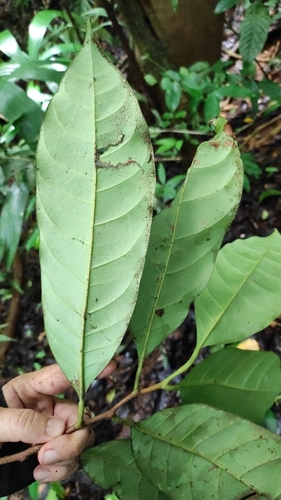
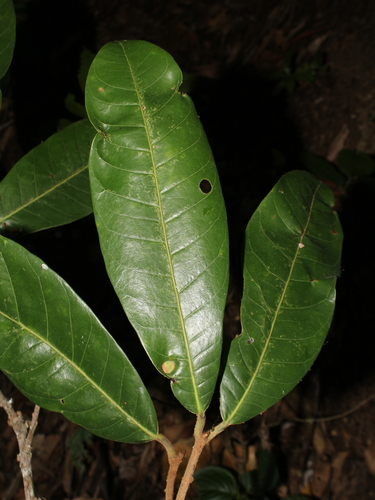
Vitellaria paradoxa
C. F. Gaertn.
Karite-nut, Shea, Shea-buttertree
iNaturalist· cc-by-nc
(c) KOUAGOU Damien, some rights reserved (CC BY-NC)
iNaturalist· cc-by-nc-sa
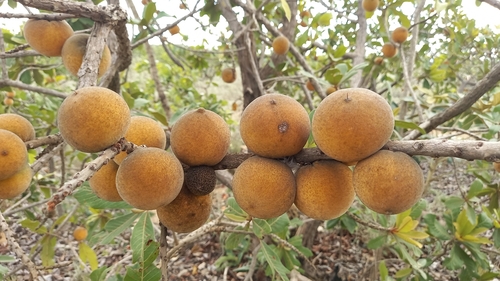
(c) Enrico Castello, some rights reserved (CC BY-NC-SA), uploaded by Enrico Castello
iNaturalist· cc-by-nc
(c) lale2023, some rights reserved (CC BY-NC)
Summary
Source: WikipediaA deciduous tree reaching 15m tall and wide, growing slowly, hardy to UK zone 10. Self-fertile with bee-pollinated flowers. Notable for attracting wildlife. Adapts to light, medium, or heavy soils with good drainage and tolerates poor soil fertility. Grows in mildly acidic to basic pH soils in semi-shade or full sun, adapting to dry or moist conditions.
Description
A deciduous tree. A compact tree which loses its leaves during the year. It grows to 15-25 m tall and has a spreading crown. The trunk is short and stout and can be 2 m across. The bark is corky. The bark is dark with cracks making it look like a crocodile skin. White latex come out when the bark is cut. The branches bend backwards almost to the ground when the leaves are wet. The leaves are oblong with wavy edges and clustered at the ends of branches. They are leathery and shiny. They are 10-25 cm long and 5-8 cm wide. The leaves are reddish when young. The flowers have both sexes and are produced in the dry season before the leaves. The flowers are white and clustered at the ends of shoots. They are about 1 cm long. They have a sweet smell. These are produced during the dry season when the tree has no leaves. The fruit are a flattened round shape and 4-5 cm across. The fruit stalk is 1-3 cm long. The fleshy layer is about 1 mm thick. When the fruit is green is exudes latex and the fruit turns brown when ripe. There can be one or up to 4 seeds which are shiny brown. The seeds have a white scar down the side. They have a white kernel and a fragile husk.
Edible Uses
The kernel of the seed (often incorrectly called a nut) contains a vegetable fat known as shea butter. Shea butter from fresh seeds is white, odourless, and of high quality, while that from stale seeds is dark and tastes bitter. High-quality shea butter is widely consumed across West Africa as a cooking fat, and refined versions have been marketed as margarine and baking fat. It is useful in pastries and confectionery because it makes dough pliable. Its similar melting point to cocoa butter (32–45°C), combined with high di-stearin content (30%) and some stearo-palmitine (6.5%), makes it a practical cocoa butter substitute that blends without altering flow properties. Traditional processing involves removing fruit pulp by fermentation or boiling, then boiling and sun- or kiln-drying the seeds (sun-drying may take 5–10 days). The dried seeds are cracked with a mortar and pestle or stones, kernels removed by trampling and redried, then crushed, ground, and kneaded into a paste. This paste is heated in water and churned until a grey, oily fat separates from the emulsion; the fat is skimmed off and washed to remove impurities, then may be further refined and moulded. This traditional method is inefficient and labour-intensive; mechanisation using hydraulic or continuous screw expellers, solvent extraction, or pre-treatment of the kernel paste with enzymes such as proteases and cellulases can substantially improve extraction efficiency. The mature fresh fruit pulp has a sweet flavour and is eaten as an important local food, particularly during the land preparation and planting season. Despite being mildly laxative, it is an important food in savannah regions. The flowers are eaten as a local food and are sometimes made into fritters. The reddish latex that exudes from deep cuts in the bark is used as a chewing gum.
Traditional Uses
The very ripe fruit pulp is eaten raw when very ripe or is lightly cooked after removing the seed. The roasted kernels are pounded and then ground to give an oily shea butter paste. This must be boiled then the oil skimmed off along with the impurities. Purified shea butter is edible and used in cooking. The fat is used in margarine.
Medicinal Uses
Shea butter serves as a suitable base for topical medicines. Applied to the skin, it relieves rheumatic and joint pains and helps heal wounds, swellings, dermatitis, bruises, and other skin problems. Its high unsaponifiable matter content, consisting of 60–70% triterpene alcohols, gives shea butter creams good penetrative properties. Allantoin, another unsaponifiable compound, is responsible for its anti-inflammatory and wound-healing effects on the skin. Shea butter is used traditionally to relieve inflammation of the nostrils, and clinical trials with rhinitis patients experiencing moderate to severe nasal congestion found it may relieve congestion more effectively than conventional nasal drops. The leaves are used to treat stomach-ache, added to vapour baths to treat headache, and used as an eye bath. Ground roots and bark treat diarrhoea, jaundice, and stomach-ache. Bark infusions have medicinal and antimicrobial properties including activity against dysentery, and are applied as an eyewash to counteract spitting-cobra venom. A bark decoction has been used in baths to facilitate childbirth and stimulate lactation.
Distribution
A tropical plant. It grows in the hot tropical lowland in areas with a low rainfall. It is common in drier parts of equatorial Africa. It occurs in savannah with a shallow water-table. It is most often between 500 and 1,000 m altitude. It grows in areas with an annual rainfall of 600-1,000 mm and a marked dry season of 6-8 months. It suits places with average temperatures of 24-30°C but can stand extremes of 21°C and 36°C. The minimum temperature should not be below 21°C and the maximum of 36°C. It does best on dry alluvial sandy soils which are rich in humus. It cannot tolerate areas which flood. It can re-grow after fire. It can grow in arid places. It occurs between latitudes 0-15°N. Mostly it grows between 500-1,000 m altitude.
Where It Grows
Africa, Asia, Benin, Burkina Faso, Cameroon, Central Africa, Central African Republic, CAR, Central America, Chad, China, Congo, Côte d'Ivoire, Dominica, East Africa, Ethiopia, Gambia, Ghana, Guinea, Guinée, Guinea-Bissau, Honduras, Ivory Coast, Mali, Niger, Nigeria, Sahel, Senegal, Sierra Leone, South Sudan, Sudan, Togo, Uganda, West Africa,
Cultivation
It grows best in areas where annual daytime temperatures are within the range 24 - 38°c, but can tolerate 18 - 43°c. It prefers a mean annual rainfall in the range 500 - 1,000mm, but tolerates 300 - 1,800mm. Grows best in a sunny position, tolerating light shade. Succeeds on a variety of soils such as clay; sandy clay; sand; stony soil and laterites. It prefers colluvial slopes with moderately moist, deep soils, rich in organic matter. Plants can also succeed in poor, lateritic soils. Prefers a pH in the range 6 - 7, tolerating 5.5 - 8. There are two main forms of the plant:- Ssp. Paradoxa grows at lower elevations, mostly at 100 - 600 metres, though can be found as high as 1,300 metres. The mean annual temperature in its range is 25 - 29?c, with a mean annual rainfall of 600 - 1,400mm and 5 - 8 months dry season where the precipitation is less than 50 mm. Ssp. Nilotica is found at the somewhat higher elevations of 450 - 1,600 metres where the mean annual rainfall is 900 - 1,400 mm and there are only 3 - 5 dry months.. Shea butter trees have been protected by farmers for many centuries in the West African savannah, particularly where cattle are scarce. Productive trees are retained when new fields are cleared, leading to areas in Sudan where more than 40% of the trees are Shea butter. Natural regeneration is favoured by fallow of at least 5 years. Shortening the fallow period leads to insufficient regeneration. In areas of cultivation, shea butter tree is found in association with annual crops, such as pearl millet, sorghum, groundnut, cotton, cassava, yams and vegetables. The tree produces a taproot up to 1, occasionally 2 metres long; with shallow lateral roots that are concentrated at a depth of 10 cm and extend up to 20 metres outward from the tree; and secondary lateral roots growing downwards to the same depth as the tap root. The taproot and secondary root system strongly develop during the first few years of growth. This enables the seedling to produce new shoots when the original ones are damaged by drought or fire. Early stem growth is slow; branching occurs after 4 - 7 years. The tree begins flowering at the age of 10 - 25 years. Early flowers may be sterile. Maturity is reached at 20 - 45 years and the total lifespan is around 200 - 300 years. Leaf fall, flowering, flushing and the onset of fruiting occur during the dry season. Leaves drop mostly at the beginning of the dry season. Trees are rarely completely leafless, or only for relatively short periods. Flowering occurs from the beginning to the middle of the dry season. About 25% of the flowers set fruit. Fruits develop in 4 - 6 months; maturation peaks in the rainy season. Productivity of the trees is variable. In a sample taken in Burkina Faso, the best 25% of the trees produced 60% of the yield, while the poorest 30% of trees produced little fruit. A good tree can bear on average 15 - 30 kg fruits per year. In a good year this may be as much as 50 kg, but then only about 15 kg in the next two years Although a clear production cycle is not confirmed, observations show a tendency for trees to give only 1 good harvest every 3 - 4 years. Although the trees are fire tolerant, their growth and fruiting are affected by fire. Therefore, trees must be protected by ring weeding. The tree is an important source of honey. Beehives placed in its branches are assured a good supply of nectar and pollen. The fruits are typically harvested in late summer to early autumn, around July to September (Northern Hemisphere), when they turn yellow or brown and fall to the ground. Shea butter trees usually flower in the rainy season, typically between March and May. Shea butter trees have a slow growth rate and may take 15 to 20 years to begin producing fruit, reaching a height of 40 to 60 feet at maturity.
Propagation
Seed should not be dried; sow as soon as possible as viability is very short. Fresh seed germinates at 90–97% at 25–30°C. Seed stored at 25°C for 70 and 140 days yielded 96% and 88% germination respectively. Seeds can be planted directly in the field or in a nursery seedbed made from a mixture of organic compost and sand, planted at 1–5 cm depth. After one year, seedlings can be transplanted within the nursery or planted directly in the field; those grown in containers are transplanted after 1–2 years. Vegetative propagation has only succeeded experimentally. Grafting can accelerate fruiting — in trials in Burkina Faso some grafted seedlings bore fruit one year after grafting. Latex exudation interferes with rooting of cuttings and with grafting, but soaking the scion in water for a few hours to drain the latex achieves around 25% grafting success. Marcotting has been tried with some success, and growth hormones improved the success rate.
Other Uses
The shea butter tree is valuable in agroforestry systems, providing shade, helping prevent soil erosion, contributing to biodiversity, and improving soil fertility. It regenerates well and is traditionally protected by farmers, playing a significant role in soil and water conservation in semi-arid West Africa. The seed husks make a good mulch and fertiliser, and studies have shown they can remove heavy-metal ions from aqueous solutions such as wastewater. The tree combines well with many cereal crops. Shea butter is widely used in cosmetics, particularly moisturisers, lotions, and lipsticks, because its high unsaponifiable matter content gives excellent moisturising and penetrative properties. Allantoin contributes to its anti-inflammatory and skin-healing effects in cosmetic and pharmaceutical products. It is also used in toothpastes, oral hygiene products, shampoos, and cosmetic creams. Low-quality shea butter, often mixed with other oils, is used as a soap base. Due to its high melting point, it is suitable for making candles. As a waterproofing agent it is applied as daubing for earthen walls, doors, and windows. The black sticky residue left after oil extraction fills cracks in walls and also serves as a waterproofing material. Wastewater from shea butter production has pesticidal properties. The press cake and husks remaining after extraction can be used as fertilisers and fuels. Leaves soaked in water produce a good lather for washing. The reddish latex (gutta shea or red kano rubber) is made into glue, chewing gum, and children's balls, and musicians use it to repair drums. Only unproductive or unhealthy trees are cut for timber. The wood is moderately heavy and hard, liable to crack on drying and requiring slow seasoning. It is difficult to work and tends to split on sawing, but polishes well and glues, nails, and screws well if pre-bored. It is durable and resistant to termites, and both sapwood and heartwood resist impregnation with preservatives. Uses include poles, house posts, rafters, flooring, domestic utensils, and furniture. It is an excellent fuelwood burning with great heat, and is a good source of charcoal.
Production
Seedlings are slow growing at first but then slow growing. Trees start producing fruit are 12-15 years and take 30 years to mature. Yields of 15-20 kg of fruit per tree are average. Trees often only produce every second or third year. The fruit takes 4-6 months to ripen. About 50 kg of fresh nuts will give 12-20 kg of dry kernels which are required to yield 4 kg of shea butter. The fruit is collected as it falls. 15-20 kg of fresh fruit can be harvested from a tree. Higher yields are possible.
Other Information
It is a commonly used food in West Africa. Fruit tend to be available in the drier more hungry season. The oil is sold in local markets.
Nutrition
| Part | Moisture | kJ | kcal | Protein | Vit A | Vit C | Iron | Zinc |
|---|---|---|---|---|---|---|---|---|
| Nuts dried | 6.9 | 2420 | 579 | 6.8 | — | — | 3 | — |
| Fruit pericarp | 74.3 | 393 | 94 | 1.9 | — | — | 4.7 | — |
| Flowers | — | — | — | — | — | — | — | — |
Synonyms
Also Known As
Anku, Bambo-tulo-iro, Bugbassami, Bulunga, Busabu, Carei, Careidje, Carite, Chamegh, Chi, Chobu, Ekumgurit, Ekungur, Ekunguru, Emin, Gi-wol, Ichamegh, Kadanya, Kare, Karehi, Karite, K'danya, Kotoble, Kourou, Leguelcare, Lulu, Meepampa, Midji, Mutaamu, Nguin, Nku, Nkudua, Okume, Okwume, Ori, Oum kouroum, Raak, Sonmou, Sougoum, Taana, Taang-kaam, Taanga, Tabi, Tabo, ere, TambTanma, Tongtia, Wado, Yaa, Yao
References (89)
- Alyegba, S. S. et al, 2013, Ethnobotanical Survey of Edible Wild Plants in Tiv Communities of Benue State, Nigeria. Journal of Natural Sciences Research. Vol.3, No.7
- Ambe, G., 2001, Les fruits sauvages comestibles des savanes guinéennes de Côte-d’Ivoire : état de la connaissance par une population locale, les Malinké. Biotechnol. Agron. Soc. Environ. 5(1), 43-48
- Aniama, S. O., et al, 2016, Ethnobotanical documentaton of some plants among Igala people of Kogi State (Nigeria). The International Journal Of Engineering And Science (IJES). 5(4) pp 33-42
- Asase, A. & Oteng-Yeboah, A. A., 2012, Plants used in Wechiau Community Hippotamus Sanctuary in Northwest Ghana. Ethnobotany research & Applications 10:605-618
- Assogbadjo, A. E. et al, 2013, Specific Richness and Cultural Importance of Wild Edible Trees in Benin. Acta Hort. 979, ISHS 2013
Show all 89 references Hide references
- Atato, A., et al, 2010, Diversity of Edible Wild Fruit Tree Species of Togo. Global Science Books.
- Atato, A.,et al, 2011, Edible Wild Fruit Highly Consumed during Food Shortage Period in Togo: State of Knowledge and Conservation Status. Journal of Life Sciences 5 (2011) 1046-1057
- Awas, T., 1997, A Study on the Ecology and Ethnobotany of Non-cultivated Food Plants and Wild Relatives of Cultivated crops in Gambella Region, Southwestern Ethiopia. Addis Ababa University. p 66 (As Butyrospermum paradoxum)
- Awodoyin, R.O., Olubode, O.S., Ogbu, J.U., Balogun, R.B., Nwawuisi, J.U. and Orji, K.O., 2015, Indigenous Fruit Trees of Tropical Africa: Status, Opportunity for Development and Biodiversity Management. Agricultural Sciences, 6, 31-41
- Batawila, K., et al, 2007, Diversite et gestion des legumes de cueillete au Togo. African Journal of Food, Agriculture, Nutrition and Development 7( 3& 4): 68
- Belem, B., et al, 2007, Use of Non Wood Forest Products by local people bordering the “Parc National Kaboré Tambi”, Burkina Faso. The Journal of Transdisciplinary Environmental Studies vol. 6, no. 1 p 9
- Belem, M., et al, 2017, Strategy of Conservation and Protection of Wild Edible Plants Diversity in Burkina Faso. ANADOLU 27 (2) 2017, 82- 90
- Bernholt, H. et al, 2009, Plant species richness and diversity in urban and peri-urban gardens of Niamey, Niger. Agroforestry Systems 77:159-179
- Bircher, A. G. & Bircher, W. H., 2000, Encyclopedia of Fruit Trees and Edible Flowering Plants in Egypt and the Subtropics. AUC Press. p 70 (As Butyrospermum paradoxum subsp. parkii)
- Bonou, A., et al, 2013, Valeur economique des Produits Forestiers Non Ligneux (PFNL) au Benin. Editions Universitaires Europeennes p 85
- Brouk, B., 1975, Plants Consumed by Man. Academic Press, London. p 240 (As Butyrospermum paradoxum subsp. parkii)
- Burkill, I.H., 1966, A Dictionary of the Economic Products of the Malay Peninsula. Ministry of Agriculture and Cooperatives, Kuala Lumpur, Malaysia. Vol 1 (A-H) p 388 (As Butyrospermum parkii)
- Burkill, H. M., 1985, The useful plants of west tropical Africa, Vol. 5. Kew.
- Busson, 1965,
- Chapman, J. D. & Chapman, H. M., 2001, The Forest Flora of Taraba and Andamawa States, Nigeria. WWF & University of Canterbury. p 203
- Codjia, J. T. C., et al, 2003, Diversity and local valorisation of vegetal edible products in Benin. Cahiers Agricultures 12:1-12
- Dalziel, J. M., 1937, The Useful plants of west tropical Africa. Crown Agents for the Colonies London.
- Diarra, N. et al, 2016, Etude ethnobotanique des plantes alimentaires utilisées en période de soudure dans les régions Sud du Mali. Int. J. Biol. Chem. Sci. 10(1): 184-197
- Facciola, S., 1998, Cornucopia 2: a Source Book of Edible Plants. Kampong Publications, p 226 (As Butyrospermum paradoxum subsp. parkii)
- FAO, 1988, Traditional Food Plants, FAO Food and Nutrition Paper 42. FAO Rome p 125 (As Butyrospermum paradoxum subsp. parkii)
- Flowerdew, B., 2000, Complete Fruit Book. Kyle Cathie Ltd., London. p 245 (As Butyrospermum paradoxum subsp. parkii)
- Food Composition Tables for use in Africa FAO http://www.fao.org/infoods/directory No. 1029 (As Butyrospermum paradoxum subsp. parkii)
- Gaisberger, H., et al, 2017, Spatially explicit multi-threat assessment of food tree species in Burkina Faso: A fine-scale approach. PLoS ONE 12 (9): e0184457
- Gallagher, D. E., 2010, Farming beyond the escarpment: Society, Environment, and Mobility in Precolonial Southeastern Burkina Faso. PhD University of Michigan.
- Garba, A., Useful Plants in the Chad region of North-East Nigeria. p 116 (As Butyrospermum paradoxum)
- Gilbert, T., et al, 2017, Diversity and local transformation of indigenous edible fruits in sahelian domain of Cameroon. Journal of Animal & Plant Sciences Vol. 26 (2): 5289-5300
- Glew, R. H., et al, 1997, Amino Acid, Fatty Avid and Mineral Composition of 24 Indigenous Plants of Burkina Faso. Journal of Food Composition and Analysis 10, 205-217 (As Butyrospermum paradoxum)
- Goode, P., 1989, Edible Plants of Uganda. FAO p 30 (As Butyrospermum paradoxum)
- Goode, P., 1989, Edible Plants of Uganda. FAO p 37
- Goode, P., 1989, Edible Plants of Uganda. FAO p 40
- Grivetti, L. E., 1980, Agricultural development: present and potential role of edible wild plants. Part 2: Sub-Saharan Africa, Report to the Department of State Agency for International Development. p 43 (As Butyrospermum paradoxum subsp. parkii)
- Grubben, G. J. H. and Denton, O. A. (eds), 2004, Plant Resources of Tropical Africa 2. Vegetables. PROTA, Wageningen, Netherlands. p 565
- Gueye, M., et al, 2014, Wild Fruits Traditionally Gathered by the Malinke Ethnic Group in the Edge of Niokolo Koba Park (Senegal). American Journal of Plant Sciences 5, 1306-1317
- Guinko, S. & Pasgo, L. J., Harvesting and marketing of edible products from local woody species in Zitenga, Burkina Faso. Unasylva - No. 168 (As Butyrospermum paradoxum)
- Hedrick, U.P., 1919, (Ed.), Sturtevant's edible plants of the world. p 140 (As Butyrospermum paradoxum subsp. parkii)
- Heubach, K., 2011, The socio-economic importance of non-timber forest products for rural livelihoods in West African savanna ecosystems: current status and future trends. PhD dissertation. Johann Wolfgang Goethe-Universitat. Frankfurt
- Hu, Shiu-ying, 2005, Food Plants of China. The Chinese University Press. p 618 (As Butyrospermum parkii)
- Ibrahim, H. A., et al, 2012, Ethnobotanical Survey of the Wild Edible Food Plants Consumption among Local Communities in Kano State, North-Western, Nigeria, International Journal of Science and Technology. Vol. 2. No. 10 p 715
- Jardin, C., 1970, List of Foods Used In Africa, FAO Nutrition Information Document Series No 2.p 32, 62 (As Butyrospermum paradoxum subsp. parkii)
- JSTOR Global Plants edible
- Karambiri, M. et al, 2016, Exploring local knowledge and preferences for shea (Vitellaria paradoxa) ethnovarieties in Southwest Burkina Faso through a gender and ethnic lens. Forests, Trees and Livelihoods.
- Keay, R.W.J., 1989, Trees of Nigeria. Clarendon Press, Oxford. p 388
- Kiple, K.F. & Ornelas, K.C., (eds), 2000, The Cambridge World History of Food. CUP p 1852 (As Butyrospermum paradoxum subsp. parkii)
- Kristensen, M and Lykke, A. M., 2003, Informant-Based Valuation of Use and Conservation Preferences of Savanna Trees in Burkina Faso. Economic Botany, Vol 57, No. 2, pp. 203-271
- Lamien-Meda, A., et al, 2008, Polyphenol Content and Antioxidant Activity of Fourteen Wild Edible Fruits from Burkina Faso. Molecules 2008,13, 581-594
- Leakey, R. R. B., 1999, Potential for novel food products from agroforestry trees: A review. Food Chemistry. 66:1-14
- Le Houerou, H. N., (Ed.), 1980, Browse in Africa. The current state of knowledge. International Livestock Centre for Africa, Ethiopia. p 163 (As Butyrospermum paradoxum)
- Lulekal, E., et al, 2011, Wild edible plants in Ethiopia: a review on their potential to combat food insecurity. Afrika Focus - Vol. 24, No 2. pp 71-121 (As Butyrospermum paradoxum subsp. parkii)
- Lulekal, E., et al, 2011, Wild edible plants in Ethiopia: a review on their potential to combat food insecurity. Afrika Focus - Vol. 24, No 2. pp 71-121
- Lykke, A. M., Mertz, O, and Ganaba, S., 2002, Food Consumption in Rural Burkina Faso, Ecology of Food and Nutrition, 41:119-152
- Martin, F. W., et al, 1987, Perennial Edible Fruits of the Tropics. USDA Handbook 642 p 59 (As Butyrospermum paradoxum subsp. parkii)
- Maydell, H. von, 1990 Trees and shrubs of the Sahel: their characteristics and uses. Margraf. p 203 (As Butyrospermum parkii)
- Menninger, E.A., 1977, Edible Nuts of the World. Horticultural Books. Florida p 31 (As Butyrospermum paradoxum subsp. parkii)
- Mertz, O., Lykke, A. M., and Reenberg, A., 2001, Importance and Seasonality of Vegetable Consumption and Marketing in Burkina Faso. Economic Botany, 55(2):276-289
- Moksia, F., et al, 2019, Diversity and Socio-Economic Value of Wild Edible Plants in the Mounts Mandara Region, Cameroon. International Journal of Sciences. Vol. 8:10
- MORTIMORE
- Muller, J. & Almedom, A. M., 2008, What is “Famine Food”? Distinguishing Between Traditional Vegetables and Special Foods for Times of Hunger/Scarcity (Boumba, Niger). Hum Ecol (2008) 36:599–607
- Nikiema, A. & Umali, B.E., 2007. Vitellaria paradoxa C.F.Gaertn. [Internet] Record from Protabase. van der Vossen, H.A.M. & Mkamilo, G.S. (Editors). PROTA (Plant Resources of Tropical Africa), Wageningen, Netherlands. < http://database.prota.org/search.htm>. Accessed 23 October 2009
- N'Danikou, S. et al, 2010, Eliciting Local Values of Wild Edible Plants in Southern Bénin to Identify Priority Species for Conservation. Economic Botany, 20(10), 2011, pp. 1–15.
- N'Diaye, M., et al.,2003, Principle fruits of gathering consumed and marketed in Guinea. Fruits, Vol. 58: 99-116
- Ojelel, S. & Kakudidi, E. K., 2015, Wild edible plant species utilized by a subsistence farming community in the Obalanga sub-county, Amuria district, Uganda. Journal of Ethnobiology and Ethnomedicine. 11:7
- Ojelel, S., et al, 2019, Wild edible plants used by communities in and around selected forest reserves of Teso-Karamoja region, Uganda. Journal of Ethnobiology and Ethnomedicine (2019) 15:3
- Oryema, C., et al, 2013, Edible wild fruit species of Gulu District, Uganda. International Journal of Biology and Biological Sciences Vol 2(4) pp 068-082
- Peters, C. R., O'Brien, E. M., and Drummond, R.B., 1992, Edible Wild plants of Sub-saharan Africa. Kew. p 184
- Purseglove, J.W., 1968, Tropical Crops Dicotyledons, Longmans. p 644
- Raebild, A., et al, 2010, Advances in domestication of indigenous fruit trees in the West African Sahel. New Forests (2011) 41:297–315
- Royal Botanic Gardens, Kew (1999). Survey of Economic Plants for Arid and Semi-Arid Lands (SEPASAL) database. Published on the Internet; http://www.rbgkew.org.uk/ceb/sepasal/internet [Accessed 11th June 2011]
- Salako, V. K. et al, 2013, Home gardens: an assessment of their biodiversity and potential contribution to conservation of threatened species and crop wild relatives in Benin. Genet Resour Crop Evol
- Segnon, A. C. & Achigan-Dako, E. G., 2014, Comparative analysis of diversity and utilization of edible plants in arid and semi-arid areas in Benin. Journal of Ethnobiology and Ethnomedicine 2014, 10:80
- Suppl. carp. 2(2):131, t. 205. 1807
- Smith, P.M., 1979, Shea butter tree, in Simmonds, N.W., (ed), Crop Plant Evolution. Longmans. London. p 321 (As Butyrospermum paradoxum subsp. parkii)
- Taxon 11:227. 1962
- Uphof, (As Butyrospermum paradoxum subsp. parkii)
- Ugese, F. D., et al, 2008, Nutritional composition of shea (Vitellaria paradoxa) fruit pulp across its major distribution zones in Nigeria. Fruits, Vol. 63, p. 163-170
- Ulian, T., et al, 2020, Unlocking plant resources to support food security and promote sustainable agriculture. Plants, People, Planet. 2020;2:421–445.
- Umaru, H. A. et al, 2007, Levels of antinutritional factors in some wild edible fruit of Northern Nigeria. Africam Journal of Biotechnology Vol.6 (16) pp. 1935-1938
- Vickery, M.L. and Vickery, B., 1979, Plant Products of Tropical Africa, Macmillan. p 32 (As Butyrospermum paradoxum subsp. parkii)
- Vivien, J., & Faure, J.J., 1996, Fruitiers Sauvages d'Afrique. Especes du Cameroun. CTA p 326
- Wickens, G.E., 1995, Edible Nuts. FAO Non-wood forest products. FAO, Rome. p 80, 153
- Wiersema, J. H. & Leon, B., 2013, World Economic Plants. A Standard Reference CRC Press. 2nd Ed. p 723
- World Checklist of Useful Plant Species 2020. Royal Botanic Gardens, Kew
- www.worldagroforestrycentre.org/treedb/
- Yaradua, S. S. & El-Ghani, M. A., 2015, Ethnobotanical Survey of Edible Plants Sold in Katsina Metropolis Markets.International Journal of Science and Research (IJSR). 4(12)
- Zika, A., et al, 2015, Traditional plant use in Burkina Faso (West Africa): a national-scale analysis with focus on traditional medicine. Journal of Ethnobiology and Ethnomedicine 2015, 11:9