Virola surinamensis
(Roland. ex Rottb.) Warb.
White ucuba, Suriname virola
iNaturalist· cc-by-nc
(c) Sébastien SANT, some rights reserved (CC BY-NC), uploaded by Sébastien SANT
iNaturalist· cc-by-nc
(c) Sébastien SANT, some rights reserved (CC BY-NC), uploaded by Sébastien SANT
iNaturalist· cc-by-nc
(c) Sébastien SANT, some rights reserved (CC BY-NC), uploaded by Sébastien SANT
Summary
Source: WikipediaVirola surinamensis, known commonly as baboonwood, ucuuba, ucuhuba and chalviande, is a species of flowering plant in the family Myristicaceae. It is found in Brazil, Costa Rica, Ecuador, French Guiana, Guyana, Panama, Peru, Suriname, and Venezuela. It has also been naturalized in the Caribbean. Its natural habitats are subtropical or tropical moist lowland forests, subtropical or tropical swamps, and heavily degraded former forest. Although the species is listed as threatened due to habitat loss by the IUCN, it is a common tree species found throughout Central and South America. Virola surinamensis grows 25–40 m (82–131 ft) tall. The leaves are 10–22 cm (3.9–8.7 in) long and 2–5 cm (0.79–1.97 in) wide. The fruits are ellipsoidal to subglobular, measuring about 13–21 mm (0.51–0.83 in) long and 11–18 mm (0.43–0.71 in) in diameter.
Description
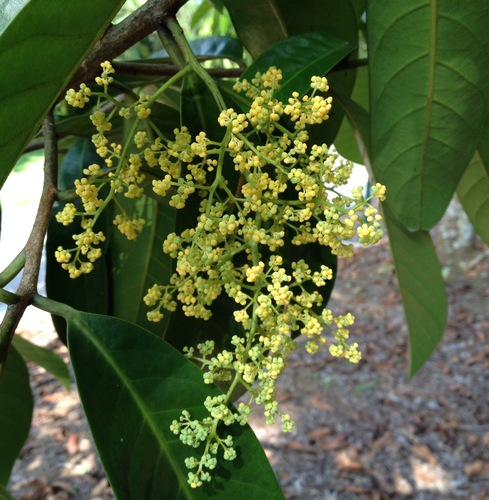
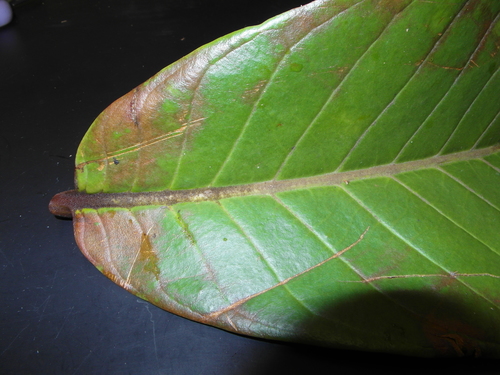
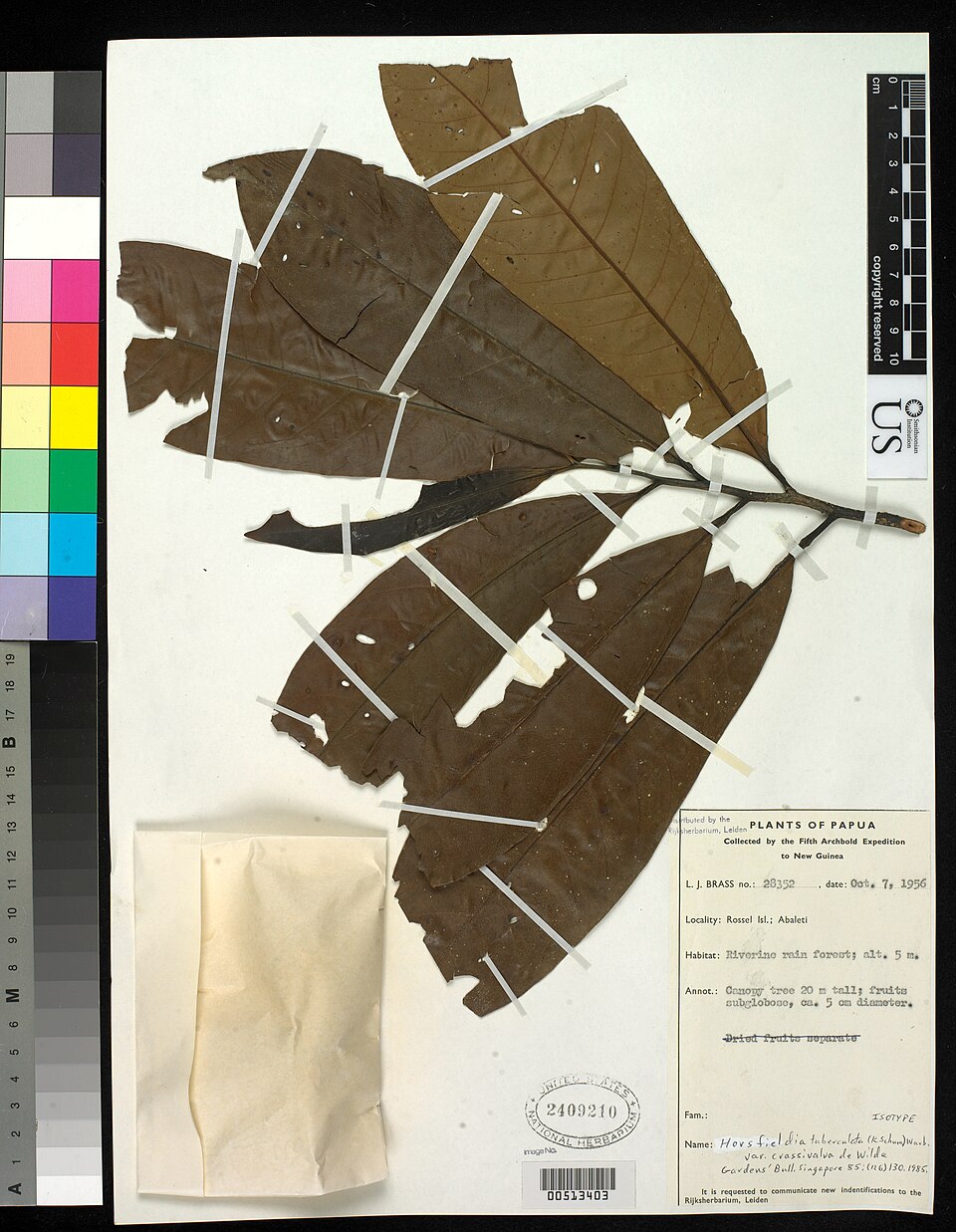
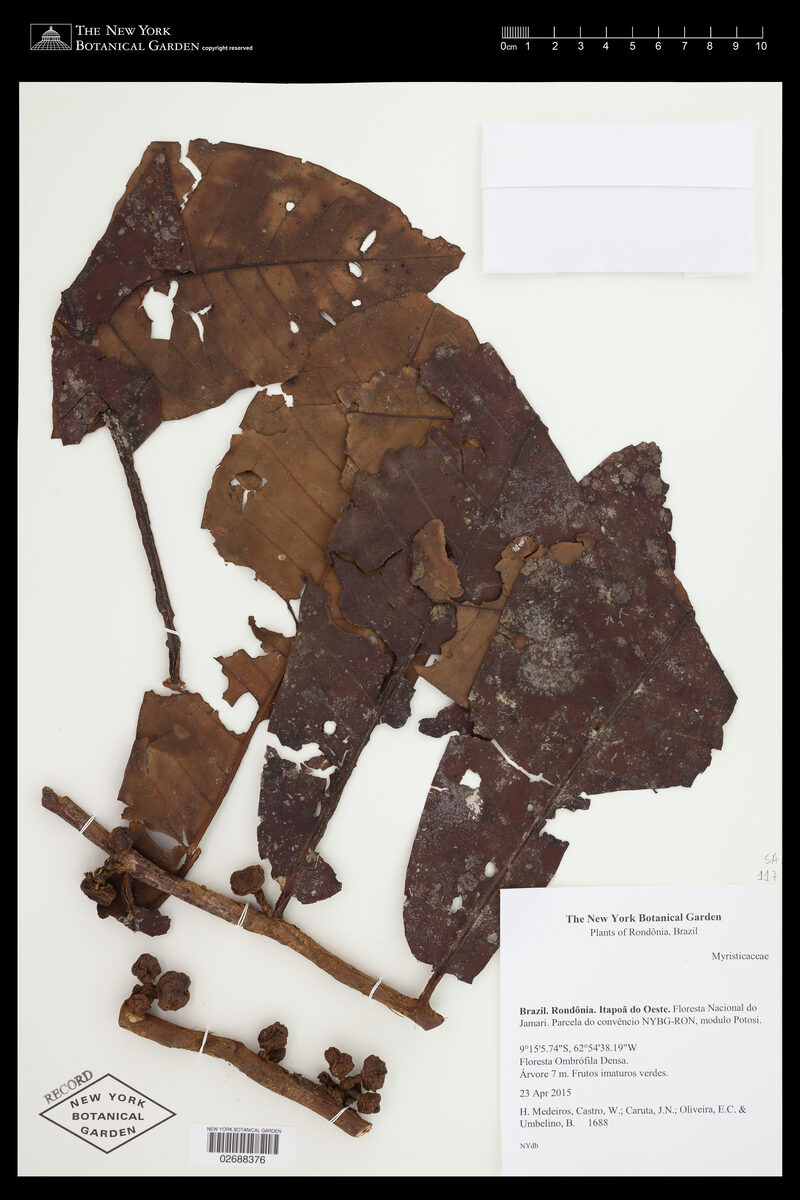
A tall tree. It can grow 20 m tall. It can have tall buttresses. It can have prop roots. The branches are in groups of 3 or 4 and are horizontal. Leaves are alternate and regularly spaced. They are 60 cm long and leathery. The male flowers are in groups of 10-20 on woody shoots. The female flowers are in groups of 2-3 in the axils of leaves. The fruit are oval capsules. They occur singly or in pairs. They have rusty coloured hairs. The nuts are large in size.
Edible Uses
The seeds are pressed for an edible fat used to flavor foods. The aril is used as a spice.
Traditional Uses
The seeds are the source of an edible fat. It is used to flavour foods.
This uses section is brief — help expand it
Medicinal Uses
The tree is harvested for its wood. It is also a source of traditional medicinal remedies for intestinal worms. The Amazon Indians Waiãpi living in the West of Amapá State of Brazil, treat malaria with an inhalation of vapor obtained from leaves of Virola surinamensis.
Distribution
A tropical plant. It grows in swamp and wet forests. It grows up to 700 m above sea level.
Where It Grows
Amazon, Antilles, Asia, Bolivia, Brazil, Central America, Colombia, Costa Rica, Ecuador, French Guiana, Guianas, Guyana, Honduras, Indonesia, Malaysia, Pacific, Panama, Papua New Guinea, PNG, Peru, Philippines, SE Asia, South America, Suriname*, Thailand, Trinidad and Tobago, Venezuela,
Cultivation
Plants can be grown from seeds.
Propagation
Seed - it has a limited viability and should be sown as soon as it is ripe. Sow in individual containers in a lightly shaded position. Germination rates are generally low, the seed sprouting within 30 - 60 days. The seedlings grow away quite slowly and take 8 - 9 months before they are ready for planting out.
Other Uses
The seeds contain 60 - 70% fat. It is used as a fuel. The fat is used for making candles and soap. Cut or damaged trees exude a blood-red, watery latex that is similar to the kino of commerce. The heartwood is cream, light brownish to pinkish-grey when first cut, turning pinkish to deep reddish or golden-brown on exposure; clearly demarcated from the sapwood. It is straight-grained; medium to coarse texture; medium lustre, growth rings not always distinct. The wood is light in weight, soft, rough-surfaced, coarse, with a low resistance to rot and very susceptible to termite and marine borer attack. It cuts well with hand and power saws; works easily with hand and machine tools; turns satisfactorily and finishes well, takes nails and screws easily without splitting; glues readily; takes a high lustrous finish. A first class peeling timber, it is used for making plywood, cabinet lining, boxes, veneer, pulping for paper.
Synonyms
Also Known As
Andiroba, Baboen, Baboonwood, Bogamani, Brazil Nutmeg, False nutmeg, Fruta dorada, Miguelario, Pala laki-laki, Pohon pala suriname, Ucahuba-nut
References (18)
- Borrell, O.W., 1989, An Annotated Checklist of the Flora of Kairiru Island, New Guinea. Marcellin College, Victoria Australia. p 111, 203 (As Myristica fatua)
- Burkill, I.H., 1966, A Dictionary of the Economic Products of the Malay Peninsula. Ministry of Agriculture and Cooperatives, Kuala Lumpur, Malaysia. Vol 2 (I-Z) p 1548 (As Myristica fatua)
- Condit, R., et al, 2011, Trees of Panama and Costa Rica. Princeton Field Guides. p 344
- Facciola, S., 1998, Cornucopia 2: a Source Book of Edible Plants. Kampong Publications, p 157
- Foreman, D.B., in Womersley, J.S., (ed), 1978, Handbooks of the Flora of Papua New Guinea. Melbourne University Press, Victoria. Vol 1, p 193 (As Myristica fatua)
Show all 18 references Hide references
- Grandtner, M. M., 2008, World Dictionary of Trees. Wood and Forest Science Department. Laval University, Quebec, Qc Canada. (Internet database http://www.wdt.qc.ca)
- Grandtner, M. M. & Chevrette, J., 2013, Dictionary of Trees, Volume 2: South America: Nomenclature, Taxonomy and Ecology. Academic Press p 690
- Heywood, V.H., Brummitt, R.K., Culham, A., and Seberg, O. 2007, Flowering Plant Families of the World. Royal Botanical Gardens, Kew. p 224
- Kermath, B. M., et al, 2014, Food Plants in the Americas: A survey of the domesticated, cultivated and wild plants used for Human food in North, Central and South America and the Caribbean. On line draft. p 916
- Menninger, E.A., 1977, Edible Nuts of the World. Horticultural Books. Florida p 83 (As Myristica fatua)
- Nova Acta Acad. Caes. Leop.-Carol. German. Nat. Cur. 68:208. 1897
- Peekel, P.G., 1984, (Translation E.E.Henty), Flora of the Bismarck Archipelago for Naturalists, Division of Botany, Lae, PNG. p 185, 187 (As Myristica fatua)
- Roa, J. A. G. & Boada, D. S. G., 2018, Fundación para el Fortalecimiento de la Fruticultura y Plantas Alimenticias no Convencionales en Colombia.
- Sukarya, D. G., (Ed.) 2013, 3,500 Plant Species of the Botanic Gardens of Indonesia. LIPI p 406, 564
- TodaFruta.com.br
- van Roosmalen, M.G.M., 1985, Fruits of the Guianan Flora. Utrecht Univ. & Wageningen Univ. p 316
- Wiersema, J. H. & Leon, B., 2013, World Economic Plants. A Standard Reference CRC Press. 2nd Ed. p 723
- World Checklist of Useful Plant Species 2020. Royal Botanic Gardens, Kew (Also as Myristica fatua)