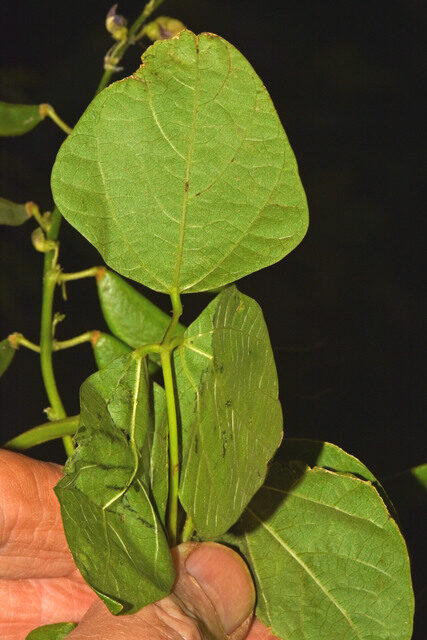
Vicia monantha
Retz.
Hard vetch, Spurred vetch, Square stem vetch
iNaturalist· cc-by-nc
(c) Rebbas, some rights reserved (CC BY-NC), uploaded by Rebbas
iNaturalist· cc-by-nc
(c) missour, some rights reserved (CC BY-NC)
Summary
Source: WikipediaVicia monantha, the barn vetch, is a widespread species of annual herb in the family Fabaceae. It native to the Mediterranean region, and western and central Asia, and has been introduced to Australia. Typical of vetches, it has a climbing habit and pinnate leaves.
Description
A short herb. A twining annual herb. It grows from 5-30 cm high. It is almost hairless. The stems are branched. The leaves have 4-7 pairs of leaflets. The flowers are pale purple. The pods are yellowish and without hairs. There are 2 subspecies.
Edible Uses
Seeds are edible cooked. The thick, floury, lentil-like seeds can be boiled as a vegetable or used as a flavouring and thickener in soups.
Traditional Uses
The thick floury seeds are eaten boiled or in soups. They can also be made into flour. It grows in areas with an average annual temperature of 7°-16°C. It can grow up to 1,300 m above sea level.
Medicinal Uses
None known.
Distribution
It grows in rocky places and on waste land. It can grow in neutral or alkaline soils. It grows in areas with an annual rainfall between 90-1,230 mm. It can grow in arid places.
Where It Grows
Afghanistan, Africa, Algeria, Arabia, Australia, Bahrain, Canary Islands, Central Asia, Cyprus, East Africa, Egypt, Europe, France, Greece, Iran, Iraq, Israel, Italy, Jordan, Kenya, Kuwait, Lebanon, Libya, Mediterranean, Middle East, Morocco, North Africa, Pakistan, Saudi Arabia, Sinai, Spain, Syria, Tajikistan, Tunisia, Turkey, Türkiye, Uganda, USA, Yugoslavia,
Cultivation
We have very little information on this species and do not know if it will be hardy in Britain, though judging by its native range it should succeed outdoors in many parts of the country. According to one report, this species is no more than a synonym of V. articulata. It is occasionally cultivated as a lentil. The following notes are based on the general needs of the genus. Succeeds in any well-drained soil in a sunny position if the soil is reliably moist throughout the growing season, otherwise it is best grown in semi-shade. This species has a symbiotic relationship with certain soil bacteria, these bacteria form nodules on the roots and fix atmospheric nitrogen. Some of this nitrogen is utilized by the growing plant but some can also be used by other plants growing nearby.
Propagation
Pre-soak the seed for 24 hours in warm water, then sow in situ in spring or autumn.
Other Uses
Can be grown as a green manure. Functions as a nitrogen fixer.
Notes
There are about 140 Vicia species. They are mostly temperate.
Synonyms
Also Known As
Auvergne lentil, Bard vetch, Foulia, One-flowered tare, Sella
References (13)
- Al-Sodany, Y. M., et al, 2013, Medicinal Plants in Saudi Arabia: I. Sarrwat Mountains at Taif, KSA. Academic Journal of Plant Sciences 6 (4): 134-145
- Bailey, C. and Danin, A., 1981, Bedouin Plant Utilization in Sinai and the Negev. Economic Botany 35(2): 145-162
- Blamey, M and Grey-Wilson, C., 2005, Wild flowers of the Mediterranean. A & C Black London. p 88
- Facciola, S., 1998, Cornucopia 2: a Source Book of Edible Plants. Kampong Publications, p 112
- Flora of Pakistan. www.eFloras.org
Show all 13 references Hide references
- Hedrick, U.P., 1919, (Ed.), Sturtevant's edible plants of the world. p 678
- Hermandez Bermejo, J.E., and Leon, J. (Eds.), 1994, Neglected Crops. 1492 from a different perspective. FAO Plant Production and Protection Series No 26. FAO, Rome. p 263, 281
- Hussey, B.M.J., Keighery, G.J., Cousens, R.D., Dodd, J., Lloyd, S.G., 1997, Western Weeds. A guide to the weeds of Western Australia. Plant Protection Society of Western Australia. p 162
- Observ. bot. 3:39. 1783
- Paczkowska, G . & Chapman, A.R., 2000, The Western Australian Flora. A Descriptive Calatogue. Western Australian Herbarium. p 453
- Plants for a Future database, The Field, Penpol, Lostwithiel, Cornwall, PL22 0NG, UK. http://www.scs.leeds.ac.uk/pfaf/
- Royal Botanic Gardens, Kew (1999). Survey of Economic Plants for Arid and Semi-Arid Lands (SEPASAL) database. Published on the Internet; http://www.rbgkew.org.uk/ceb/sepasal/internet [Accessed 1st May 2011]
- World Checklist of Useful Plant Species 2020. Royal Botanic Gardens, Kew