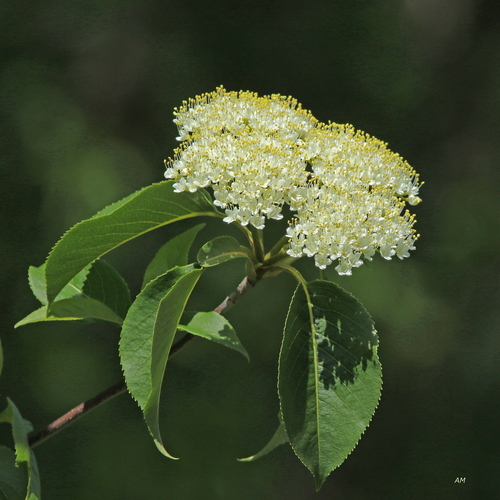
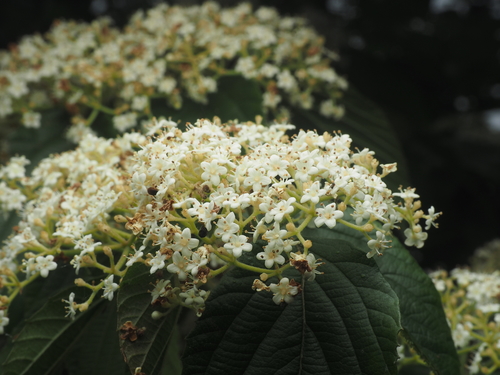
Viburnum japonicum
(Thunb.) Spreng.
Japanese Viburnum
iNaturalist· cc-by
(c) Marco Mussita, some rights reserved (CC BY), uploaded by Marco Mussita
iNaturalist· cc-by-nc
(c) 王錦堯(Ong Jin Yao), some rights reserved (CC BY-NC)
Summary
Source: WikipediaViburnum japonicum, the Japanese viburnum, is a species of flowering plant in the family Viburnaceae. It native to Zhejiang in China, Gageodo island in South Korea, the Ryukyu Islands, and Japan. A rounded evergreen bush reaching 6–8 ft (1.8–2.4 m), with glossy leaves and strongly scented flowers, it is hardy to USDA zone 7.
Description
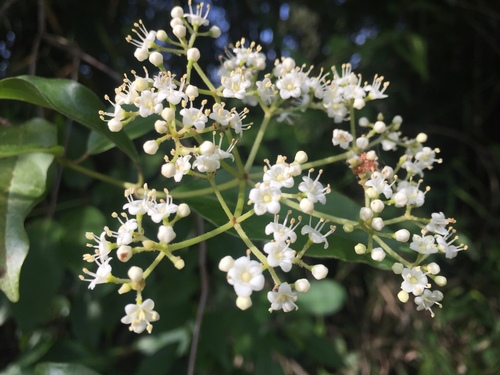
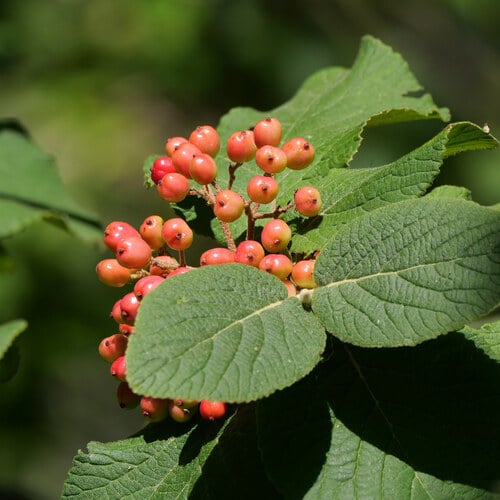
An evergreen shrub. It grows 2.4 m high and spreads 2.4 m wide. The leaves are long and leathery and shiny. They are oval and dark green above but paler underneath. The flowers are small and white. They are in clusters. They have a strong scent. The fruit are red berries.
Edible Uses
The fruit can be eaten raw or cooked. The ovoid fruit is about 8mm long and contains a single large seed. The leaves can also be cooked, though they are considered a famine food and only used when nothing else is available.
Traditional Uses
The leaves are eaten with oil and salt.
This uses section is brief — help expand it
Medicinal Uses
None known
Distribution
It is a temperate plant. It does best in light to medium, well-drained soils. It needs an open sunny position. It is resistant to frost but sensitive to drought. It suits hardiness zones 7-9. Arboretum Tasmania.
Where It Grows
Asia, Australia, China, Japan, Korea, Taiwan, Tasmania,
Cultivation
It can be grown by seed or cuttings.
Propagation
Seed is best sown in a cold frame as soon as it is ripe. Germination can be slow, sometimes taking more than 18 months. Seed harvested green — fully developed but not yet fully ripe — and sown immediately in a cold frame should germinate the following spring. Stored seed needs 2 months of warm stratification followed by 3 months of cold stratification, and may still take 18 months to germinate. Prick seedlings into individual pots when large enough to handle and grow on in a cold frame or greenhouse, planting out in late spring or early summer the following year. Softwood cuttings taken in early summer in a frame should be potted individually once rooting begins and planted out the following late spring or early summer. Half-ripe cuttings, 5–8cm long with a heel if possible, taken in July or August in a frame, should be potted as soon as they root. These can be difficult to overwinter and are best kept under glass until spring before planting out. Mature wood cuttings taken in winter in a frame should root in early spring; pot when large enough and plant out in summer if sufficient new growth has formed, otherwise overwinter in a frame and plant out the following spring. Layering of the current season's growth in July or August takes 15 months.
Other Uses
None known Special Uses Scented Plants
Notes
There are about 150 Viburnum species. Also put in the family Caprifoliaceae.
References (9)
- Bodkin, F., 1991, Encyclopedia Botanica. Cornstalk publishing, p 1015
- Brickell, C. (Ed.), 1999, The Royal Horticultural Society A-Z Encyclopedia of Garden Plants. Convent Garden Books. p 1049
- Cundall, P., (ed.), 2004, Gardening Australia: flora: the gardener's bible. ABC Books. p 1467
- Hibbert, M., 2002, The Aussie Plant Finder 2002, Florilegium. p 306
- Lord, E.E., & Willis, J.H., 1999, Shrubs and Trees for Australian gardens. Lothian. p 269
Show all 9 references Hide references
- Plants for a Future database, The Field, Penpol, Lostwithiel, Cornwall, PL22 0NG, UK. http://www.scs.leeds.ac.uk/pfaf/
- READ,
- Ryan, S., 2008, Dicksonia. Rare Plants Manual. Hyland House. p 60
- Syst. veg. 1:934, 943. 1824