Vaccinium uliginosum
L.
Bog bilberry
iNaturalist· cc-by-nc-nd
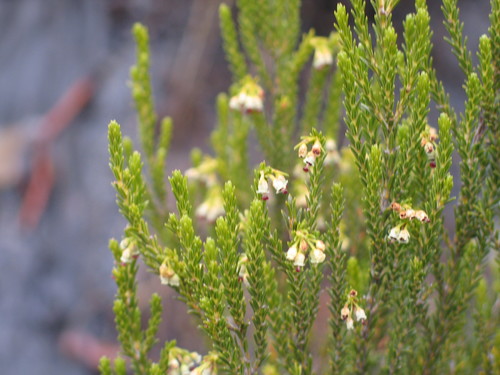
(c) Nikita Tiunov, some rights reserved (CC BY-NC-ND)
iNaturalist· cc-by-nc
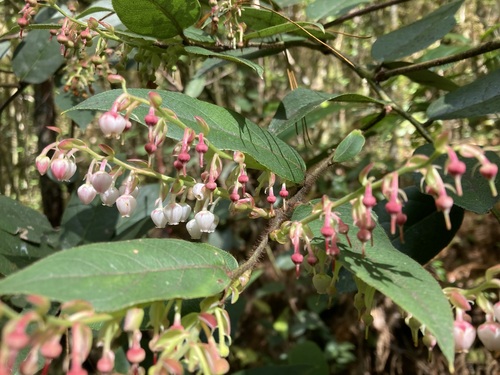
(c) Ольга Курякова, some rights reserved (CC BY-NC), uploaded by Ольга Курякова
iNaturalist· cc-by-nc
(c) Vladimir Bryukhov, some rights reserved (CC BY-NC), uploaded by Vladimir Bryukhov
Summary
Source: WikipediaVaccinium uliginosum (bog bilberry, bog blueberry, alpine blueberry or western blueberry) is an edible Eurasian and North American flowering plant in the heath family Ericaceae.
Description
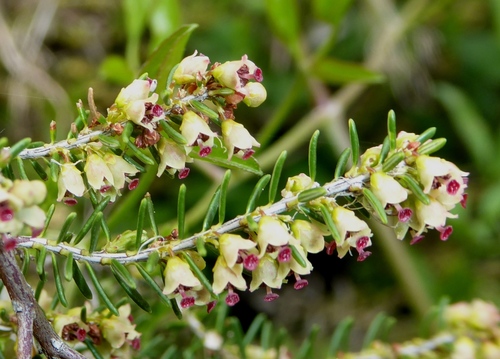
A small shrub. It has an open sprawling habit and forms loose mats. It grows 30-60 cm tall. It loses its leaves during the winter. The young branches are a yellowish-green and rounded. The leaves are 8-12 mm long and 3-8 mm wide. The leaves have prominent veins underneath. The leaves turn bright red in the autumn. The flowers are pale pink. They can occur singly or in clusters in the axils of leaves. The fruit are large, juicy purple/black berries. They are 5-12 mm across. They are edible.
Edible Uses
The fruit is juicy and sweet, and can be eaten raw or cooked. It can also be dried and used like raisins. The fruit is a reasonable source of vitamin C and is about 6mm in diameter. Some caution is advised regarding toxicity. A tea can also be made from the leaves and dried fruits.
Traditional Uses
The berries are fermented to make an alcoholic drink. Caution: Alcohol is a cause of cancer. The berries are also used to colour wine. The fruit are eaten raw occasionally. They are used for jams, jellies and pies. They are also frozen and dried. CAUTION: Large numbers can cause giddiness and headaches.
Medicinal Uses
The plant has antiseptic, astringent, carminative, hypnotic, and hypoglycaemic properties, and is also used as an antidiarrhoeal. An infusion of the leaves and sugar has traditionally been given to a mother a few days after childbirth to help her regain her strength.
Known Hazards
The fruit can cause headaches if they are eaten in large quantities. This is probably the result of infestation by a fungus.
Distribution
It is a cold temperate plant. It grows in arctic bogs. It suits moist conditions with sphagnum moss. It suits cold climates. In north China it grows between 900-2,300 m above sea level.
Where It Grows
Alaska, Arctic, Armenia, Asia, Australia, Austria, Azerbaijan, Balkans, Belarus, Britain, Bulgaria, Canada, Caucasus, Central Asia, China, Czech Republic, Denmark, Estonia, Europe, Faroe Islands, Finland, France, Georgia, Hungary, Iceland, Italy, Japan, Kazakhstan, Korea, Latvia, Lithuania, Macedonia, Mediterranean, Mongolia, North America, Norway, Poland, Russia, Scandinavia, Siberia, Slovenia, Spain, Sweden, Turkey, Türkiye, Ukraine, USA,
Cultivation
Requires a moist or wet lime free soil, preferring one that is rich in peat or a light loamy soil with added leaf-mould. Prefers a very acid soil with a pH in the range of 4.5 to 6, plants soon become chlorotic when lime is present. Grows well in a bog garden. Succeeds in full sun or light shade though it fruits better in a sunny position. Requires shelter from strong winds. Dislikes root disturbance, plants are best grown in pots until being planted out in their permanent positions. This species is closely allied to V. myrtillus. Plants in this genus are notably resistant to honey fungus.
Propagation
Sow seed in late winter in a greenhouse using a lime-free potting mix, barely covering the seed. Stored seed may need up to 3 months of cold stratification. Alternatively, sow fresh seed in a greenhouse as soon as it is ripe. When seedlings reach about 5cm tall, prick them out into individual pots and grow on in a lightly shaded greenhouse position for at least their first winter. Plant out into permanent positions in late spring or early summer, after the last expected frosts. Half-ripe cuttings, 5–8cm with a heel, can be taken in August and rooted in a frame, though this is slow and difficult. Layering can be done in late summer or early autumn (though one source suggests spring is preferable) and takes around 18 months. Division of suckers can be carried out in spring or early autumn.
Other Uses
None known.
Production
The berries can be beaten off the bush and the leaves winnowed away.
Other Information
They are a popular fruit.
Notes
They have health benefits.
Dangerous Lookalikes
This plant can be confused with the following toxic species. Always verify identification carefully before consuming any wild plant.
Deadly Nightshade
Atropa belladonna
Joan Simon from Barcelona, España
Bog bilberry
Vaccinium uliginosum
(c) Nikita Tiunov, some rights reserved (CC BY-NC-ND)
Deadly Nightshade: Tall herbaceous plant (1-2m), single shiny black cherry-sized berries, star-shaped calyx, large oval leaves, sweet but dangerous taste.
Bog bilberry: Low woody shrub, berries in clusters with crown/remnant calyx ring, sweet taste.
Nutrition
| Part | Moisture | kJ | kcal | Protein | Vit A | Vit C | Iron | Zinc |
|---|---|---|---|---|---|---|---|---|
| Fruit | 88 | 213 | 51 | 0.7 | — | — | 0.3 | 0.2 |
Synonyms
Also Known As
Alpine blueberry, Barjanska kopišnica, Blokkebaer, Bog blueberry, Galubika, Golubnika, Gonobobel, Gonobel, Juapukka, Lurji motsvi, Mikkelsbaer, Moorberry, Pijanica, Sinikas, Sinine marja, Sinya borovinka, Western Blueberry, Western huckleberry, Whortleberry
References (59)
- Beckstrom-Sternberg, Stephen M., and James A. Duke. "The Foodplant Database." http://probe.nalusda.gov:8300/cgi-bin/browse/foodplantdb.(ACEDB version 4.0 - data version July 1994) (As Vaccinium occidentale)
- Bodkin, F., 1991, Encyclopedia Botanica. Cornstalk publishing, p 1003
- W. H. Brewer, S. Watson, & A. Gray, Bot. California 1:451. 1880 (As Vaccinium occidentale)
- Bowser, M., 2017, Handout on Edible Plants of the Kenai Peninsula. USFWS Kenai National Wildlife Refuge p 13
- Bussman, R. W., et al, 2021, Unity in diversity—food plants and fungi of Sakartvelo (Republic of Georgia), Caucasus. Journal of Ethnobiology and Ethnomedicine (2021) 17:72 p 9
Show all 59 references Hide references
- Cerne, M., 1992, Wild Plants from Slovenia used as Vegetables. Acta Horticulturae 318
- Christanell, A., et al, 2010, The Cultural Significance of Wild Gathered Plant Species in Kartitsch (Eastern Tyrol, Austria) and the Influence of Socioeconomic Changes on Local Gathering Practices. Chapter 3 in Ethnobotany in the New Europe. Berghahn Books.
- Crate, S. A., 2008, "Eating Hay": The Ecology, Economy and Culture of Viliui Sakha Smallholders of Northeastern Siberia. Human Ecology 36:161-174
- Denes, A., et al, 2012, Wild plants used for food by Hungarian ethnic groups living in the Carpathian Basin. Acta Societatis Botanicorum Poloniae 81 (4): 381-396 (As Vaccinium gaultherioides)
- Duke, J.A., 1992, Handbook of Edible Weeds. CRC Press. p 208
- Dzhangaliev, A. D., et al, 2003, The Wild Fruit and Nut Plants of Kazakhstan, Horticultural Reviews, Vol. 29. pp 305-371
- Elias, T.S. & Dykeman P.A., 1990, Edible Wild Plants. A North American Field guide. Sterling, New York p 164
- Esperanca, M. J., 1988. Surviving in the wild. A glance at the wild plants and their uses. Vol. 1. p 132
- Facciola, S., 1998, Cornucopia 2: a Source Book of Edible Plants. Kampong Publications, p 99
- Fisk, J. R. & Hoover, E., 2015, Wild Fruits of Minnesota. A Field Guide. University of Minnesota p 32
- Girard, N. J., 2020, Sustainable Foraging of Wild Edible Plants in Norway. A Biocultural Approach. M. Sc. thesis Norwegian University. p 130
- Hakkinen, S. H., et al, 1999, Content of the Flavonols Quercetin, Myricetin, and Kaemferol in 25 Edible Berries. Journal of Agricultural and Food Chemistry. 47: 2274-2279
- Harris, C.S. et al, 2014, Investigating Wild Berries as a Dietary Approach to Reducing the Formation of Advanced Glycation Endproducts: Chemical Correlates of In Vitro Antiglycation Activity. Plant Foods Hum Nutr 69:71–77
- Hedrick, U.P., 1919, (Ed.), Sturtevant's edible plants of the world. p 668
- Heller, C. A., 1962, Wild Edible and Poisonous Plants of Alaska. Univ. of Alaska Extension Service. p 48
- Holloway, P. S. & Alexander, G., 1990, Ethnobotany of the Fort Yukon Region, Alaska. Economic Botany, Vol. 44, No. 2 pp. 214-225
- http://en.hortipedia.com
- http://www.botanic-gardens-ljubljana.com/en/plants
- Jernigan, K. (Ed.), 2012, A Guide to the Ethnobotany of the Yukon-Kuskokwim Region. Draft.
- Jernigan, K. A., et al, 2017, Naukan ethnobotany in post-Soviet times: lost edibles and new medicinals. Journal of Ethnobiology and Ethnomedicine (2017) 13:61
- Johansson, A., Laakso, P. and Kallio, H., 1997, Characterization of seed oils of wild, edible Finnish berries. Food Chemistry 204:300-307
- Jones, A., 2010, Plants that we eat. University of Alaska Press. p 88
- Kalle, R. & Soukand, R., 2012, Historical ethnobotanical review of wild edible plants of Estonia (1770s-1960s) Acta Societatis Botanicorum Poloniae 81(4):271-281
- Kermath, B. M., et al, 2014, Food Plants in the Americas: A survey of the domesticated, cultivated and wild plants used for Human food in North, Central and South America and the Caribbean. On line draft. p 896
- Kolosova, V., et al, 2020, Foraging in Boreal Forest: Wild Food Plants of the Republic of Karelia, NW Russia. Foods 2020, 9, 1015; p 9
- Kremer, B.P., 1995, Shrubs in the Wild and in Gardens. Barrons. p 116
- Kuhnlein, H. V., et al, 2009, Indigenous Peoples' food systems. FAO Rome
- Łukasz Łuczaj and Wojciech M Szymański, 2007, Wild vascular plants gathered for consumption in the Polish countryside: a review. J Ethnobiol Ethnomedicine. 3: 17
- Luczaj, L. et al, 2013, Wild edible plants of Belarus: from Rostakinski's questionnaire of 1883 to the present. Journal of Ethnobiology and Ethnomedicine 9:21
- MacKinnon, A., et al, 2009, Edible & Medicinal Plants of Canada. Lone Pine. p 114
- Mullory, C. & Aitken, S., 2012, Common Plants of Nunavut. Inhabit Media p 174
- Moerman, D. F., 2010, Native American Ethnobotany. Timber Press. p 586
- Nedelcheva A., 2013, An ethnobotanical study of wild edible plants in Bulgaria. EurAsian Journal of BioSciences 7, 77-94
- Pieroni, A.,& Giusti, M. E., 2009, Alpine Ethnobotany in Italy: Journal of Ethnobiology and Ethnomedicine. 5:32
- Pieroni, A. & Soukand, R., 2017, Are Borders more Important than Geographical Distance? The Wild Food Ethnobotany of the Boykos and its Overlap with that of the Bukovinian Hutsuls in Western Ukraine. Journal of Ethnobiology 37(2): 326–345
- Pieroni, A. & Soukand, R., 2018, Forest as Stronghold of Local Ecological Practice: Currently Used Wild Food Plants in Polesia, Northern Ukraine. Economic Botany, XX(X) pp. 1-21
- Plants for a Future database, The Field, Penpol, Lostwithiel, Cornwall, PL22 0NG, UK. http://www.scs.leeds.ac.uk/pfaf/ (Also as Vaccinium occidentale)
- Porsild, A.E., 1974, Rocky Mountain Wild Flowers. Natural History Series No. 2 National Museums of Canada. p 320
- Porsild, A.E., Edible Plants of the Arctic. p 21
- Prakofjewa, J., et al, 2023, Boundaries Are Blurred: Wild Food Plant Knowledge Circulation across the Polish-Lithuanian-Belarusian Borderland. Biology 2023, 12, 571.
- Pruse, B., et al, 2021, Active Wild Food Practices among Culturally Diverse Groups in the 21st Century across Latgale, Latvia. Biology 2021, 10, 551.
- Reis, S. V. and Lipp, F. L., 1982, New Plant Sources for Drugs and Foods from the New York Botanical Garden herbarium. Harvard. p 229 (As Vaccinium occidentale)
- Simkova, K. et al, 2014, Ethnobotanical review of wild edible plants used in the Czech Republic. Journal of Applied Botany and Food Quality 88, 49-67
- Soukand, R., et al, 2017, Multi-functionality of the few: current and past uses of wild plants for food and healing in Liubań region, Belarus. Journal of Ethnobiology and Ethnomedicine (2017) 13:10
- Sp. pl. 1:350. 1753
- Svanberg, I., et al, 2012, Edible wild plant use in the Faroe Islands and Iceland. Acta Societatis Botanicorum Poloniae 81(4): 233-238
- Trehane, J., 2004, Blueberries, Cranberries and Other Vacciniums. Timber Press. p 183, 242
- Turner, N., 1995, Food Plants of Coastal First Peoples. Royal BC Museum Handbook p 86
- Turner, N., 1997, Food Plants of Interior First Peoples. Royal BC Museum Handbook p 123
- Urgamal, M., Oyuntsetseg, B., Nyambayar, D. & Dulamsuren, Ch. 2014. Conspectus of the vascular plants of Mongolia. (Editors: Sanchir, Ch. & Jamsran, Ts.). Ulaanbaatar, Mongolia. “Admon“ Press. 334pp. (p. 79-90).
- Whitney, C. W., et al, 2012, A Survey of Wild Collection and Cultivation of Indigenous Species in Iceland. Human Ecology 40:781-787
- Wiersema, J. H. & Leon, B., 2013, World Economic Plants. A Standard Reference CRC Press. 2nd Ed. p 710
- Williams, D., 2017, Ainu Ethnobiology. Contributions in Ethnobiology. Society of Ethnobiology. p 148
- World Checklist of Useful Plant Species 2020. Royal Botanic Gardens, Kew