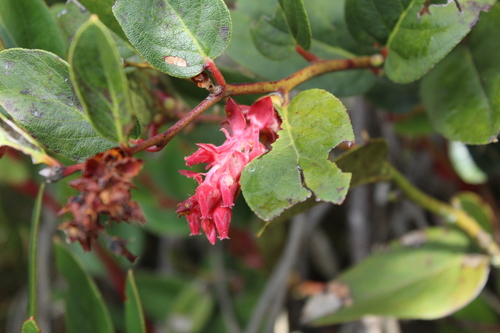
Arctostaphylos pungens
Kunth
Pointleaf manzanita
iNaturalist· cc-by-nc
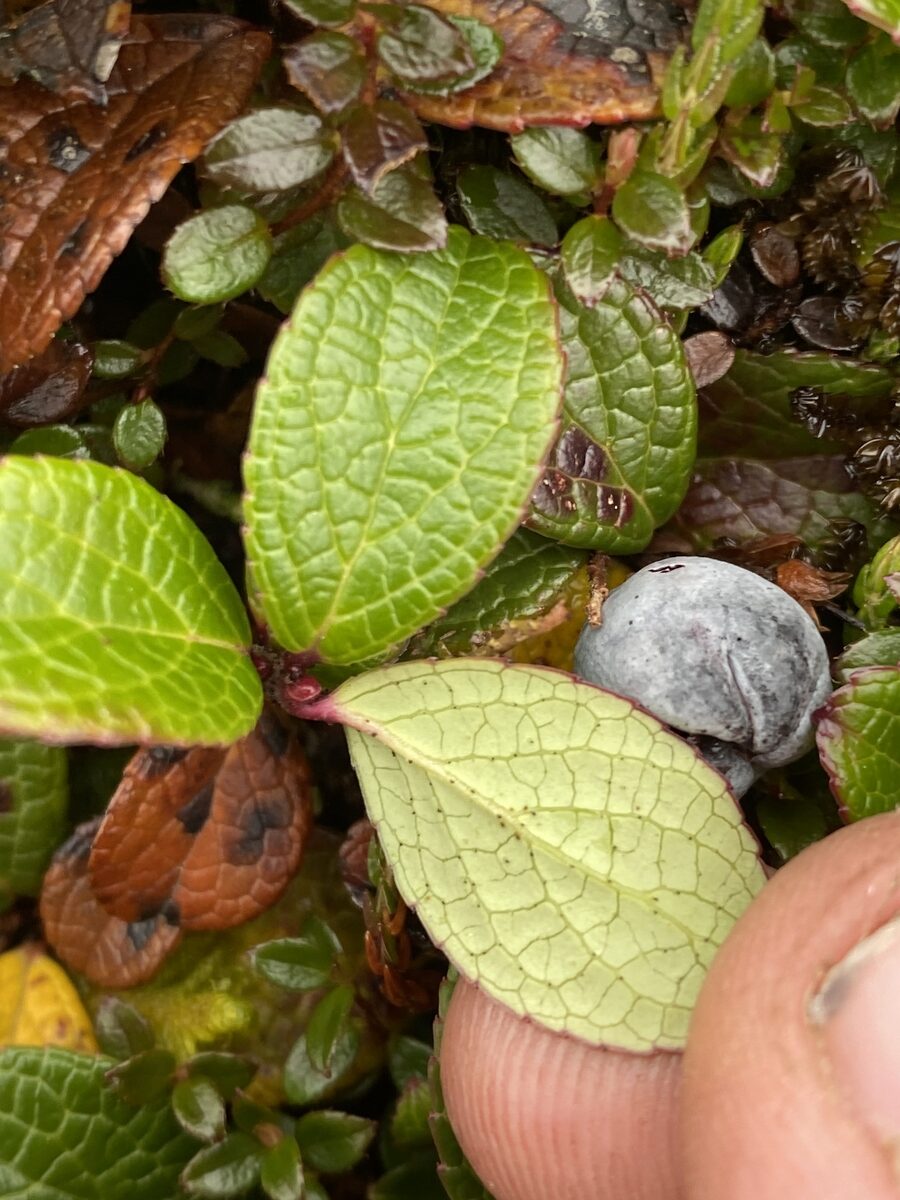
(c) lonnyholmes, some rights reserved (CC BY-NC), uploaded by lonnyholmes
iNaturalist· cc-by-nc
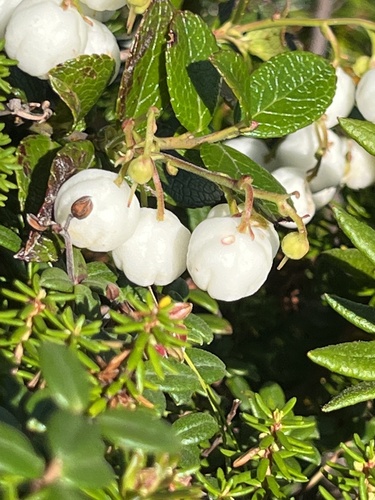
(c) BJ Stacey, some rights reserved (CC BY-NC)
iNaturalist· cc-by-nc
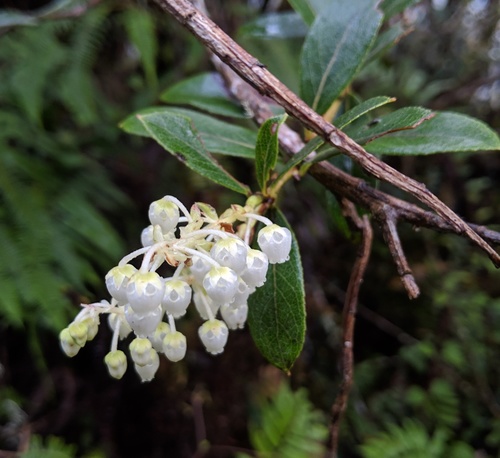
(c) BJ Stacey, some rights reserved (CC BY-NC)
Summary
Source: WikipediaArctostaphylos pungens, with the common name pointleaf manzanita, is a species of manzanita. It is native to the Southwestern United States and to northern and central Mexico, where it grows in chaparral and woodland habitats, and on desert ridges. Arctostaphylos pungens can be seen growing at Tent Rocks National Monument in New Mexico at an elevation of about 6000 feet.
Description
A shrub. It grows 3 m high and spreads 1.8 m wide. It has deep red-brown peeling bark. The leaves are oval and grey-green. They mostly have a sharp point. The flowers are white to pink. The fruit is glossy and brown. They are 5-8 mm across.
Edible Uses
Edible Parts: Fruit Edible Uses: Fruits are edible and among the best-tasting manzanitas, less astringent than A. patula. The red to reddish-brown drupes contain 4–8 nutlets, which are also edible. Unripe fruits can be tart, but they are often palatable. Mature fruits are sweet-tart with powdery flesh. Flowers can be steeped into tea [2-3]. Fruit - raw or cooked. An agreeable acid flavour, but the fruit is dry and mealy. Hard to digest, the fruit should be eaten in moderation. It can be dried and ground into a powder and then used as mush or as a flavouring in soups, etc. A cooling drink can be made from the fruit. Fruits ground into meal for mush, cakes, or cider-like drinks. Historically important to Native American diets [2-3].
Traditional Uses
The fruit are used for making jelly.
This uses section is brief — help expand it
Medicinal Uses
Astringent Skin An infusion of the leaves is used in the treatment of diarrhoea. An infusion is also used in the treatment of the rash caused by poison oak, Toxicodendron diversiloba. Leaves are sometimes used as mild astringents.
Distribution
It is a temperate plant. It grows up to 2,700 m altitude in Mexico. It occurs in Durango. It suits hardiness zones 6-10. Melbourne Botanical gardens.
Where It Grows
Australia, Central America, Mexico*, North America, USA,
Cultivation
Evergreen shrub, 1–3 m tall, with gray-green leaves and smooth reddish bark. Forms dense thickets that stabilize soils on slopes.. Requires a deep moist well-drained light or medium lime-free loam in sun or semi-shade, but plants produce less fruit when they are grown in the shade. This species is closely related to A. manzanita. Plants resent root disturbance and should be placed in their final positions as soon as possible. Habitat & Growing Conditions: Grows in chaparral, shrub oak, juniper, and pinyon pine communities from California to Texas and into Mexico. Blooms February–June. Prefers well-drained, dry soils in sunny exposures.
Propagation
Seed - best sown in a greenhouse as soon as it is ripe. Pre-soak dried seed in boiling water for 10 - 20 seconds or burn some straw on top of them and then stratify at 2 - 5°c for 2 months. The seed usually germinates in 2 - 3 months at 15°c. When large enough to handle, prick the seedlings out into individual pots and grow them on in a cold frame or greenhouse for at least their first winter. Plant out in late spring or early summer. Cuttings of side shoots of the current season's growth, 5 - 8cm with a heel, August to December in a frame. The cuttings are very slow and can take a year to root. Division in early spring. Take care because the plant resents root disturbance. Pot the divisions up and keep them in a lightly shaded position in a cold frame or greenhouse until they are growing away actively. Layering in spring.
Other Uses
Dye Fuel Wood A yellowish-brown dye is obtained from the leaves, it does not require a mordant. The wood makes a good fuel, producing a long-lasting hot fire. The hard wood has been used for making small tools, awl handles etc. Special Uses
Notes
There are about 50 Arctostaphylos species.
Nutrition
| Part | Moisture | kJ | kcal | Protein | Vit A | Vit C | Iron | Zinc |
|---|---|---|---|---|---|---|---|---|
| Fruit | — | 222 | 2.67 | — | — | — | — | — |
Synonyms
Also Known As
Madreselva, Pinguica, Rochiwari
References (11)
- Bircher, A. G. & Bircher, W. H., 2000, Encyclopedia of Fruit Trees and Edible Flowering Plants in Egypt and the Subtropics. AUC Press. p 39
- Camou-Guerrero, A., et al, 2008, Knowledge and use Value of Plant Species in a Raramuri Community: A Gender Perspective for Conservation. Human Ecology, 36:259-272
- Cruz, I. M., et al, 2015, Edible fruits and seeds in the State of Mexico. Revista Mexicana de Ciencias Agricolas. Vol. 6. Num. 2 pp 331-346
- Cundall, P., (ed.), 2004, Gardening Australia: flora: the gardener's bible. ABC Books. p 177
- Grandtner, M. M., 2008, World Dictionary of Trees. Wood and Forest Science Department. Laval University, Quebec, Qc Canada. (Internet database http://www.WDT.QC.ca)
Show all 11 references Hide references
- https://www.fireflyforest.com/flowers/category/edible-plants/ Edible Plants – Southeastern Arizona Wildflowers and Plants
- Luteyn, J. L., et al, 1995, Ericaceae, Part II. The Superior-Ovaried Genera (Monotropoideae, Pyroloideae, Rhododendroideae, and Vaccinioideae P.P.) Flora Neotropica, Vol. 66, pp. i-iv+1-560
- Plants for a Future database, The Field, Penpol, Lostwithiel, Cornwall, PL22 0NG, UK. http://www.scs.leeds.ac.uk/pfaf/
- Segura, S., et al, 2018, The edible fruit species in Mexico. Genet Resour Crop Evol (2018) 65:1767–1793
- F. W. H. A. von Humboldt et al., Nov. gen. sp. 3:218[folio]; 3:278[quarto]. 1819
- World Checklist of Useful Plant Species 2020. Royal Botanic Gardens, Kew