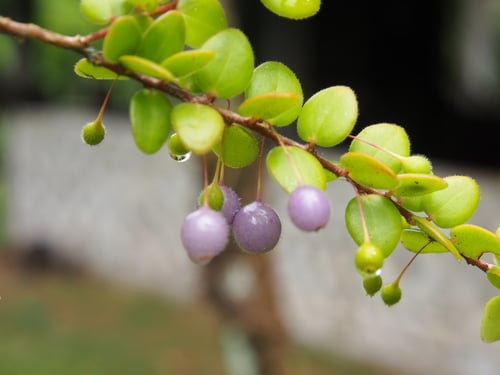
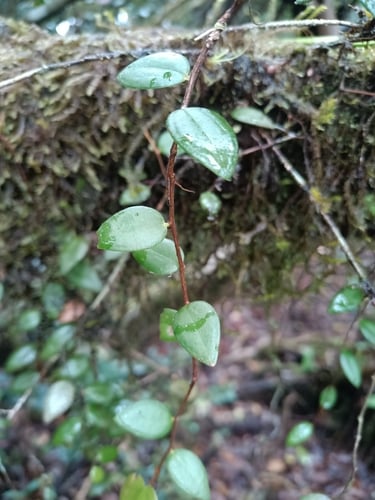
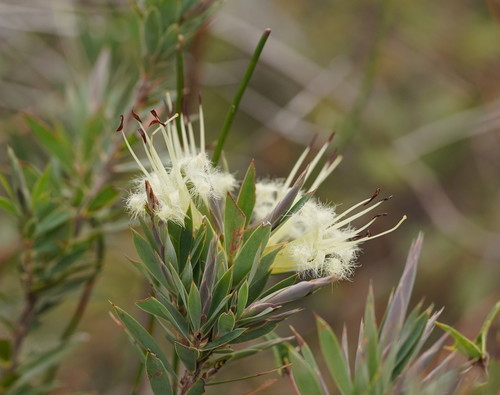
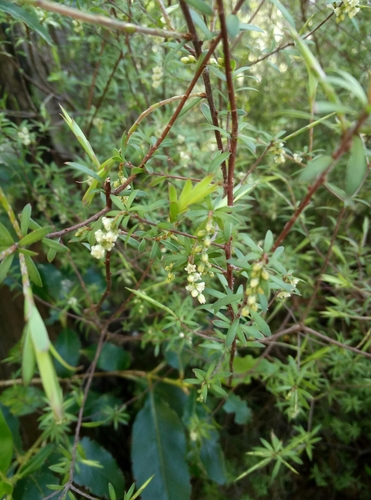
Vaccinium bracteatum
Thunberg
Sea bilberry, Black rice tree, Oriental blueberry
iNaturalist· cc-by-nc
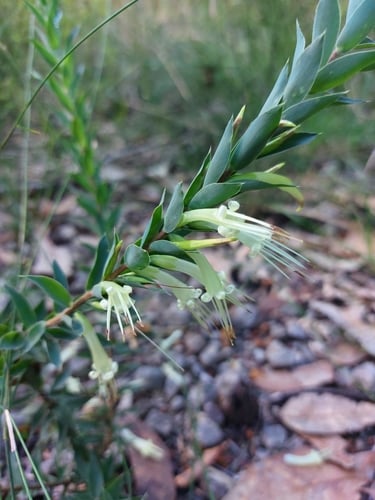
(c) shiguangshi, some rights reserved (CC BY-NC), uploaded by shiguangshi
iNaturalist· cc-by-nc
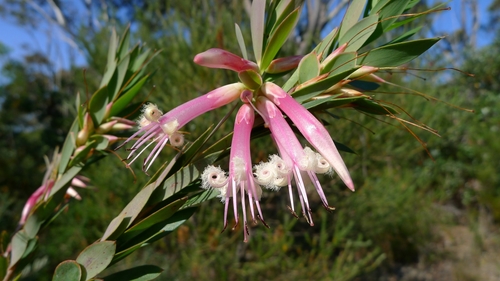
(c) 陳育賢, some rights reserved (CC BY-NC), uploaded by 陳育賢
iNaturalist· cc-by-nc
(c) Wolli Huang, some rights reserved (CC BY-NC), uploaded by Wolli Huang
Summary
Source: WikipediaVaccinium bracteatum, the sea bilberry or Asiatic bilberry, is a species of Vaccinium native to Asia.
Description
An evergreen shrub. It grows 0.6-0.9 m tall. It spreads 0.6-0.9 m wide. It can be 3 m high. The branches are slender and grey but are red when young. The leaves are narrowly oval and have small teeth. The leaves are red when young and turn pale green. They are 5 cm long by 2 cm wide. The flowers are small and white or pink. There are often 10 flowers in a group. The fruit are red berries. The fruit are 5 mm across.
Edible Uses
The fruit can be eaten raw or cooked and measures about 6mm in diameter.
Traditional Uses
The fruit are slightly acid and eaten raw when fully ripe. They are also used for jam and wine. The leafy shoots are boiled with rice to turn it black.
Medicinal Uses
The plant has been used in the treatment of cancer.
Distribution
A tropical plant. It grows in temperate places. It grows in dense forests. In Yunnan in China it grows between 1,100-2,000 m altitude. It grows in subtropical broadleaved evergreen forest. In Japan it grows in poor soils along the coast. It suits hardiness zones 7-10. In Sichuan and Yunnan.
Where It Grows
Asia, Australia, Cambodia, China, Indochina, Indonesia, Japan*, Korea-South, Laos, Malaysia, Myanmar, SE Asia, Taiwan, Thailand, Vietnam,
Cultivation
Requires a moist but freely-draining lime free soil, preferring one that is rich in peat or a light loamy soil with added leaf-mould. Prefers a very acid soil with a pH in the range of 4.5 to 6, plants soon become chlorotic when lime is present. Succeeds in full sun or light shade though it fruits better in a sunny position. Requires shelter from strong winds. Plants are hardy at Kew but they are better grown in milder areas. Dislikes root disturbance, plants are best grown in pots until being planted out in their permanent positions. Closely related to V. sprengelii. Plants in this genus are notably resistant to honey fungus.
Propagation
Sow seed in late winter in a greenhouse using a lime-free potting mix, barely covering the seed. Stored seed may need up to 3 months of cold stratification. Alternatively, sow fresh seed in a greenhouse as soon as it is ripe. Prick seedlings out into individual pots once they reach about 5cm tall, and grow them on in a lightly shaded greenhouse position for at least their first winter. Plant out in late spring or early summer after the last expected frosts. Half-ripe cuttings, 5–8cm with a heel, can be taken in August and rooted in a frame, though this is slow and difficult. Layering can be done in late summer or early autumn — or in spring according to some sources — and takes 18 months. Suckers can be divided in spring or early autumn.
Other Uses
None known.
Other Information
Fruit are sold in local markets.
Dangerous Lookalikes
This plant can be confused with the following toxic species. Always verify identification carefully before consuming any wild plant.
Deadly Nightshade
Atropa belladonna
Joan Simon from Barcelona, España
Sea bilberry
Vaccinium bracteatum
(c) shiguangshi, some rights reserved (CC BY-NC), uploaded by shiguangshi
Deadly Nightshade: Tall herbaceous plant (1-2m), single shiny black cherry-sized berries, star-shaped calyx, large oval leaves, sweet but dangerous taste.
Sea bilberry: Low woody shrub, berries in clusters with crown/remnant calyx ring, sweet taste.
Synonyms
Also Known As
Inai batu, Kelam padang, Mata keli, Sashibu-no-ki, Shashambo, Sontram la-hoa, Tranaeng-puech chu, Wakuraha, Xinang, Ying nat
References (19)
- Burkill, I.H., 1966, A Dictionary of the Economic Products of the Malay Peninsula. Ministry of Agriculture and Cooperatives, Kuala Lumpur, Malaysia. Vol 2 (I-Z) p 2257 (As Vaccinium malaccense)
- Calcutta J. Nat. Hist. 8:172. 1847 (As Vaccinium malaccense)
- Cundall, P., (ed.), 2004, Gardening Australia: flora: the gardener's bible. ABC Books. p 1453
- Fl. jap. 156. 1784
- Giesen, W., 2013, Paludiculture: sustainable alternatives on degraded peat land in Indonesia (revised draft)
Show all 19 references Hide references
- Hu, Shiu-ying, 2005, Food Plants of China. The Chinese University Press. p 611
- Hui, Y. H., Handbook of Food Science, Technology, and Engineering. Volume 2. Table 98:2
- Hwang, H., et al, 2013, A Study on the Flora of 15 Islands in the Western Sea of Jeollanamdo Province, Korea. Journal of Asia-Pacific Biodiversity Vol. 6, No. 2 281-310
- Jin, Chen et al, 1999, Ethnobotanical studies on Wild Edible Fruits in Southern Yunnan: Folk Names: Nutritional Value and Uses. Economic Botany 53(1) pp 2-14
- Levy-Yamamori, R., & Taaffe, G., 2004, Garden Plants of Japan. Timber Press. p 252
- Luo, B., et al, 2019, Wild edible plants collected by Hani from terraced rice paddy agroecosystem in Honghe Prefecture, Yunnan, China. Journal of Ethnobiology and Ethnomedicine 15:56
- Milow, P., et al, 2013, Malaysian species of plants with edible fruits or seeds and their evaluation. International Journal of Fruit Science. 14:1, 1-2
- Phon, P., 2000, Plants used in Cambodia. © Pauline Dy Phon, Phnom Penh, Cambodia. p 623
- Plants for a Future database, The Field, Penpol, Lostwithiel, Cornwall, PL22 0NG, UK. http://www.scs.leeds.ac.uk/pfaf/
- Sleumer, 1967, Ericaceae, Flora Malesiana, Ser. 1 Vol. 6 (8) p 801
- Trehane, J., 2004, Blueberries, Cranberries and Other Vacciniums. Timber Press. p 219
- USDA, ARS, National Genetic Resources Program. Germplasm Resources Information Network - (GRIN). [Online Database] National Germplasm Resources Laboratory, Beltsville, Maryland. Available: www.ars-grin.gov/cgi-bin/npgs/html/econ.pl (10 April 2000)
- Wiersema, J. H. & Leon, B., 2013, World Economic Plants. A Standard Reference CRC Press. 2nd Ed. p 709
- World Checklist of Useful Plant Species 2020. Royal Botanic Gardens, Kew