Urospermum picroides
(L.) Scop. ex F. W. Schmidt
False hawkbit, Sow thistle
iNaturalist· cc-by-nc-sa
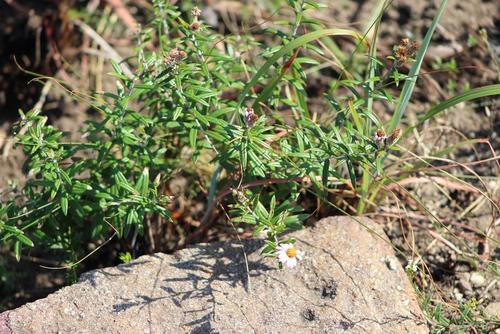
(c) Valter Jacinto, some rights reserved (CC BY-NC-SA)
iNaturalist· cc-by
(c) Thomas Mesaglio, some rights reserved (CC BY)
iNaturalist· cc-by
(c) Thomas Mesaglio, some rights reserved (CC BY)
Summary
Source: WikipediaUrospermum picroides is a species of flowering plant in the family Asteraceae known by the common name prickly goldenfleece. It is native to Eurasia and it is known as an introduced species in many other regions, including North and South America, Australia, and southern Africa. It grows as a common weed in disturbed habitat. This annual herb grows up to 30 to 50 centimeters tall. It is coated in long hairs and bristles. The bristly leaves are variously shaped, often divided into many sharp-toothed lobes. The inflorescence bears flower heads on thick peduncles. The head is 1 to 2 centimeters long or more and filled with yellow ray florets. It is enveloped in several pointed phyllaries which are covered in bristly hairs. The fruit is an achene well over a centimeter in length which is tipped with a pappus of bristles.
Description
A low herb which keeps growing from year to year. It grows 60 cm tall. The leaves at the base are divided into lobes along the stalk. The lobes point backwards. The leaves on the stem are oval or sword shaped. They clasp the stem and the upper leaves are opposite. The flower bracts are oval or sword shaped and often have a dark violet edge. They have long points and bristly hairs. The flower heads are pale yellow. The achenes are 11-15 mm long.
Edible Uses
Both the leaves and roots of this plant are eaten, and it has a long history as a traditional food in southern Croatia and adjacent southwestern Herzegovina. It is a regionally important wild green vegetable with a diverse phytochemical composition, including various metabolites and sesquiterpene derivatives.
Traditional Uses
The leaves are cooked and eaten. They are used in soups and stews. They are also used with other greens in a vegetable pie. The stems are eaten raw as a snack.
Medicinal Uses
Recent studies indicate that this plant shows no significant toxicity to normal cells and has notable anti-inflammatory properties. It can increase secretion of the anti-inflammatory cytokine IL-10 while decreasing levels of the pro-inflammatory IL-6, supporting its potential as a safe functional food and nutraceutical.
Distribution
It is a Mediterranean climate plant. It grows on fallow land and waste ground. It grows in warm temperate places. It can grow in dry soil. It can grow in arid places. In Argentina it grows below 500 m above sea level.
Where It Grows
Africa, Albania, Argentina, Armenia, Australia, Azores, Balkans, Bosnia, Caucasus, Chile, Crete, Croatia, Egypt, Europe, France, Greece, Iran, Israel, Italy, Lebanon, Mediterranean, Middle East, North Africa, Portugal, Sicily, Slovenia, South America, Spain, Syria, Turkey, Türkiye, Uruguay, Yugoslavia,
Propagation
Seed.
Other Uses
None known.
Synonyms
Also Known As
Cardiddazza spinusa, Cerrajon, Coleta, Cristalle, Fogghje di vacca, Garlupa, Helvacik, Iaddina grass, Lattuquedde, Korkolekanida, Plestina, Plesti guzica, Srhkodlakava repatka, Zochos, Zuccho
References (22)
- Biscotti, N. & Pieroni, A., 2015, The hidden Mediterranean diet: wild vegetables traditionally gathered and consumed in the Gargano area, Apulia, SE Italy. Acta Societatis Botanicorum Poloniae 84 (3): 327-338
- Biscotti, N. et al, 2018, The traditional food use of wild vegetables in Apulia (Italy) in the light of Italian ethnobotanical literature. Italian Botanist 5:1-24
- Blamey, M and Grey-Wilson, C., 2005, Wild flowers of the Mediterranean. A & C Black London. p 462
- Blanco-Salas, J., et al, 2019, Wild Plants Potentially Used in Human Food in the Protected Area “Sierra Grande de Hornachos” of Extremadura (Spain). Sustainability 2019, 11, 456
- Dashorst, G.R.M., and Jessop, J.P., 1998, Plants of the Adelaide Plains & Hills. Botanic Gardens of Adelaide and State Herbarium. p 152
Show all 22 references Hide references
- Dolina, K. & Luczaj, L., 2014, Wild food plants used on the Dubrovnik coast (south-eastern Croatia) Acta Soc Bot Pol 83(3):175–181
- Facciola, S., 1998, Cornucopia 2: a Source Book of Edible Plants. Kampong Publications, p 44
- Geraci, A., et al, 2018, The wild taxa utilized as vegetables in Sicily (Italy): a traditional component of the Mediterranean diet. Journal of Ethnobiology and Ethnomedicine (2018) 14:14
- http://www.botanic-gardens-ljubljana.com/en/plants
- Hussey, B.M.J., Keighery, G.J., Cousens, R.D., Dodd, J., Lloyd, S.G., 1997, Western Weeds. A guide to the weeds of Western Australia. Plant Protection Society of Western Australia. p 106
- Luczaj et al, 2013, Wild vegetable mixes sold in the markets of Dalmatia (southern Croatia). Journal of Ethnobiology and Ethnomedicine. 8:2
- Martin, F.W. & Ruberte, R.M., 1979, Edible Leaves of the Tropics. Antillian College Press, Mayaguez, Puerto Rico. p 186
- Nebel, S., Pieroni, A. & Heinrich, M., 2006, Ta cho`rta: Wild edible greens used in the Graecanic area in Calabria, Southern Italy. Appetite 47 (2006) 333–342
- Özdemir, E. and Kültür, S., 2017, Wild Edible Plants of Savaştepe District (Balıkesir, Turkey), Marmara Pharm J 21/3: 578-589
- Paczkowska, G. & Chapman, A.R., 2000, The Western Australian Flora. A Descriptive Catalogue. Western Australian Herbarium. p 177
- Pasta, S., et al, 2020, An Updated Checklist of the Sicilian Native Edible Plants: Preserving the Traditional Ecological Knowledge of Century-Old Agro-Pastoral Landscapes. Frontiers in Plant Science. Volume 11|Article 388
- Pieroni, A., et al, 2020, Wild food plants traditionally gathered in central Armenia: archaic ingredients or future sustainable foods? Environment, Development and Sustainability. Springer p 12
- Psaroudaki, A., et al, 2012, Ten Indigenous Edible Plants: Contemporary Use in Eastern Crete, Greece. Culture, Agriculture, Food and Environment Vol. 34, Issue 2 pp. 172–177
- Psaroudaki, A., et al, 2015, Genetic structure and population diversity of eleven edible herbs of Eastern Crete. Journal of Biological Research-Thessaloniki, 22:7
- Royal Botanic Gardens, Kew (1999). Survey of Economic Plants for Arid and Semi-Arid Lands (SEPASAL) database. Published on the Internet; http://www.rbgkew.org.uk/ceb/sepasal/internet [Accessed 14th April 2011]
- Samml. Phys.-Oukon. Aufsauze 1: 275. 1795
- Tardio, J., et al, Ethnobotanical review of wild edible plants in Spain. Botanical J. Linnean Soc. 152 (2006), 27-71