Dichopogon strictus
(R. Br.) Baker
Chocolate lily, Grass lily
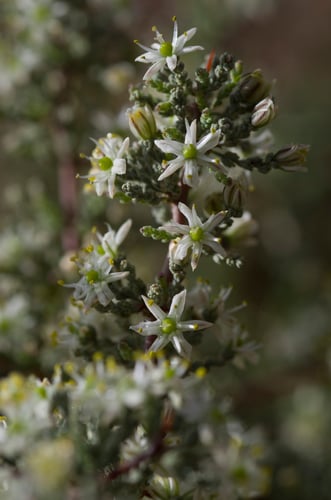
iNaturalist· cc-by-nc-sa
(c) Reiner Richter, some rights reserved (CC BY-NC-SA)
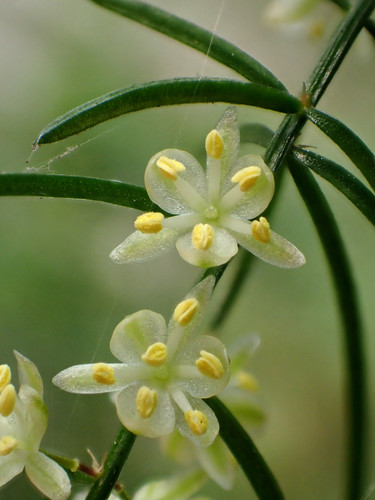
iNaturalist· cc-by-nc
(c) Robert Lawrence, some rights reserved (CC BY-NC)
iNaturalist· cc-by-nc
(c) Robert Lawrence, some rights reserved (CC BY-NC)
Summary
Source: WikipediaDichopogon strictus (syn. Arthropodium strictum), commonly known as chocolate lily, is a herbaceous perennial plant species native to Australia.
Description
A small lily which forms tufts. It keeps growing from year to year. It grows 0.4-1 m tall and spreads 40-90 cm across. The leaves are soft and narrow. They are 40 cm long by 1.5 cm wide. They are grass-like. The flowering stems are slender. They are 30 cm long. The flowers are purple and star shaped. There are 6 stamens which do not have hairs. The anthers have yellow bases. The flowers have a smell. They are 3 cm across. They occur singly in a bract and droop. The fruit is a capsule which is round and 0.8 cm across. This is erect.
Edible Uses
The roots can be eaten raw or cooked and are usually sweet, though sometimes bitter. Each plant produces several tubers, typically up to 3.5cm long, found around 15cm below the soil surface. The flowers are also edible raw and have a chocolate scent.
Traditional Uses
The root tubers are cooked and eaten. The flowers and stems are ground up and cooked.
This uses section is brief — help expand it
Medicinal Uses
None known
Distribution
A temperate plant. It grows in grassland and woodland. It is a temperate plant but will grow in the subtropics. It can grow in semiarid places. It needs well drained soil. It can grow in full sun or light shade. It can stand light frosts. Tasmania Herbarium.
Where It Grows
Australia*, Tasmania*,
Cultivation
Plants can be grown by seed or division. It can self seed once established. They can also be grown by transplanting tubers.
Propagation
Sow seed in spring in a greenhouse. Prick seedlings into individual pots once large enough to handle, and grow on under glass through at least their first winter. Plant out in late spring or early summer after the last expected frosts. Can also be propagated by division.
Other Uses
None known
Notes
There are 12 Arthropodium species. Also put in the family Laxmanniaceae.
Nutrition
| Part | Moisture | kJ | kcal | Protein | Vit A | Vit C | Iron | Zinc |
|---|---|---|---|---|---|---|---|---|
| Tubers | 81.8 | 233 | 56 | 1.8 | — | — | 3 | 0.3 |
Synonyms
References (28)
- Bodkin, F., 1991, Encyclopedia Botanica. Cornstalk publishing, p 339
- Cameron, M., (Ed.) 1981, A Guide to Flowers & Plants of Tasmania. Reed p 92
- Cherikoff V. & Isaacs, J., The Bush Food Handbook. How to gather, grow, process and cook Australian Wild Foods. Ti Tree Press, Australia p 195
- Cherikoff V. & Isaacs, J., The Bush Food Handbook. How to gather, grow, process and cook Australian Wild Foods. Ti Tree Press, Australia p 151, 188
- Cribb, A.B. & J.W., 1976, Wild Food in Australia, Fontana. p 148
Show all 28 references Hide references
- Cronin, L., 1989, The Concise Australian Flora. Reed. p 100
- Curtis, W.M., & Morris, D.I., 1994, The Student's Flora of Tasmania. Part 4B St David's Park Publishing, Tasmania, p 388
- Dashorst, G.R.M., and Jessop, J.P., 1998, Plants of the Adelaide Plains & Hills. Botanic Gardens of Adelaide and State Herbarium. p 158
- Elliot, W.R., & Jones, D.L., 1984, Encyclopedia of Australian Plants suitable for cultivation. Vol 3. Lothian. p 265
- Gilfedder, L et al, 2003, The Nature of the Midlands. Midlands Bushweb. PO Box 156 Longford, Tasmania. p 68 (As Arthropodium strictum)
- Gott, B & Conran, J., 1991, Victorian Koorie Plants. PO Box 666 Hamilton, Victoria 3300, Australia. p 15
- Hastings Advance Community College, 2017, Uses for Native Plants of the Mornington Peninsula. 86pp. p 19
- Hibbert, M., 2002, The Aussie Plant Finder 2002, Florilegium. p 33 (As Arthropodium strictum)
- Hibbert, M., 2002, The Aussie Plant Finder 2002, Florilegium. p 86 (As Dichopogon strictus)
- Lazarides, M. & Hince, B., 1993, Handbook of Economic Plants of Australia, CSIRO. p 26 (As Arthropodium strictum)
- Low, T., 1991, Wild Food Plants of Australia. Australian Nature FieldGuide, Angus & Robertson. p 105
- Low, T., 1992, Bush Tucker. Australia’s Wild Food Harvest. Angus & Robertson. p 112
- Lim, T. K., Edible Medicinal and Non-Medicinal Plants Volume 7 Flowers
- Lim, T. K., 2015, Edible Medicinal and Non Medicinal Plants. Volume 9, Modified Stems, Roots, Bulbs. Springer p 33
- Molyneux, B & Forrester, S., 1997, The Austraflora A-Z of Australian Plants. Reed. p 74
- Morley, B.D., & Toelken, H.R., (Eds), 1983, Flowering Plants in Australia. Rigby. p 329 (As Arthropodium strictum)
- Plants for a Future database, The Field, Penpol, Lostwithiel, Cornwall, PL22 0NG, UK. http://www.scs.leeds.ac.uk/pfaf/
- Prodr. 276. 1810 (As Arthropodium strictum)
- Tasmanian Herbarium Vascular Plants list p 68 (As Arthropodium strictum)
- Whiting, J. et al, 2004, Tasmania's Natural Flora. Tasmania's Natural Flora Editorial Committee PO Box 194, Ulverstone, Tasmania, Australia 7315 p 347 (As Arthropodium strictum)
- Williams A. & Sides, T., 2008, Wiradjuri Plant Use in the Murrumbidgee Catchment. Murrumbidgee Catchment Management Authority. Wagga Wagga, p 78
- www.ceres.org/au/bushfood catalogue (As Arthropodium strictum)
- Zola, N., & Gott, B., 1992, Koorie Plants Koorie People. Koorie Heritage Trust. p 42