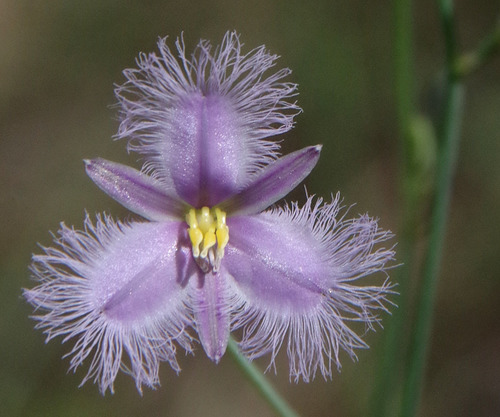
Chlorophytum comosum
(Thunb.) Jacques
Spider plant
iNaturalist· cc-by-nc
(c) truffletheguineapig, some rights reserved (CC BY-NC), uploaded by truffletheguineapig
iNaturalist· cc-by-nc
(c) maricel patino, some rights reserved (CC BY-NC)
Summary
Source: WikipediaChlorophytum comosum, usually called spider plant or common spider plant due to its spider-like look, also known as spider ivy, airplane plant, ribbon plant (a name it shares with Dracaena sanderiana), and hen and chickens, is a species of evergreen perennial flowering plant of the family Asparagaceae. It is native to tropical and Southern Africa but has become naturalized in other parts of the world, including Western Australia and Bangladesh. Chlorophytum comosum is easy to grow as a houseplant because of its resilience, but it can be sensitive to the fluoride in tap water, which commonly gives it "burnt tips". Variegated forms are the most popular.
Description
A herb that keeps growing from year to year. It grows 30 cm high and spreads 50 cm wide. The stems are erect and slender. They are wiry and arches over. The leaves are long and like straps. They are at the base of the plant. They have yellow and green stripes. The flowers are small and white.
Edible Uses
The fruit, tubers, and roots are edible.
Medicinal Uses
The plant (part not specified) is used for treating bronchitis, fractures and burns. A study isolated three new spirostanol pentaglycosides and four known saponins. The saponins were examined for inhibitory activity on tumor promoter-induced phospholipid metabolism of HeLa cells. The antiproliferative effects of a n-butanol extract from Chlorophytum comosum was tested in vitro against four human cell lines. Results showed the extract to have antiproliferative effects and apoptosis in human cell lines.
Known Hazards
Spider plants are non-toxic to humans and pets, and are considered edible.
Distribution
It is best in light to medium, well-drained, moist soil. It needs a protected shaded position.
Where It Grows
Africa, Asia, Australia, East Africa, Guam, Iran, Korea, Middle East, Pacific, Slovenia, Southern Africa, St Helena, Tuvalu, Uganda, Zimbabwe,
Cultivation
Plants can be grown from offsets.
Propagation
Seed - Division of rhizomes. Division of young plantlets that develop on the flowering stem
Other Uses
The plant can be grown as a ground cover. According to a NASA study, when grown as a pot plant this species can absorb 96% of the carbon monoxide in a controlled environment within a 24-hour period, making it one of the most effective air purifiers in its research.
Notes
Also put in the family Anthericaceae and Liliaceae.
Synonyms
Also Known As
čopasta zelenčica, Nalwebe
References (5)
- Aberoumand, A., 2008, Comparison of protein values from seven wild edible plants of Iran. African Journal of Food Science. Vol 2. pp 73-76
- Aberoumand, A. and Deokule, S. S., 2009, Determination of Elements Profile of Some Wild Edible Plants. Food Anal. Methods. 2:116-119
- Aberoumand, A., 2011, Major Antinutrients and Phytochemical Investigation Found in an Iranian Edible Plant Source. J. Nat. Prod. Plant resourc. 1(2):56-61
- Bodkin, F., 1991, Encyclopedia Botanica. Cornstalk publishing, p 253
- Thaman, R. R, 2016, The flora of Tuvalu. Atoll Research Bulletin No. 611. Smithsonian Institute p 48