Typhonodorum lindleyanum
Schott
Giant aroid
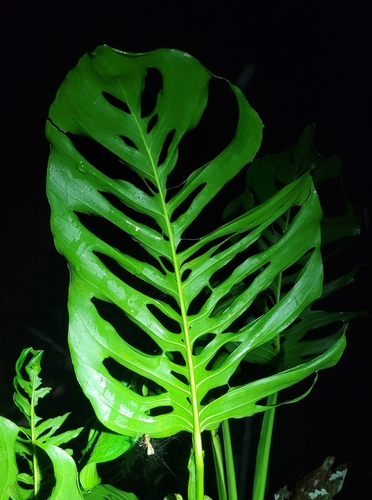
iNaturalist· cc-by-nc
(c) ccaneydunod, some rights reserved (CC BY-NC), uploaded by ccaneydunod
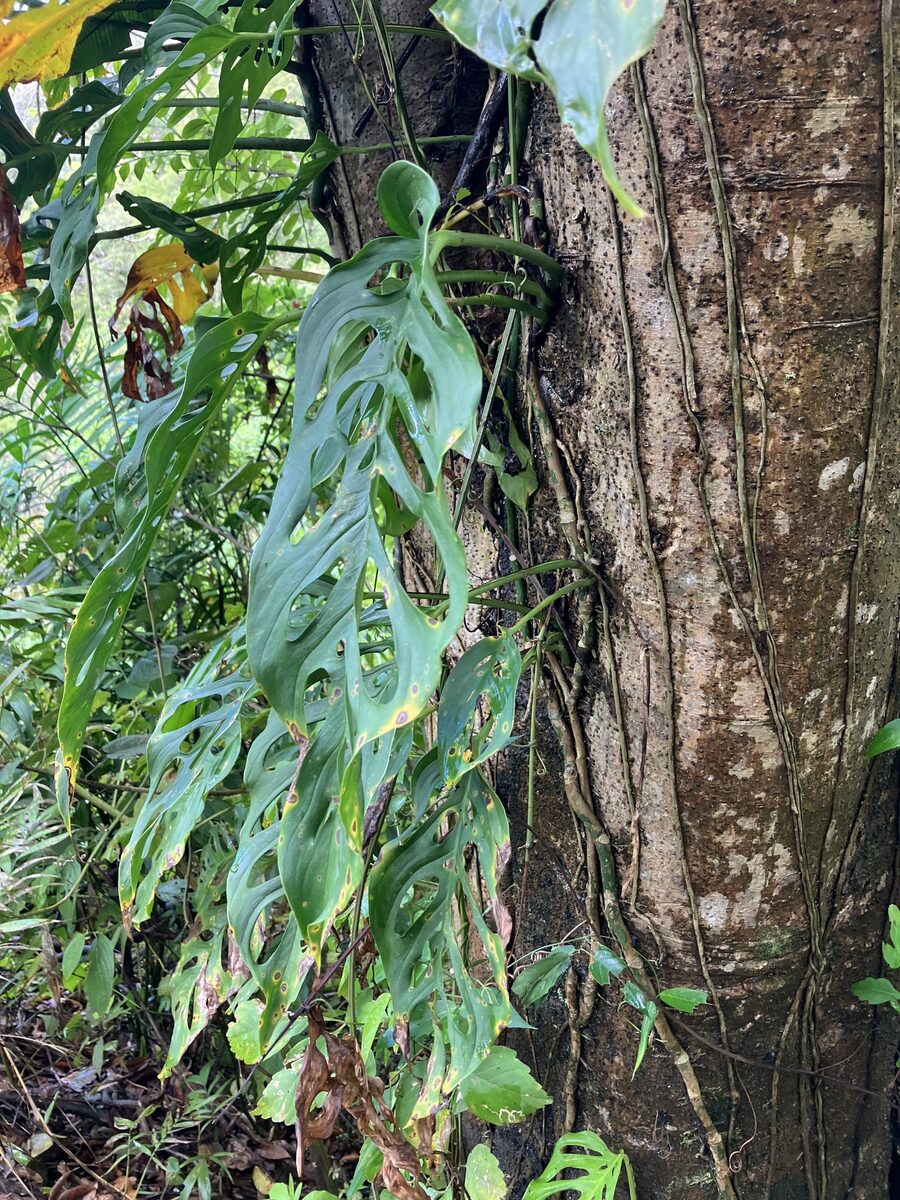
iNaturalist· cc-by-nc
(c) Ben Temaat, some rights reserved (CC BY-NC)
iNaturalist· cc-by-nc
(c) dscherberich, some rights reserved (CC BY-NC)
Description
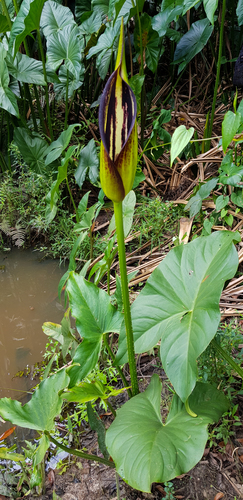
A taro family plant with a thick trunk and broad leaves. It is a large herb that keeps growing from year to year. It has a false stem like a banana. This can be 4 m tall and 30 cm across at the base. There is an underground rhizome. The leaf stalks and sheth are 3 m long. The leaf blade is 140 cm long and 85 cm wide. It is shaped like an arrow head. The flowers are a column shaped spadix 55 cm long. It is yellow to white and has a large leaf like spathe that is 80 cm long around it. The fruit are large and oval. They contain round berries 4 cm across. These are yellow when ripe. There are 1-2 flattened brown seeds inside.
Edible Uses
The large rhizome is roasted and eaten after being chopped and boiled, then washed several times to remove oxalates, or alternatively soaked in water for 2 days and sun-dried. The fleshy seeds are roasted and eaten.
Traditional Uses
The large rootstock or rhizome is processed, roasted and eaten. They are chopped and boiled and washed several times. to remove the oxalates. Alternatively they are chopped and soaked in water for 2 days then dried in the sun. The fleshy seeds are roasted and eaten. Caution: Plants in this family usually have oxalate crystals and need special processing.
Medicinal Uses
It is used as a famine food.
Known Hazards
Plants in the arum family contain oxalate crystals that require special processing to remove; oxalates can irritate the throat.
Distribution
A tropical plant. It grows in shallow water. It needs a temperature above 20°C. It is often in swamps near the sea. Mt Cootha Botanical Gardens.
Where It Grows
Africa, Australia, Comoros, East Africa, Madagascar, Tanzania,
Cultivation
Plants can be grown from fresh seed sown into mud. It can also be grown using suckers.
Propagation
Seed - Suckers.
Other Uses
A fibre is obtained from the leaf sheaths. It is used for making heavy fish lines. It is a very easy matter to gently draw out the threads after abruptly breaking the sheath, provided they are pulled out parallel to the axis. Thus obtained, the threads are at first a deep yellow, becoming much lighter with washing. A variety of the plant which has reddish and blackish sheaths gives better fibres than the variety which has white sheaths. The leaves are used for thatching. The leaves are used as a mulch.
Production
The rootstocks are harvested during the rainy season. Dried slices and flour can be stored for several months.
Other Information
It is a famine food. The oxalates can irritate the throat.
Notes
There is only one Typhonodorum species.
Also Known As
Mbie, Mgombakofi, Mtongonya, Via
References (14)
- Bot. Jahrb. 1:188. 1881 [As madagasariense]
- Brown, D., 2000, Aroids. Plants of the Arum family. Timber Press. (Second edition) p 272 (As Typhonodorum madagarascariense)
- Grubben, G. J. H. and Denton, O. A. (eds), 2004, Plant Resources of Tropical Africa 2. Vegetables. PROTA, Wageningen, Netherlands. p 565
- Herb., E. A., 1981,
- http://www.b-and-t-world-seeds.com/Aroideth.htm
Show all 14 references Hide references
- Jardin, C., 1970, List of Foods Used In Africa, FAO Nutrition Information Document Series No 2. p 20, 21, 49 (Also as Typhonodorum madagarascariense)
- Menninger, E.A., 1977, Edible Nuts of the World. Horticultural Books. Florida p 112
- Oesterr. Bot. Wochenbl. 7:70. 1857
- Peters, C. R., O'Brien, E. M., and Drummond, R.B., 1992, Edible Wild plants of Sub-saharan Africa. Kew. p 12
- Romanowski, N., 2007, Edible Water Gardens. Hyland House. p 116
- Ruffo, C. K., Birnie, A. & Tengnas, B., 2002, Edible Wild Plants of Tanzania. RELMA p 684
- Styger, E., et al, 1999, Indigenous fruit trees of Madagascar: potential components of agroforestry systems to improve human nutrition and restore biological diversity. Agroforestry Systems 46: 289-310
- Walsh, M., 2009, The Use of Wild and Cultivated Plants as famine Foods on Pemba Island, Zanzibar. Études océan Indien. 42-43
- World Checklist of Useful Plant Species 2020. Royal Botanic Gardens, Kew