Arisaema tortuosum
(Wall.) Schott.
Jack-in-the-pulpit, Whipcord cobra lily
iNaturalist· cc0
no rights reserved, uploaded by S.MORE
iNaturalist· cc0
no rights reserved, uploaded by S.MORE
iNaturalist· cc-by-nc
(c) Rajendra Koranga, some rights reserved (CC BY-NC), uploaded by Rajendra Koranga
Summary
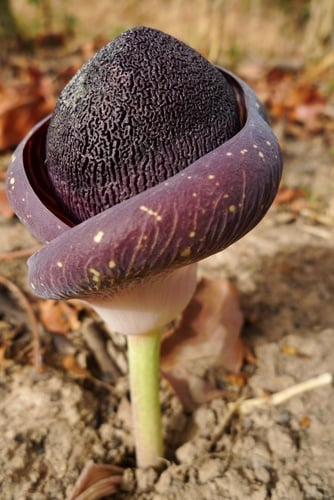
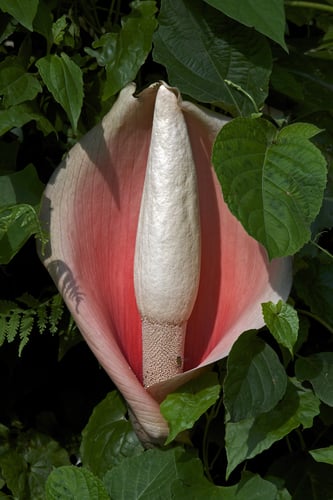
Source: WikipediaArisaema tortuosum, the whipcord cobra lily, is a plant species in the family Araceae. It has a distinctive purple or green whip-like spadix which arises from the mouth of its "jack-in the-pulpit" flower and may be up to 30 cm long. Flowers may be male or bisexual. The clustered fruits are green at first, ripening to red. The plant grows in large clumps and can be up to 2 metres in height. It occurs in rhododendron forest, scrub, and alpine meadows in the Himalayas, western China, southern India and Myanmar. The species is readily propagated from seed or offsets.
Description
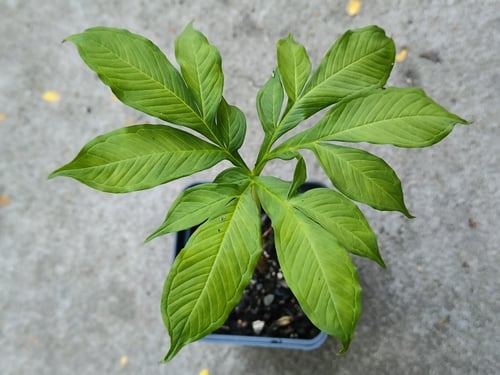
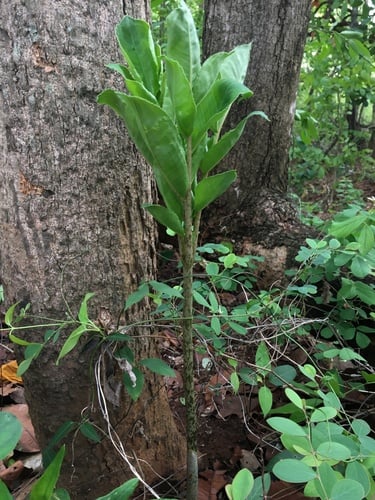
A herb which forms tubers. It grows 1.5 m high. The tubers are round and flattened and 2-6 cm across. The leaf stalk is mottled. There are one or two leaves and 11-13 leaflets. These are narrow or sword shaped. The flower spathe is green and the tube is long. The mouth is contracted and has a long pointed tip. The fruit is a berry. The seeds have 4 or 5 angles.
Edible Uses
Edible Parts: Root Edible Uses: Tuber - it must be thoroughly dried or cooked before being eaten. The tubers are boiled and eaten in Nepal, mixed with lime juice (Citrus aurantifolia) or another sour substance. The tubers are buried in masses in pits until acetous fermentation takes place, they are then dug up, washed and cooked, by which means their acrimonious principles are in part dispersed. However, violent illness has still been known to follow a hearty meal of the tubers. See also the notes above on toxicity.
Traditional Uses
The corms are cooked in water then mixed with salt and chilli. The young leaves are cooked and used as a vegetable. The fruit are roasted. The tuberous roots are buried and fermented. They are then dug up and washed and cooked. The young leaf stalk is soaked overnight in salt water and then pickled or cooked in sour yoghurt.
Medicinal Uses
Vermifuge The roots have been used as a vermifuge in cattle. The juice of the tubers is applied to the wounds of cattle in order to kill any parasites. The dried powdered tubers is applied to snake bites. The seeds have been mixed with salt and used to treat colic in sheep.
Distribution
It is a warm temperate plant. It grows in highland high rainfall areas. In China it grows in rocky slopes, path sides, stream sides, especially in disturbed areas between 1300-2900 m. In Nepal it grows at 1500-2200 m altitude. It suits hardiness zones 7-10. In Sichuan and Yunnan.
Where It Grows
Asia, Australia, Bhutan, China, Himalayas, India, Indochina, Myanmar, Nepal, Pakistan, SE Asia, Tibet,
Cultivation
It is grown from corms.
Propagation
Seed - best sown as soon as it is ripe in a shady position in a cold frame. Stored seed remains viable for at least a year and can be sown in spring in the greenhouse but it will probably require a period of cold stratification. Germination usually takes place in 1 - 6 months at 15°c. When large enough to handle, prick the seedlings out into individual pots and grow them on in light shade in the greenhouse for at least a coupe of years until the corms are more than 20mm in diameter. Plant out into their permanent positions whilst they are dormant. Division of tubers when the plant dies down in late summer.
Other Uses
Insecticide The tubers have insecicidal properties. Special Uses
Notes
There are about 150-170 Arisaema species.
Synonyms
Also Known As
Baanko, Baddha, Bako, Banko, Barkaunle, Buru hada, Chamua, Curved-hood cobra lily, Dhudhda, Diva, Galgal, Haavumari gida, Jangli suran, Jhag papri, Kushnopheni, Leetu, Sarpako makai, Shaungal, Vayu
References (31)
- Aryal, K. P., et al, 2018, Diversity and use of wild and non-cultivated edible plants in the Western Himalaya. Journal of Ethnobiology and Ethnomedicine (2018) 14:10
- Behera K. K., et al, 2008, Wild Edible Plants of Mayurbhanj District, Orissa, India. J. Econ. Taxon. Bot. Vol. 32 (Suppl.) pp 305-314
- Bircher, A. G. & Bircher, W. H., 2000, Encyclopedia of Fruit Trees and Edible Flowering Plants in Egypt and the Subtropics. AUC Press. p 41 (As Arisaema curvatum)
- Brown, D., 2000, Aroids. Plants of the Arum family. Timber Press. (Second edition) p 316
- Brickell, C. (Ed.), 1999, The Royal Horticultural Society A-Z Encyclopedia of Garden Plants. Convent Garden Books. p 137
Show all 31 references Hide references
- Chauhan, S. H., et al, 2018, Consumption patterns of wild edibles by the Vasavas: a case study from Gujarat, India. Journal of Ethnobiology and Ethnomedicine (2018) 14:57
- Cundall, P., (ed.), 2004, Gardening Australia: flora: the gardener's bible. ABC Books. p 185
- Flora of Pakistan.
- GAMMIE
- Gautam, R. S., et al, 2022, Ethnobotanical Review of Wild Edible Plants of Nepal. Journal of Natural History Museum Volume 32, 2021-22 p 104
- Hedrick, U.P., 1919, (Ed.), Sturtevant's edible plants of the world. p 72 (Also as Arisaema curvatum)
- Hibbert, M., 2002, The Aussie Plant Finder 2002, Florilegium. p 32
- Joshi, N., et al, 2007, Traditional neglected vegetables of Nepal: Their sustainable utilization for meeting human needs. Tropentag 2007. Conference on International Agricultural Research for Development.
- Joshi, N. & Siwakoti, M., 2012, Wild Vegetables Used by Local Community of Makawanpur District and Their Contribution to Food Security and Income Generation. Nepal Journal of Science and Technology Vol. 13, No. 1 (2012) 59-66
- Kar, A., & Borthakur, S. K., 2008, Wild vegetables of Karbi - Anglong district, Assam, Natural Product Radiance, Vol. 7(5), pp 448-460
- Kumar, G.M., & Shiddamallayya, N., 2014, Documentation of Wild Plant Tubers as Food Resources in Hassan District, Karnataka, International Journal of Applied Biology and Pharmaceutical Technology. 5(2) p 90
- Kumar, R., et al, 2013, Ethnoboptany of Tharus or Dudhwa National Park, India. Mintage journal of Pharmaceutical & Medical Science 6-11
- Lim, T. K., 2015, Edible Medicinal and Non Medicinal Plants. Volume 9, Modified Stems, Roots, Bulbs. Springer p 11
- Manandhar, N.P., 2002, Plants and People of Nepal. Timber Press. Portland, Oregon. p 96
- Masoodi, H. U. R. & Sundriyal, R. C., 2020, Richness of non-timber forest products in Himalayan communities—diversity, distribution, use pattern and conservation status. Journal of Ethnobiology and Ethnomedicine 16:56
- Meitei, L. R., et al, 2022, An ethnobotanical study on the wild edible plants used by forest dwellers in Yangoupokpi Lokchao Wildlife Sanctuary, Manipur, India. Ethnobotany Research and Application 23:15
- Mishra, M., 2013, Utilization of wild tuberous plants in extreme environmental condition: A Case of Baiga Tribe of Central India. The Journal of Ethnobiology and Traditional Medicine. Photon 118 (2013) 366-372
- Misra, R. C., et al, 2013, Genetic resources of wild tuberous food plants traditionally used in Similipal Biosphere Reserve, Odisha, India. Genetic Resources and Crop Evolution. Vol. 60 No. 2. Springer
- Pandy, R. K. & Saini, S. K., 2007, Edible plants of tropical forests among tribal communities of Madhya Pradesh. Indian Journal of Traditional Knowledge. 6(1), pp 185-190
- Plants for a Future database, The Field, Penpol, Lostwithiel, Cornwall, PL22 0NG, UK. http://www.scs.leeds.ac.uk/pfaf/
- Rana, D., et al, 2019, Ethnobotanical knowledge among the semi-pastoral Gujjar tribe in the high altitude (Adhwari’s) of Churah subdivision, district Chamba, Western Himalaya. Journal of Ethnobiology and Ethnomedicine (2019) 15:10
- Ryan, S., 2008, Dicksonia. Rare Plants Manual. Hyland House. p 121
- H. Schott & S. L. Endlicher, Melet. bot. 17. 1832
- Shrestha, S., 2021, Wild Edible Plants of Dhankuta, Eastern Nepal. Rupantaran : A Multidisciplinary Journal Vol. V : pp 100-109, September, 2021 p 102
- Uprety, Y., et al, 2012, Diversity of use and local knowledge of wild edible plant resources in Nepal. Journal of Ethnobotany and Ethnomedicine 8:16
- WATT (As Arisaema curvatum)