Arisaema speciosum
(Wall.) Mart.
Cobra lily
iNaturalist· cc-by
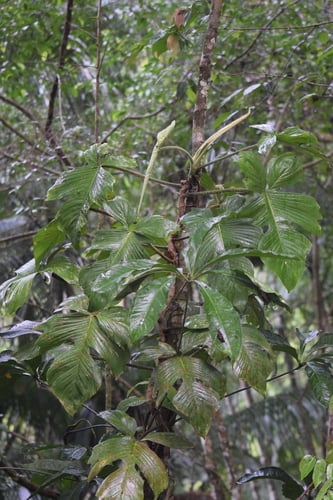
(c) Sagnik Dutta Roy, some rights reserved (CC BY), uploaded by Sagnik Dutta Roy
iNaturalist· cc-by
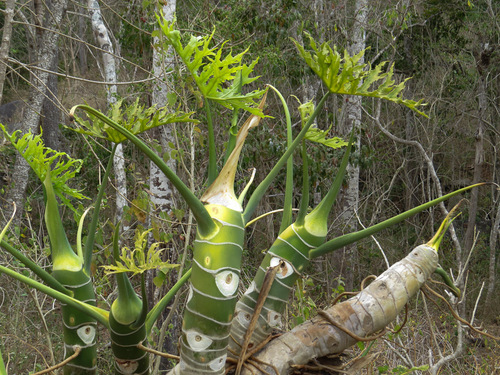
(c) Paulmathi Vinod, some rights reserved (CC BY), uploaded by Paulmathi Vinod
iNaturalist· cc-by-nc
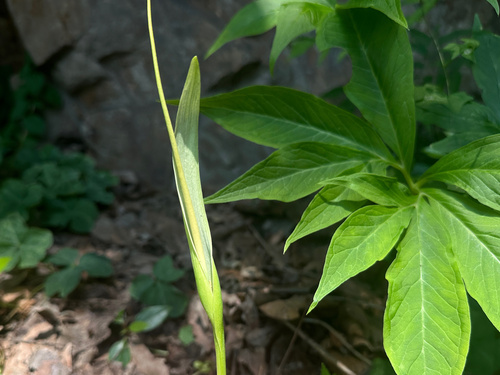
(c) hyeonsoo_kim, some rights reserved (CC BY-NC)
Summary
Source: WikipediaArisaema speciosum is a species of flowering plant in the family Araceae, native to Nepal, East Himalaya, Assam, Tibet and south-central China.
Description
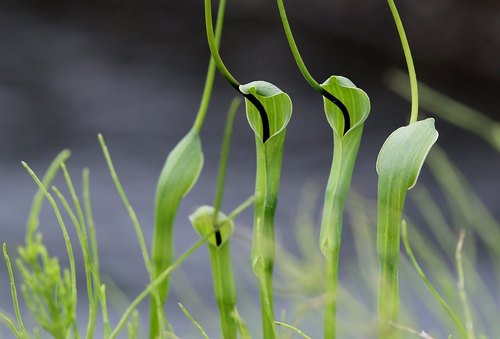
A tuber plant. It is 60 cm long. The rhizome is 7-9 cm long by 2.5-6 cm wide. The leaf stalk is stout and mottled red-brown. There is one leaf which is divided into 3 leaflets. These are triangular or oval shaped. They have red edges. They are 20 cm long by 13 cm wide. The flower appears below the leaves. The bract around the flower is hooded and dark red. It has white stripes. It is 20 cm long. It is curved inwards and has a thread like tip. The fleshy flower stalk is yellowish-pink. It is 50 cm long.
Edible Uses
The corm (rhizome) is edible but must be eaten only after repeated boiling to remove oxalates.
Traditional Uses
The corm (rhizome) is eaten but only after repeated boiling. This is to remove oxalates.
This uses section is brief — help expand it
Known Hazards
The raw corm contains oxalates and is toxic if not properly prepared by repeated boiling.
Distribution
It is a warm temperate to subtropical plant. It grows in broadleaf forests between 2400-2800 m altitude in southern China. It suits hardiness zones 8-10.
Where It Grows
Asia, Australia, Bhutan, China, Himalayas, Indochina, Malaysia, Nepal, Northeastern India, SE Asia, Sikkim, Vietnam,
Cultivation
It can be grown from the corm or pieces of the rhizome.
Notes
There are about 150-170 Arisaema species.
Synonyms
Also Known As
Bankh, Gurbo, Kiralu, Kiri-ki-kuri, Samo-ki-khumb, Sapko makai, Sarpa ko makai, Tel-hawng, Thin nam tinh
References (15)
- Ambasta S.P. (Ed.), 2000, The Useful Plants of India. CSIR India. p 52
- Bircher, A. G. & Bircher, W. H., 2000, Encyclopedia of Fruit Trees and Edible Flowering Plants in Egypt and the Subtropics. AUC Press. p 41
- Bodkin, F., 1991, Encyclopedia Botanica. Cornstalk publishing, p 101
- Burkill, I.H., 1966, A Dictionary of the Economic Products of the Malay Peninsula. Ministry of Agriculture and Cooperatives, Kuala Lumpur, Malaysia. Vol 1 (A-H) p 240
- Cundall, P., (ed.), 2004, Gardening Australia: flora: the gardener's bible. ABC Books. p 185
Show all 15 references Hide references
- Flora 14:458. 1831 (ex Schott in H. Schott & S. L. Endlicher, Melet. bot. 17. 1832)
- Kar, A., et al, 2013, Wild Edible Plant Resources used by the Mizos of Mizoram, India. Kathmandu University Journal of Science, Engineering and Technology. Vol. 9, No. 1, July, 2013, 106-126
- Li Heng, Araceae, Flora of China.
- Lim, T. K., 2015, Edible Medicinal and Non Medicinal Plants. Volume 9, Modified Stems, Roots, Bulbs. Springer p 11
- Manju, S., and Sundriyal, R. C., 2001, Wild Edible Plants of the Sikkim Himalaya: Nutritive Values of Selected Species. Economic Botany 55(3): 377-390
- Mehta, P. S. et al, 2010, Native plant genetic resources and traditional foods of Uttarakhand Himalaya for sustainable food security and livelihood. Indian Journal or Natural products and Resources. Vol 1(1), March 2010 pp 89-96
- Mukhia, P.K., et al, 2013, Wild plants as Non Wood Forest Products used by the rural community of Dagana, a southern foothill district of Bhutan, SAARC Journal, 27 pages
- PROSEA handbook Volume 9 Plants yielding non-seed carbohydrates. p166
- Singh, H.B., Arora R.K.,1978, Wild edible Plants of India. Indian Council of Agricultural Research, New Delhi. p11
- World Checklist of Useful Plant Species 2020. Royal Botanic Gardens, Kew