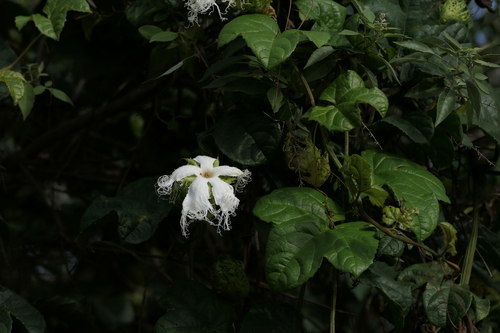
Trochomeria macrocarpa
(Sonder) Hook.f.
Baboon cucumber
iNaturalist· cc-by-nc
(c) Rouxne Botha, some rights reserved (CC BY-NC), uploaded by Rouxne Botha
iNaturalist· cc-by-nc
(c) Richard Gill, some rights reserved (CC BY-NC)
iNaturalist· cc-by-nc
(c) Richard Gill, some rights reserved (CC BY-NC)
Description
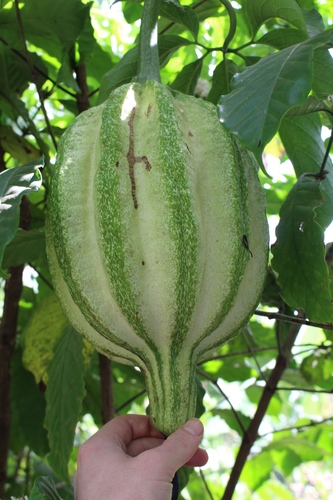
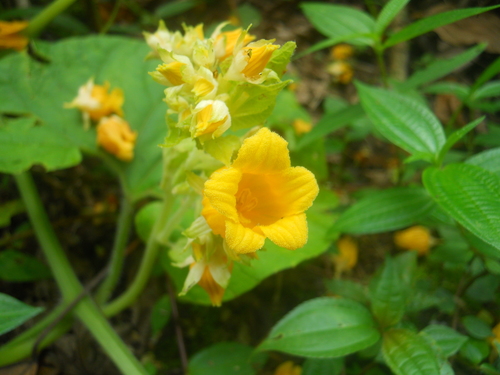
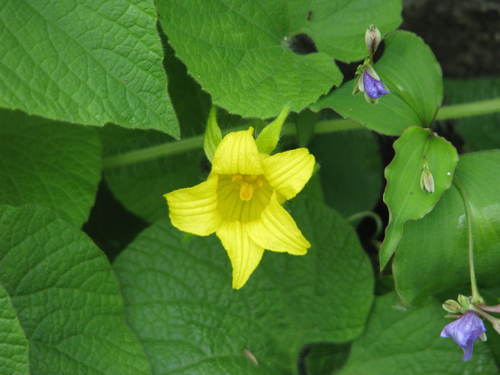
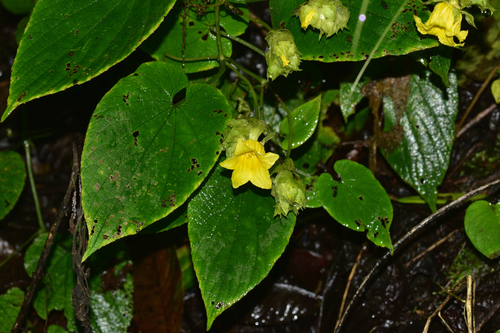
A herb. It is a pumpkin family plant. It is a climber. It grows new stems each year. The stems can be 2-6 m long. It has a woody rootstock that is fleshy and tuberous. This is large and like a yam and is deep in the ground. The leaves are 2-7 cm long by 2-8 cm wide. They are broadly oval. They are heart shaped. The have 5 lobes like fingers on a hand. It has simple tendrils. The fruit are 4-7 cm long by 2-3 cm wide. They are orange or red. The seeds are 9-10 mm long by 5-7 mm wide. They are white.
Edible Uses
Root - cooked. The large yam-like root, often deep in the ground, is dug up when mature after the rains; it is boiled or roasted and eaten. Not all the tuber is eaten - the core, for example, is often discarded as being too bitter. The ellipsoid-ovoid tuber can be up to 60cm in diameter and can be buried up to 60cm below ground level. There is a report that the fruit is eaten, and can keep a person going for the whole day without the need for other food. However, there are also reports that the fruit is not eaten. The fruit can easily be confused with the highly toxic fruit of Adenia digitata. The bright orange-red oval, fleshy fruit are around 20mm long.
Medicinal Uses
The root is sometimes used medicinally. No more information given.
Known Hazards
The fruit is non-toxic, but in The Gambia an unstated part of the plant is recognized as poisonous.
Distribution
It is a tropical plant. It grows in deciduous woodland and savannah. It grows amongst rocks and in sand. It grows between 610-1525 m above sea level. It can grow in arid places.
Where It Grows
Africa, Angola, Botswana, Burkina Faso, Central Africa, East Africa, Eswatini, Ethiopia, Gambia, Guinea, Guinée, Guinea-Bissau, Kenya, Malawi, Mali, Mozambique, Namibia, Nigeria, Senegal, South Africa, Southern Africa, Sudan, Swaziland, Tanzania, Togo, Uganda, West Africa, Zambia, Zimbabwe,
Cultivation
A plant of the tropics and subtropics, where it can be found at elevations from 600 - 2,500 metres. In S. Africa the plant is found in summer-rainfall areas where the mean annual rainfall can range from 600 - 1,000mm. Found wild in very sunny to very shady areas. Prefers well-drained or moist, sandy, loamy and/or rocky soils. A dioecious species, both male and female forms need to be grown if fruit and seed are required.
Synonyms
Also Known As
Akwalu, Alalata, Basgo, Cifufu, Ohana
References (18)
- Burkill, H. M., 1985, The useful plants of west tropical Africa, Vol. 1. Kew.
- Dalziel, J. M., 1937, The Useful plants of west tropical Africa. Crown Agents for the Colonies London.
- Flora of West Tropical Africa. 1:177, 1927 (As Trochomeria dalzielii)
- Flora Zambesiaca. http://apps.kew.org/efloras
- Fowler, D. G., 2007, Zambian Plants: Their Vernacular Names and Uses. Kew. p 23
Show all 18 references Hide references
- Fox, F. W. & Young, M. E. N., 1982, Food from the Veld. Delta Books. p 178
- Grivetti, L. E., 1980, Agricultural development: present and potential role of edible wild plants. Part 2: Sub-Saharan Africa, Report to the Department of State Agency for International Development. p 24 (As Trochomeria dalzielii)
- Jardin, C., 1970, List of Foods Used In Africa, FAO Nutrition Information Document Series No 2.p 108
- Lee, 1979,
- Long, C., 2005, Swaziland's Flora - siSwati names and Uses http://www.sntc.org.sz/flora/
- Maguire, 1978,
- Malan & Owen-Smith, 1974,
- Peters, C. R., O'Brien, E. M., and Drummond, R.B., 1992, Edible Wild plants of Sub-saharan Africa. Kew. p 103
- Royal Botanic Gardens, Kew (1999). Survey of Economic Plants for Arid and Semi-Arid Lands (SEPASAL) database. Published on the Internet; http://www.rbgkew.org.uk/ceb/sepasal/internet [Accessed 16th April 2011]
- Ruiters-Welcome, A. K., 2019, Food plants of southern Africa. Ph.D. thesis. Univ. of Johannesburg p 50
- Silberbauer, 1972, 1981,
- Swaziland's Flora Database http://www.sntc.org.sz/flora
- Welcome, A. K. & Van Wyk, B.-E., 2019, An inventory and analysis of the food plants of southern Africa. South African Journal of Botany 122 (2019) 136–179