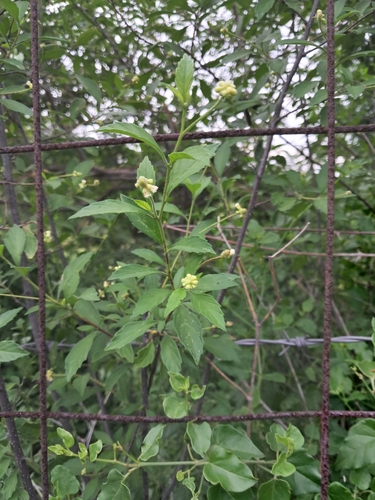
Trigonotis radicans
(Turcz.) Steven
iNaturalist· cc-by-nc
(c) jianglei, some rights reserved (CC BY-NC)
iNaturalist· cc-by-nc
(c) jianglei, some rights reserved (CC BY-NC)
iNaturalist· cc-by-nc
(c) jianglei, some rights reserved (CC BY-NC)
Summary
A low-growing perennial reaching 20cm tall with a spreading habit. Flowers bloom June to August, with seeds ripening July to September. Hermaphroditic flowers attract various pollinators. Thrives in light sandy, loamy, or heavy clay soils across a wide pH range from mildly acidic to mildly alkaline. Tolerates semi-shade or full sun and prefers consistently moist soil conditions.
Description
A herb. It keeps growing from year to year. There are several stems. They are 50 cm tall. Rooting branches develop from the upper sections. The leaves at the base have leaf stalks 18 cm long. The leaves are oval and 1-4 cm long. The flowers occur singly above the axils of the leaves on the stem. They are light blue of white.
Edible Uses
Young leaves are harvested and cooked.
Medicinal Uses
None known.
Distribution
It is a temperate plant. It grows on the edges of forests and in meadows.
Where It Grows
Asia, China, Japan, Korea, Russia, Siberia,
Propagation
No specific information is available for this species. It is suggested to sow seed in a cold frame in spring, prick out seedlings into individual pots as soon as they are large enough to handle, and plant out during summer if sufficiently developed. If not, grow on in the greenhouse through the first winter and plant out in early summer the following year.
Other Uses
None known.
References (1)
- Plants for a Future database, The Field, Penpol, Lostwithiel, Cornwall, PL22 0NG, UK. http://www.scs.leeds.ac.uk/pfaf/