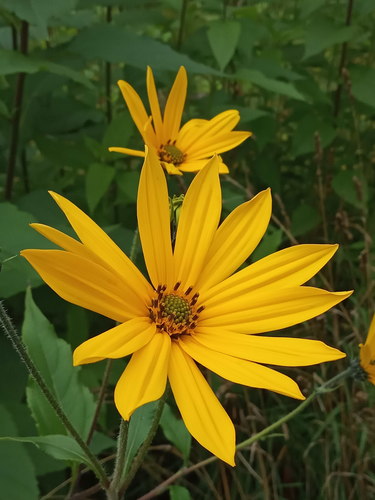
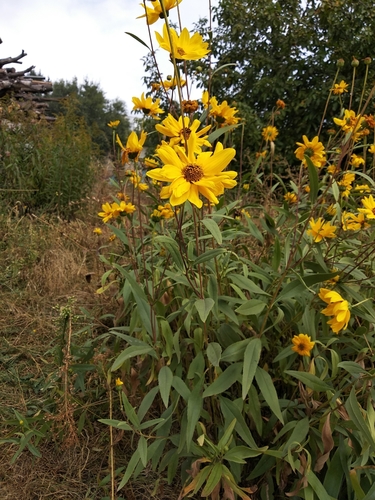
Artemisia princeps
Pampan.
Mugwort, Japanese mugwort
iNaturalist· cc-by
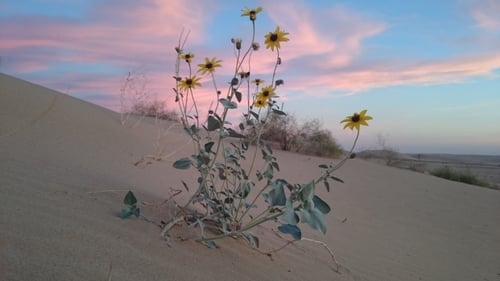
(c) WATANABE Hitoshi 渡辺仁, some rights reserved (CC BY), uploaded by WATANABE Hitoshi 渡辺仁
iNaturalist· cc-by-nc
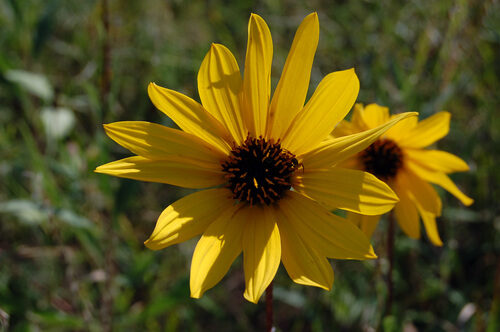
(c) Andy Goerdel - Texas Master Naturalist, Good Water Chapter, some rights reserved (CC BY-NC), uploaded by Andy Goerdel - Texas Master Naturalist, Good Water Chapter
iNaturalist· cc-by-sa
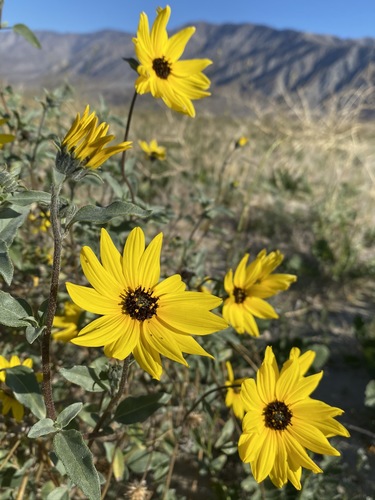
(c) Kenpei, some rights reserved (CC BY-SA)
Summary
Source: WikipediaArtemisia princeps, also commonly called yomogi, Japanese mugwort, Korean wormwood, Korean mugwort or wormwood in English, is an Asian plant species in the sunflower family, native to China, Japan and Korea. It is a perennial, very vigorous plant that grows to 1.2 meters (3 ft 11 in). This species spreads rapidly by means of underground stolons and can become invasive. It bears small, buff-colored flowers from July to November which are hermaphroditic, and pollinated by wind. The leaves are feather shaped, scalloped and light green, with white dense fuzz on the underside.
Description
A herb or small shrub. It grows 80-150 cm tall. The leaves have short leaf stalks. The leaves have a covering underneath. The leaves in the middle of the stem are oval and 6-12 cm long by 4-8 cm wide and are divided into 2 pairs of segments alogn the stalk.
Edible Uses
Edible Parts: Leaves Edible Uses: Colouring Condiment Leaves and young seedlings - raw or cooked. Used in salads and soups after the bitterness has been removed. After being lightly boiled the young leaves are pounded into glutinous-rice dumplings (known as 'mochi'). They impart a delightful aroma, flavour and colour. Mugwort mochi is often sold in N. American health food stores.
Traditional Uses
The leaves and young seedlings are eaten in salads and soups. The bitterness is first removed. They slightly boiled leaves are pounded and add flavour, colour and aroma to rice. They are used for tea and for fermentation.
Medicinal Uses
Bitter Bitter.
Known Hazards
Although no reports of toxicity have been seen for this species, skin contact with some members of this genus can cause dermatitis or other allergic reactions in some people.
Distribution
It is a temperate plant. It grows on slopes and the edges of forests between 100-1,400 m above sea level. In Sichuan and Yunnan.
Where It Grows
Asia, China, Japan, Korea, Taiwan,
Cultivation
We have very little information on this species and do not know if it will be hardy in Britain, though judging by its native range it should succeed outdoors in many parts of this country. This species spreads rapidly by means of underground stolons and can become invasive. The following notes are based on the general needs of the genus. Easily grown in a well-drained circumneutral or slightly alkaline loamy soil, preferring a warm sunny dry position. Established plants are drought tolerant. Plants are longer lived, more hardy and more aromatic when they are grown in a poor dry soil. Members of this genus are rarely if ever troubled by browsing deer.
Propagation
Seed - surface sow from late winter to early summer in a greenhouse, making sure that the compost does not dry out. When large enough to handle, prick the seedlings out into individual pots and grow them on in the greenhouse for their first winter. Plant out in late spring or early summer. Division in spring or autumn. Basal cuttings in late spring. Harvest the young shoots when about10 - 15cm long, pot up in a lightly shaded position in a greenhouse or cold frame and plant them out when well rooted. Very easy.
Other Uses
None known Special Uses
Other Information
It is an important flavouring herb in Japanese and Korean cooking.
Notes
There are about 300 Artemisia species.
Nutrition
| Part | Moisture | kJ | kcal | Protein | Vit A | Vit C | Iron | Zinc |
|---|---|---|---|---|---|---|---|---|
| Leaves - flavour | 85.9 | 176 | 42 | 4.8 | — | 35 | 4.3 | 0.6 |
Synonyms
Also Known As
Ssuk, Yomogi
References (14)
- Brown, D., 2002, The Royal Horticultural Society encyclopedia of Herbs and their uses. DK Books. p 131
- Chen, B. & Qiu, Z., Consumer's Attitudes towards Edible Wild Plants, Ishikawa Prefecture, Japan. p 22 www.hindawi.com/journals/ijfr/aip/872413.pdf
- Facciola, S., 1998, Cornucopia 2: a Source Book of Edible Plants. Kampong Publications, p 34
- Kim, H. & Song, M., 2013, Ethnobotanical analysis for traditional knowledge of wild edible plants in North Jeolla Province (Korea). Genetic. Resour. Crop Evol. (2013) 60:1571-1585
- Kuo, W. H. J., (Ed.) Taiwan's Ethnobotanical Database (1900-2000), http://tk.agron.ntu.edu.tw/ethnobot/DB1.htm (As var orientalis)
Show all 14 references Hide references
- Larkcom, J., 1991, Oriental Vegetables, John Murray, London, p 129
- Nouvo Giorn. Bot. Ital. ser. 2, 36:444. 1930
- Ong, H. G., et al, 2015, Ethnobotany of the wild edible plants gathered in Ulleung Island, South Korea. Genet Resourc Crop Evol. Springer
- Plants for a Future database, The Field, Penpol, Lostwithiel, Cornwall, PL22 0NG, UK. http://www.scs.leeds.ac.uk/pfaf/
- Seidemann J., 2005, World Spice Plants. Economic Usage, Botany, Taxonomy. Springer. p 56
- Song, M., et al, 2013, Traditional knowledge of wild edible plants in Jeju Island, Korea. Indian Journal of Traditional Knowledge. 12(2) pp 177-194
- Trendafilova, A., et al, 2020, Research Advances on Health Effects of Edible Artemisia Species and Some Sesquiterpene Lactones Constituents. Foods 2021, 10, 65. p 5
- Wiersema, J. H. & Leon, B., 2013, World Economic Plants. A Standard Reference CRC Press. 2nd Ed. p 73
- World Checklist of Useful Plant Species 2020. Royal Botanic Gardens, Kew